2025 W-2 Forms are now available in your GMS Connect employee portal here.

  • It’s already difficult to manage payroll for a small business, but it can get even trickier if you have employees who work out of state. Whether you have remote employees, live near a border, or have any other reason for an employee to complete their work in a different state, there are certain rules set by the Department of Labor (DOL) and other federal and state agencies that you need to follow when handling payroll for those workers.

    A map of the U.S. for out-of-state employees with certain payroll requirements.

    Who is Considered an Out-of-State Employee?

    Identifying an out-of-state employee is pretty simple – it’s an individual whose primary work is completed outside of the state where your business is registered. However, the tax implications of out-of-state employees aren’t quite so simple.

    An employee’s resident state is where that person makes their permanent home. On the flip side, a nonresident state is any state where that employee commutes to or spends some time in for work. While it may be easy to assume that out-of-state employees live and work remotely in their resident state, that’s not necessarily the case. Any of the following workers count as an out-of-state employee.

    • Someone who lives and works in a state outside of your business’ registered state
    • Someone who lives in the same state as your business, but travels to and works in another
    • Someone who lives outside of your business’ state, but travels to a separate state and works there

    For example, let’s say your business is registered in Ohio and you have an employee who lives and works remotely in Florida. That individual is an out-of-state employee. However, let’s pretend that the employee lives right by the Ohio border and rents office space in the Buckeye state. In this case, the employee would technically be an in-state employee since he or she completes his or her primary work in Ohio, despite it not being the resident state. There’s also the case that if your employee lives in Ohio, but travels to and works in Michigan, that person is an out-of-state employee. 

    In general, an employee whose primary work is not in your business’ state is essentially an out-of-state worker. This makes it important to ask your employer where they perform the majority of their work – the answer will play a big role come tax time.

    Key Differences When Handling Payroll for Out-of-State Employees

    Once you’ve identified which of your employees qualify as out-of-state workers, it’s time to handle your payroll. When it comes to out-of-state employees, there are three big steps you need to take.

    Register with any necessary state tax agencies

    While your business is already registered in your home state, that’s not enough for employees in other states. You’ll need to register your business with the tax agency of every state where any official employees complete their primary work, whether that’s one additional state or several. 

    You’ll also need to check with that tax agency to see if you’ll also need to register with that state’s labor and unemployment agency. If not, that state government may come calling at some point, and they won’t be pleased.

    Follow the local laws of applicable states

    While you may understand all of your state’s laws regarding payroll policies, outside regulations can create a whole new challenge. There are several different pay and labor laws that can impact your out-of-state employees’ paychecks. As such, it’s important to make sure you look into several different areas to see if you need to modify your payroll.

    Minimum wage

    If you have out-of-state employees who make minimum wage, you’ll need to make sure that you don’t just follow your own state’s rate. For example, an out-of-state employee who works in Michigan is entitled to $9.65 an hour, so that person won’t be pleased if you pay them at Ohio’s $8.70 rate.

    Certain states also have special rules aside from flat rates or have plans to escalate rates over time. South Carolina has no state minimum wage law, but employers that fall under the Fair Labor Standards Act are required to use the federal rate of $7.25. New Jersey plans to increase its rate each year until it hits $15 per hour in 2026. If you have an employee in another state, you’ll need to pay close attention to the DOL’s updated list of minimum wage laws to make sure you don’t miss a special rule or accidentally get caught paying an old rate.

    Pay frequency

    Depending on where your employee works, he or she may have a different payday than the workers in your state. Certain states have set requirements on how often you should pay employees, while others give owners leeway into setting paydays, whether it’s weekly, monthly, or some other option. The DOL tracks each state’s payday requirements, including if employers need to provide written notice or seek permission for certain pay periods.

    Overtime

    There are states that simply observe the federal overtime rules, but others apply their own laws that can add an extra wrinkle to your payroll. Some states like California have daily overtime laws that kick in when employees work more than 12 hours in a day. Others may set different weekly hour requirements. In general, the DOL notes that if state and federal rules conflict with each other “the employee is entitled to overtime according to the higher standard.” Regardless, you’ll want to check with any applicable state labor office to get a definitive answer on your obligations.

    Workers’ compensation and disability insurance

    Like the other considerations, you’ll need to check with your employee’s state to see if it has any notable differences in purchasing workers’ compensation. Texas is the only state where workers’ compensation is optional, but other states can have some disparities from your local requirements. Some states, such as Ohio, require you to purchase insurance from a monopolistic state fund. Other states ramp up the penalties for not carrying workers’ compensation. Either way, check in with the official state organization to make sure your out-of-state employees are covered.

    There are also some locations that add some payroll requirements for disability insurance. Five total states require you to withhold state disability insurance from paychecks, which means you need to factor that into your calculations if you have an employee who works in the following places.

    • California
    • Hawaii
    • New Jersey
    • New York
    • Hawaii

    Paycheck delivery

    While the Fair Labor Standards Act (FLSA) requires that employers keep accurate records of every employee’s hours and wages, it does not require you to provide those employees with pay stubs. However, certain states have different standards for how employers need to deliver pay information. Depending on location, states may:

    • Have no requirements about providing pay information statements to employees.
    • Require employers to provide or furnish a statement of pay information that each employee can at least access electronically. The majority of states fall under this group.
    • Require employers to provide written or printed pay statements and give employees the ability to print electronic statements.
    • Give employees a chance to opt out of a paperless pay program and receive paper pay stubs.
    • Allow employees to opt-in to a paperless pay system if an employer wishes to offer one.

    In addition to paystubs, states can have differing rules on when you need to provide an employee’s final paycheck when he or she leaves or is terminated. As such, you’ll want to look up those terms if an out-of-state employee is no longer with your company.

    Withhold taxes based on your employee’s work location

    In addition to workers’ compensation, overtime, and other key considerations, withholding taxes plays a major part in managing payroll. Depending on where employees work, you may need to withhold state and local income taxes from their paychecks if it’s required in your employee’s city or county. 

    As you’d expect, your withholding responsibilities depend on where your employee works. Seven states don’t have income taxes or only have them on dividend and interest income. As such, you wouldn’t need to withhold income taxes for an out-of-state employee who works in Florida or any of the other six states. As a bonus, you also won’t need to register with the tax agencies for states where you don’t withhold income tax.

    There are also 16 states that require employers to withhold local taxes in addition to income taxes. As such, you’ll need to research and withhold both taxes from paycheck based on that state’s rates.

    Reciprocal states

    If that doesn’t sound tricky enough, some states have tax reciprocity. Essentially, reciprocal states have agreements in place with other specific states that allow employers to withhold taxes based on the state of residence instead of where an employee works. As such, an employee can give you a reciprocal withholding certificate if they wish to request you withhold taxes for their home state instead of the work state if both locations have an agreement in place.

    Here’s a breakdown of existing reciprocal tax agreements, listed by an employee’s home state in bold. (Note: People who work in the District of Columbia can live in any state

    • Illinois – Iowa, Kentucky, Michigan, Wisconsin
    • Indiana – Kentucky, Michigan, Ohio, Pennsylvania
    • Iowa – Illinois
    • Kentucky – Illinois, Indiana, Michigan, Ohio, Wisconsin, West Virginia
    • Maryland – District of Columbia, Kentucky, Maryland, Pennsylvania, West Virginia
    • Michigan – Illinois, Indiana, Kentucky, Minnesota, Ohio, Wisconsin
    • Minnesota – Michigan, North Dakota
    • Montana – North Dakota
    • New Jersey – Pennsylvania
    • North Dakota – Minnesota, Montana
    • Pennsylvania – Indiana, Maryland, New Jersey, Ohio, Virginia, West Virginia
    • Ohio – Indiana, Kentucky, Michigan, Pennsylvania, West Virginia
    • Virginia – District of Columbia, Kentucky, Maryland, Pennsylvania, West Virginia
    • Wisconsin – Illinois, Indiana, Kentucky, Michigan
    • West Virginia – Kentucky, Maryland, Ohio, Pennsylvania 

    Feeling Overwhelmed? Simplify Your Payroll with GMS

    Whether you need to plan for out-of-state employees or simply need to manage payroll for your in-state office, the process is a lot of hard work. There’s also the issue that even after investing a lot of time in payroll, a simple mistake or two can lead to upset employees and non-compliance issues with various federal and state agencies.

    If you’re fed up with the time and stress involved with managing payroll, GMS can help. As a PEO, our experts can manage your company’s payroll, decreasing your workload and liabilities so you can focus on growing your business instead of calculating paycheck deductions.

    Ready to free up your calendar while streamlining critical HR functions? Contact us today to talk to one of our experts about your company’s HR needs.

  • Hiring the right person isn’t an easy task. It’s even harder to do so in a timely fashion. When your business is ready to hire, it benefits you to do so quickly. Not only do long hiring processes cost you time and money, they also delay you from filling a needed role on your team (and that’s not including your onboarding process).

    Every hour spent during the hiring process is an hour taken away from other essential business tasks. However, it’s also vital to recognize that rushing a hire can lead to other costly issues. Settling for a bad fit – or worse, dealing with negligent hiring – will only set your business back even further. Hiring means you need to perform an important balancing act – speed up the hiring process while finding the right candidate.

    While tricky, it’s not impossible to speed up the hiring process without rushing. Here are ways you can streamline your hiring process to get the candidates you need quicker than before.

    A job candidate interview by a company that wants to quickly hire employees. 

    Templatize Your Job Descriptions

    Every job description you write from scratch is extra time and effort you can avoid. Using a consistent format for new postings will not only help you draft descriptions quicker than before, but it can also make them easier to scan for potential applicants. 

    In terms of what format you should use, it can depend on exactly what type of position you need for your business. If you had a past job description that worked out well, you can use that as a base and modify it as necessary. If not, the following format is a good start:

    • Job summary (what it is and why it’s appealing)
    • Qualifications for the ideal candidate (both mandatory and ones that would be beneficial)
    • Company benefits
    • Clear call to action for how to apply and next steps

    From there, you can add in different sections based on what’s important to you and your business. Is company culture a huge part of your hiring process? Include a section about it in the format. You can also fill in specific parts of each description ahead of time, such as specific benefits that would apply to every potential employee. Adding these details to a base template now will only save you time on every description in the future.

    Write Clear Job Descriptions

    While a template will help, it’s important to make sure that your descriptions are specific enough to weed out certain applicants. One way to sidetrack your hiring process is to accidentally attract the wrong types of candidates. It’s important to be very clear about exactly what you want in a potential new employee to clear up any confusion from people who either aren’t right for the job or simply don’t have the qualifications. That means thinking very carefully about the following factors:

    • Which objectives the position should achieve
    • The core skills required to meet these objectives
    • Description of a typical day in the position, including regular duties, occasional tasks, etc.

    By spending a little extra time going into detail about necessary skills and objectives, you can signal to unqualified applicants that the job isn’t right for them. This in turn will save you from going through these applications (and potentially interviewing extra unqualified candidates).

    Be More Selective About the Candidates You Bring in for an Interview

    While a good description can cut out some less satisfactory applicants, you’ll still likely receive some resumes that don’t quite meet your standards. However, some people are tempted to still interview some of these applicants to try and reach a nice, round number of candidates. 

    The problem with this approach is that it’s more important to interview the right candidates instead of trying to hit a quota. If you’re only impressed by two or three candidates, focus on just them instead of hoping that a fringe applicant might exceed expectations. This also applies to people during the first-round interviews as well. If someone isn’t impressive, it’s best not to give them more of your time just because you had hoped for a certain number of finalists. In the end, being discerning will save you hours of wasted time, especially if you have a more rigorous hiring process.

    Cut Out Unnecessary Steps

    Speaking of a rigorous hiring process, try and see if you truly need every step to find the right candidate. The hiring process is different for every company, so you may be able to eliminate some measures that aren’t as important for you.

    A good example of this is the traditional request for references. If you don’t find that much value in talking to a candidate’s references, don’t include it in your process. You could also wait to ask for references for a few key candidates after you’ve interviewed them. This will cut down on the amount of calls you need to make or having to wait for these contacts to respond to your message – and that’s if you decide you need to talk to them at all. Try and identify which steps are really important for your search. If you find some are just there for show, get rid of them and use that time for something else.

    Have a Prepared List of Interview Questions

    Like your job description, it’s good to have a base list of interview questions made ahead of time. This list will make sure you’re asking the right questions every time to quickly see if a candidate is right for your position. It can also help you from going into an interview and asking all your questions off the cuff – nobody wants to accidentally bring up a taboo interview topic that can lead to problems.

    In terms of which questions to include, you’ll want to focus on inquiries that will identify certain skills and behaviors. Monster.com suggests breaking questions down into a few different groups:

    • Icebreakers to build rapport and help candidates relax
    • Traditional questions to gather general information about a candidate’s skills and experience
    • Situational questions to understand what a candidate would do in a specific, relevant situations
    • Behavioral questions to learn about how a candidate handled a past experience.
    • Culture fit questions to gauge whether a candidate would thrive in your workplace environment.

    Consider Group Interviews

    Sometimes, you have openings with several qualified candidates, but it’s hard to devote enough time to give every person a one-on-one interview. Instead of cutting a few promising people because of a time crunch, consider having multiple people participate in one interview at a time. 

    Not only will this create massive time savings, but it also has some interesting advantages. For one, multiple candidates mean that you’ll get different perspectives (and the opportunity to see how other candidates react to those perspectives). In addition, group interviews can help interviewers from getting too comfortable with a candidate. While it’s good to feel relaxed with a candidate, that newfound comfort level can prevent some people from asking some of the tougher questions that will help you gather information. 

    A Better, More Efficient Hiring Process

    When it comes to hiring, you don’t need to choose between hiring quickly or finding the perfect person. By tweaking your approach, you can achieve both goals for your business.

    Need some help streamlining your hiring efforts? Contact GMS today to talk to one of our experts about how we can save you time and money by managing your employee recruitment and onboarding processes.

  • It’s not easy running a business. In trying times, it becomes even harder. Disasters, pandemics, and other events can wreak havoc on your business. While property damage and other issues can be calculated, it’s difficult to measure the impact these events have on a key element of your business – your employees. 

    Difficult times can have a direct impact on your employees both professionally and personally. Supporting them during these times can help ease your employees’ situation, which can both resonate with your workforce and help improve productivity. Here are five steps you can take to make a difficult situation better for you and your employees.

    An employee working from home during a pandemic.

    Frequent, Clear Communication

    During difficult times, a lack of information will only create bigger problems. It’s important to act as a voice of reason, providing a clear sense of what’s going on at the office, what’s expected of employees, and providing comfort as necessary.

    While disasters, pandemics, and other events may create unusual working situations, good communication can help ease concerns and restore some sense of normalcy. Trying times call for straightforward messages that should be supportive and convey both confidence and security. Be open about the situation, tell them how your business will adapt, and make yourself and other company leaders available for questions. You also want to be very specific about next steps for the company. You may not be able to address everyone’s  concerns immediately communicating these next steps can keep everyone on the same page and eliminate confusion that will only lead to other problems.

    In terms of how to communicate these messages, there are a variety of means at your disposal. Certain channels may be more realistic than others depending on the size and nature of your business, but consider using several of these methods to make sure you can reach everyone in your company.

    • Company-wide and department-level emails
    • Posts on company intranet and internet sites
    • Updates on internal communication apps like Slack or HipChat
    • Video meetings through platforms like Zoom or Microsoft Teams
    • Personalized emails or texts
    • Signs posted onsite

    Connect with the Team

    While it’s helpful to let employees know that you or a relevant team leader is available for questions, don’t be afraid to take the first step as well if you see individuals who need help. Check in with your employees to see how they’re doing. Even if there’s no update, it’s good to show employees that they’re not alone and that their input is valued.

    It can also be beneficial to try and connect the rest of your team when separated due to disaster, pandemic, or other unexpected reasons. Video conferencing and group chat technology can help employees keep in contact and feel less isolated, so utilizing these means for business meetings or even social events like work happy hours can help improve morale in trying times.

    Mitigate Risks if Necessary

    While clear communication plays a big role in easing concerns, it’s also important to take any necessary actions as well. This includes taking measures to let your employees know that you’re taking their safety seriously. 

    Mitigating risks can take many different forms depending on the nature of your business. For a pandemic, this could involve providing facemasks, creating hand-washing stations, and adding measures to enforce social distancing. For a disaster, it could mean fixing any property damage and putting in additional safeguards, such as reinforced windows or other preventative means. Safety training can also educate employees on ways to protect themselves while showing your support for their wellbeing.

    Create Flexible Working Situations

    In a time when people may be worried about working in close proximity or need to be closer to their loved ones, a little flexibility can go a long way. If employees are concerned about coming into work, consider letting them work from home if it’s feasible. You could also loosen up restrictions on work hours so that employees could shape their schedules around personal needs. Not only can these accommodations help create a more family-friendly working environment, it can help alleviate anxiety for any concerned employees.

    Don’t Rush a Return to “Normal”

    After an event changes the way you do business, it can be tempting to try and get everything back to normal as soon as possible. However, it’s important not to force the situation until you reach a point where you can return to business as usual. 

    A disaster, pandemic, or some other trying event is a stressful, even traumatizing time for you and your business. Rushing everyone back in the office before you’re ready can lead to unfocused, upset employees who won’t be able to do their jobs appropriately. It’s best to take everything one step at a time until you can finally return to normal working conditions.

    Difficult times make hard choices even harder. Fortunately, you don’t have to navigate through these decisions alone. As a PEO, Group Management Services can take the administrative burden off your shoulders and provide guidance through pandemics, disasters, and other events. Contact GMS today to talk to one of our experts about how we can support both you and your employees.

  • Like it or not, remote work is here to stay. In 2023, 12.7% of full-time employees were remote, and 28.2% were in a hybrid model, and those numbers are expected to increase in the coming years. With 98% of workers wanting to work remotely at least part of the time, all industries, specifically more remote-friendly roles and sectors such as administration and staffing, should expect a continued push for remote work. As the landscape of work continues to evolve, it’s crucial for employers to stay informed.

    Technological advances have made it easier for employers to provide work-from-home privileges to employees. However, this increase in remote and hybrid roles raises an important question: How does workers’ compensation apply to employers who work from home? Whether your employees are temporarily working from home or are full-time telecommuters, it’s your responsibility to understand exactly how workers’ compensation applies to remote employees and what steps you should take to protect yourself and your workers.

    Are Remote Employees Eligible For Workers’ Compensation?

    In short, yes. Even if your employers work from home or some other remote location, they are covered under workers’ compensation. A work-related injury is compensable under workers’ compensation regardless of where the injury occurs. In general, the courts found that hazards in a remote employee’s home also count as a work hazard if that person completes their duties in that space. This means employers are still responsible for providing a safe work environment, even if that environment is not on company property. However, workers’ compensation is designed to protect both employers and employees in these situations.

    It’s essential to understand that not every injury or illness suffered in a work-from-home space is automatically considered work-related. To be eligible for workers’ compensation, a remote employee must experience an injury or illness that “arises out of and in the course of employment,” which refers to the employee’s actions and the timing of the injury. These two details are crucial because remote employees must demonstrate that their injury or illness occurred while acting in their employers’ interests. Having a clear understanding of these criteria will empower you and your employees to confidently navigate the workers’ compensation process.

    Carpal tunnel syndrome is an easy example of an injury that could happen at home and would be covered by workers’ compensation. Repetitive injuries, brought on by excessive typing, occur in many desk workers, whether in the office or at home. Though you can offer ergonomic desk equipment to limit the chance of this happening, it does not guarantee the prevention of this syndrome. Therefore, workers’ compensation would still apply.

    How Can I Limit Workers’ Compensation Liability For Remote Employees?

    While you can’t monitor employees who work from home as closely, you can still take measures to limit work-related injuries and protect your business. This process begins by creating and implementing a detailed at-home work policy outlining remote work expectations. This policy should include general expectations and reporting procedures and offer safety guidelines for a home office or designated work area.

    Moreover, you can limit your liability through the following:

    • Defining core work hours and specific job duties for each employee: By providing your team with an established role, you ensure that every employee is equipped with the necessary training and knowledge, minimizing the likelihood of errors or accidents that could result in injuries. Setting core hours also aids in safeguarding against employee burnout and the risks associated with overworking.
    • Providing training on ergonomic workstations and safety measures: This involves training your team on workstations that can promote good posture, reduce strain, and enhance overall well-being. In addition, it includes educating them on essential safety practices to prevent workplace-related injuries, specifically in a home environment. In most cases, injuries from slips, trips, and falls at home are covered in workers’ compensation, so stay vigilant and train your team.
    • Conducting periodic home office checks: When appropriate, reviewing an employee’s remote office can help identify and eliminate work area safety hazards. This doesn’t mean barging into an employee’s home unannounced; instead, it should be offered as a safety initiative employees can opt into.
    • Setting fixed meal and rest periods: Establish fixed meals and breaks outside of core hours, specifically for telecommuters. If an incident does occur, these defined hours can help determine whether an injury was “in the course of” employment.
    • Requiring homeowner’s or renter’s insurance: Most employees will already have this but making it a requirement for remote privileges can help cover any potential equipment damage or liability if anything happens in their home. Be sure to review said insurance to ensure all contingencies are covered.

    It’s also important to note that states can have differing laws about what constitutes a work-related injury. These laws can shift over time, so try to keep up to date with your state’s rules and regulations to help keep your workers safe and protect your business against improper claims.

    Employee Safety With GMS

    Every year, U.S. businesses suffer the consequences of workplace injuries. Not only do these injuries result in lost time, but safety violations can and will lead to costly fines. Ensure your team has the tools they need to succeed while creating a culture of safety. Professional employer organizations (PEOs), like GMS, can help you take a proactive approach to workplace safety.

    Want to take the appropriate steps to stay current on labor regulations and protect your business? Contact GMS today to talk to one of our experts about professional risk management and other workplace safety issues.

  • During the summer of 2019, I spent my time as a full-time sales intern at GMS, but didn’t want my relationship to end with them just yet. The end of the summer was when I finally felt I had the hang of everything I had learned and I wanted to continue putting myself to use. 

    I was lucky enough to go into my senior year at Kent State University with a flexible schedule allowing me to keep an internship while remaining a student. Thankfully, GMS gave me the opportunity to do this internship one-to-two days a week. This time around, I was able to work as the marketing intern under the Marketing Coordinator, Matt Schoolcraft. 

    A group of interns and employees in a business setting. 

    A New Business-to-Business Experience

    As a marketing major, I saw this as an amazing opportunity to learn and gain more experience, so I was eager at this opportunity. Spending the entire summer at GMS gave me the background knowledge needed to jump right in. There were many classes at school spent learning about marketing skills needed for business to consumer organizations and not many highlighting a business-to-business approach. Knowing GMS is a business-to-business organization, I was eager to see that different technique. 

    Working with Matt helped me gain a better understanding on the different tactics that GMS takes to give clients the best information possible. In the past, I have run social media accounts for companies that are business-to-consumer, but what I learned at GMS was a completely different view. Your target market entirely changes which will influence the content a company is putting out. That sounds obvious, but I didn’t have the experience, which opens a new door of learning opportunities. This helped me get better insight and hands on experience needed for working with companies like GMS.

    Prospecting was a huge part of what I learned as an intern. You can only learn so many definitions in a classroom before it becomes so much information in your head and you don’t see it happening in person. Being hands on with social media prospecting, internal prospecting, and visual prospecting helped me bridge the two internships together from a sales and marketing standpoint. Creating blog posts and having that linked to my name was a huge eye opener for me. Getting creative to write about human resources and provide information helped me learn about the field while being a resume builder! There are so many tools and resources I got to see working in this position that made everyday fun and exciting. 

    An Opportunity for Growth

    Looking back at my first day a year ago as a sales intern, to looking at myself now is night and day. Finding an internship that makes you learn something new daily is extremely important as you will excel personally and professionally. I am very grateful to have been given the opportunity to work under two managers that have helped me, pushed me, and taught me day in and day out.

    Want to join the GMS family? Check out our current openings and apply to GMS today!

  • With small businesses still feeling the impact of COVID-19, the New Jersey Economic Development Authority (NJEDA) is attempting to help employers ease their financial burden. Applications for the NJEDA Small Business Emergency Assistance Grant Program may be closed, but the organization still has several other initiatives available for Garden State employers. Here’s a breakdown of some various programs and loans that will be available as of May 18, 2020 or in the near future.

    Small Business fund money for organizations in New Jersey. 

    Direct Loans

    If conventional financing is unavailable, NJEDA may provide loans up to $2 million for fixed assets and $750,000 for working capital. To qualify, a business must commit to create or retain one full-time job for every $65,000 of NJEDA exposure within a two-year period.

    Learn more about NJEDA’s direct loans.

    Micro Business Loan Program

    NJEDA’s Micro Business Loan Program allows for-profit businesses in New Jersey to access up to $50,000 for working capital or to purchase equipment. These loans are available to businesses with annual revenues of less than $1,500,000 in the most current fiscal year and have 10 or fewer full-time employees.

    Learn more about the Micro Business Loan Program.

    Small Business Fund

    If you’re struggling to get bank financing, NJEDA’s Small Business Fund offers some financial resources for creditworthy small, minority-owned, or women-owned businesses. The fund offers loans of up to $500,000 for businesses with up to $3 million in revenue. In addition, these businesses must have operated for at least one full year, while not-for-profits require at least three full years in operation.

    Learn more about the Small Business Fund.

    NJ Entrepreneur Support Program

    NJEDA’s Entrepreneur Support Program is a $5 million program aimed to help out entrepreneurial companies impacted by COVID-19 in the Garden State. The program encourages private sector investors to provide continued capital flows to companies they have provided funding to in the past. To help encourage these continued capital flows, NJEDA will guarantee up to 80 percent of the total investment amount, with a cap of $200,000 per company.

    Learn more about the NJ Entrepreneur Support Program.

    Small Business Emergency Assistance Guarantee Program

    NJEDA’s $10 million Small Business Emergency Assistance Program allows qualifying businesses to access working capital loans NJEDA’s existing Premier Lenders or Premier CDFI programs. The program provides 50 percent guarantees on these – along with waived fees – as long as the business or non-profit organization uses them to cover operating expenses while they were impacted by COVID-19. Each qualifying business or organization is eligible to receive relief up to an NJEDA exposure of $100,000.

    Learn more about the Small Business Emergency Assistance Guarantee Program.

    Emergency Technical Assistance Program

    While not a direct relief fund, NJEDA’s $150,000 Emergency Technical Assistance Program is designed to provide technical assistance to New Jersey-based companies applying for other State and U.S. Small Business Administration programs. NJEDA has partnered with four organizations to offer support through this program:

    • African American Chamber of Commerce of New Jersey (AACCNJ)
    • New Jersey State Veterans Chamber of Commerce
    • Rising Tide Capital
    • Statewide Hispanic Chamber of Commerce of New Jersey (SHCCNJ)

    As part of the program, the above organizations provide application assistance in a variety of ways, including preparing financial information, packaging application documentation, and other aid. In turn, these organizations will be based on completed and submitted SBA applications for the businesses they’ve helped.

    Learn more about the Emergency Technical Assistance Program.

    Trying to navigate through these uncertain financial times? Contact GMS to talk to one of our experts about any HR, payroll, or other important questions you have today.

  • “Normalcy”, “Normality”, “Normal”; No more. I’ve never heard the verbal and written abuse of a seemingly, well, normal, word as much as the six-letter description of what is supposed to be over the past three months. For those of us familiar with the U.S. healthcare system, we’ve discarded the word “normal” from our vocabulary long ago.

    As many of us anxiously await the “end” of the most recent global pandemic one common phrase has stood out among healthcare industry experts as the most detrimental aspect of the recent outbreak: “overwhelming the healthcare system.” In short, overwhelming the healthcare system can be illustrated by imagining the hospitals in our areas completely overrun with so many COVID diagnoses that it affects the ability for facilities to manage and effectively treat regular hospital patients (not spurred by the pandemic) resulting in worsened health outcomes for all. Luckily, we will avoid a blanketed overwhelming scenario in the U.S. due to this pandemic, but that doesn’t relieve the concern of a looming explosion of chronic illness that is likely to take a similar path within the American population.

    An overlay of helathcare system charts from overwhelming chronic illness over basic medical equipment. 

    The Potential Impacts of Overwhelming Chronic Illness on the U.S. Healthcare System

    For the remainder of this post, we’ll isolate one of these chronic illnesses to get an idea of what overwhelming our healthcare system with chronic illness would look like financially. In its various forms, this illness affects, has affected, or will affect approximately 152.3 million Americans. Of those 152.3 million individuals:

    • 68.3 million are currently diagnosed, previously have been diagnosed, or have the disease but have yet to be officially diagnosed
    • 84 million are in a “pre-disease” situation where they are at high risk of being diagnosed or are on a quick path to the fully blown disease
    • 90 percent of those 84 M in the pre-disease stage aren’t even aware they’re at risk 

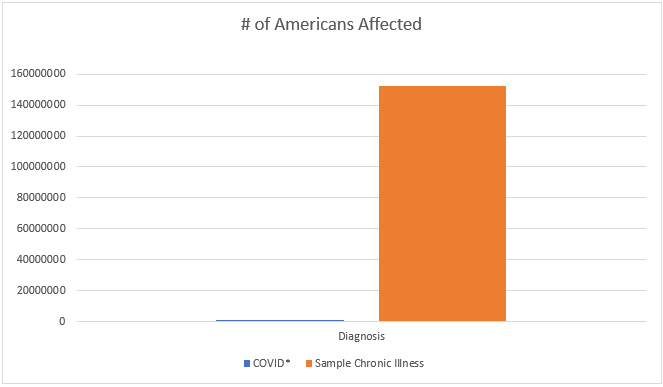
    To put these numbers into perspective, below is a graph comparing the number of COVID-19 diagnosis in the United States (as of 4/25/20) vs. the aforementioned chronic illness:

    A chart comparing COVID-19 cases to a chronic illness. 

    From sheer diagnosis numbers alone, this chronic illness should appear way more drastic to our hospital system than our current pandemic (obviously, the numbers surrounding COVID are subject to change as we learn more). This would assume that all diagnosed patients end up in our hospital system which isn’t a guarantee. To compensate for that lack of future clinical data, we’ll substitute what we know from a financial aspect on how impactful this chronic disease could be to our HC system. To do this I’m going to use some “creative” arithmetic. Bear with me.

    A Hypothetical Financial Projection

    To try and make this as accurate as possible, we’re going to take inflation into account. To do so, we’ll use the generation markers for Baby Boomers (55 – 76 years old) as a starting point for our projection. The financial data surrounding this chronic illness is largely from 2017 so we’ll use three years of inflation projections to get us into 2020 USD, and then another 21 years of projections to completely age-out the current Baby Boomer population (ending in 2041). 

    From 2017 – 2020 we’ve experienced about $0.05 in inflation. Now, unrealistically, we’re going to assume that every three years we will continue to have a $0.05 inflation hike. This projection would put the U.S. at a $0.35 inflation hike between 2020 and 2041. 

    Now we can apply our existing data. According to an organization specializing in this disease, $327 billion is spent annually to treat those diagnosed. Referencing our population data, those diagnosed represents a small minority of those likely to develop the disease as a whole: 34.2 million diagnoses vs. 152.3 million diagnoses, pre-diagnoses, and former diagnoses. If we can break down our data to represent the cost of an individual diagnosis, we can then scale for inflation and a more accurate financial point to include all of those at risk, not just those who have been officially diagnosed. Here’s the math step by step:

    1. $327 Billion spent in 2017 for all American Diagnoses * 1.05 =  $343.35 Billion USD in 2020 currency (1.05 represents the inflation rate between 2017-2020).
    2. $343.35 Billion (2020 Dollars) * 1.35 = $463.5225 Billion (2041 Dollars – Assuming we see a $0.05 inflation hike every 3 years between 2020 and 2041). 
    3. $463 Billion dollars is a huge chunk of change even on a national scale. What this figure doesn’t include are the pre-diagnosed, un-diagnosed, and formerly diagnosed Americans that are at a higher likelihood to develop or re-develop the disease. This $463 Billion figure represents only 34.2 million of the 152.3 million Americans at risk:
    4. $463,522,500,000 / 34,200,000 diagnosed = $13,553.29 per diagnosis per year. It’s important to keep in mind that these costs are the total impact on the healthcare system.
    5. $13,553.29/diagnosis * 152.3 Million Americans at risk = $2.064 Trillion per year in theoretical financial impact towards the US healthcare system in 2041 for this chronic illness. 

    If you’re still wondering which chronic illness we’ve used to project these outcomes, it’s Diabetes Mellitus. These figures represent solely the cost of treating diabetes itself (insulin, test strip, A1C monitors, physician services, glucose monitors, etc.), not the complications that can stem from the disease. Some common complications are stroke, heart disease, neuropathy, eye and skin complications (like glaucoma and deep skin infections or sepsis), etc.

    These numbers are meant to be staggering. This is a projection for one chronic illness out of hundreds, with hundreds more to be developed or contracted between now and 2041. If our healthcare system was at the brink of being overwhelmed during the COVID pandemic, what capacity can we expect the system to hold for a chronic illness that will affect 197.58 percent more Americans and cost billions if not trillions of dollars? The good news, type II Diabetes (a heavy, heavy majority of diabetes diagnoses statistics) is reversible through proper medication, diet, exercise, and lifestyle changes. The bad news? Many other chronic illnesses are not. 

    Steps for a Sustainable Healthcare System

    If this pandemic has shown us some shortfalls within our healthcare system, now is the time to correct them. Individual education and individual ownership of lifestyle choices are immediately impactful changes we can all make to ensure the healthcare system is sustainable for future generations. If we can successfully manage our own health, we won’t need to rely on a potentially ineffective healthcare system. 

    Contact GMS to discuss how we are partnering with local businesses to control and stabilize their healthcare programs for years to come. Our industry experts are prepared to discuss the future of healthcare and how it may affect your business, your employees, and you.

  • In response to the economic impact of the COVID-19 outbreak, the Coronavirus Aid, Relief, and Economic Security (CARES) Act was signed into law on March 27, 2020. Among many different types of loans and incentives, the CARES Act introduced tax relief for businesses in the form of payroll tax credits, enhanced net operating loss (NOL) deductions, and payroll tax deferment. However, the payroll tax deferral section of the CARES Act raised several questions for small and medium-sized businesses, especially those that received loans from the Paycheck Protection Program (PPP).

    To help answer these questions, the IRS released guidance on April 10, 2020, regarding payroll tax deferrals. Here’s what business owners need to know when it comes to paying taxes on social security this year.

     Small business owner defers payroll taxes under CARES Act.

    What deposits and payments can employers defer?

    Section 2302 of the CARES Act enables employers to defer certain payroll taxes, specifically the employer contribution of Federal Insurance Contributions Act (FICA) taxes, otherwise referred to as the employer’s portion of social security taxes. Typically, employers are required to pay 6.2 percent of social security taxes for each employee’s covered wages on a semi-weekly or monthly basis.

    The deferral applies to deposits and payments of the employer’s share of the 6.2 percent social security tax owed for 2020. Without the CARES Act, this tax would have otherwise been required to be made during the period beginning on March 27, 2020, and ending December 31, 2020. There is no dollar cap on the total amount of an employer’s social security taxes that can be deferred.

    It’s important to note that the CARES Act does not cover other payroll taxes, such as the Medicare tax (1.45 percent) or the employee’s share of the social security tax. The CARES Act does, however, outline tax deferrals in an equivalent amount for self-employed individuals subject to the Self Employment Contributions Act (SECA) and employers and employees subject to the Railroad Retirement Tax Act (RRTA).


    When are deferred tax payments due?

    In order to avoid penalties, the deferred payments of the employer’s share of social security tax must be deposited by the following dates:

    • On December 31, 2021, 50 percent of the deferred amount must be paid.
    • On December 21, 2022, the remaining amount must be paid.


    Who is eligible to defer tax payments?

    All employers, regardless of size, may defer the deposit and payment of the employer’s share of social security tax. However, employers who received PPP loans become ineligible to continue deferring tax payments after receiving notice from the lender that the loan is forgiven. The Small Business Administration (SBA) says “the loan will be fully forgiven if the funds are used for payroll costs, interest on mortgages, rent, and utilities” if you are able to maintain your workforce.

    For payments deferred through the forgiveness date, employers may continue to defer payments until the end of 2021 and 2022 as described above without incurring penalties for failure to pay. The CARES Act also states that employers who have had a loan forgiven under the U.S. Treasury Program Management Authority are also ineligible to defer payments.


    Do employers need to make special elections to defer tax payments?

    No, employers do not need to make any special elections to defer deposits and payments for payroll taxes. The IRS will revise the Employer’s Quarterly Federal Tax Return (Form 941) for the second quarter (April through June 2020). The IRS says information will soon be released regarding deposits and payments otherwise due on or after March 27, 2020, for the first quarter (January through March 2020).

    Contact us if you have any HR or payroll-related questions on how to keep things running smoothly through this transition. 

  • Whether your business is facing a difficult financial situation or hit a slow season, it may seem like layoffs are your only option. However, there is another way that you can reduce payroll costs without completely cutting jobs: furloughs. 

    Furloughs are a cost-saving measure that can provide employers with financial flexibility without completely severing ties with employees. Of course, you’ll need to ask yourself a few questions to figure out if furloughs make sense for your business. 

    An empty workplace after a business furloughed its employees. 

    What is a Furlough and How is it Different Than Laying Someone Off?

    In short, a furlough is time off without pay. Unlike an employee who is laid off, people who are furloughed are still technically employed by your company. Instead of completely severing ties with employees, furloughs allow you to temporarily part with workers and send them home without pay. Once the furlough is over, the affected employees can return to work and resume their normal duties.

    During this time, furloughed employees cannot do any work on behalf of their employer – even a short phone call or a half-hour of work is considered a violation of the no-work rule. As such, even small tasks can result in you having to pay furloughed employees for their time (or the whole day for exempt workers).

    How Long Do Furloughs Last?

    The length of the furlough can be as short or long as you need. That means that furloughs could range anywhere from a week to several months. Indefinite furloughs are also an option if you’re unsure of how long you’ll need to maintain a lower payroll. If you plan to furlough employees, you’ll want to find a balance between the needs of your business and an amount of time that won’t drive your valued employees to find employment elsewhere.

    How Do Furloughs Affect Hourly vs. Salaried Employees?

    Employers have the right to impose furloughs on both exempt and nonexempt employees, although there are some key differences in terms of cost savings. With hourly employees, you can calculate the total number of hours saved with a furlough and evaluate savings. You can also furlough salaried employees, as these workers are only entitled to pay during weeks in which they work. As such, a long-term furlough won’t change their exemption status. 

    How Do Furloughs Impact Employee Benefits?

    While your employees won’t be paid during a furlough, they are still technically employed by your company. As such, there is some expectation that these employers are entitled to group health coverage, retirement plans, and other such benefits offered by your business. 

    Despite this expectation, you still may have the option to discontinue or reduce the benefits of furloughed employees. However, you’ll want to communicate this with your employees ahead of this decision. Of course, you’ll also need to check your state’s employment laws to see if there are any stipulations about the treatment of employee benefits during furloughs. The Society for Human Resource Management (SHRM) suggests considering the following points:

    • Your group health plan may dictate if coverage continues or ends during a furlough. Certain plans extend active coverage during short-term leaves of absence, while others set minimum hour requirements.
    • You typically must offer affordable COBRA continuation coverage for all group health plans if coverage ends because of termination or a reduction in hours. Also, an increase in the employee’s share of the premium because of the furlough is a loss of coverage for this purpose.
    • Terminating group health plan coverage for furloughed employees may lead to ACA penalties.
    • Covered employees must still pay monthly premiums/contributions to maintain coverage during a furlough. Make arrangements with employees in advance of the furlough to avoid lapses in coverage or invalidated plans. Payment arrangements for allowable coverage should be made in advance with employees and can include payments via mail, ACH, or a COBRA vendor.
    • Evaluate 401(k) and other retirement plan implications. For example, a furlough may trigger a “partial termination” clause, which may lead to 100 percent vesting for affected participants.

    Can Furloughed Employees Get Unemployment?

    While furloughed employees are still technically employed by your company, they will still typically qualify for unemployment benefits. In fact, the CARES Act expanded unemployment benefits for furloughed employees. According to CNBC, these employees are now “eligible to receive their state-administered benefit, based on previous earnings, for up to 39 weeks.”

    Can Furloughed Employees Work Elsewhere?

    Yes, furloughed employees can find alternative employment. In addition, certain states allow furloughed workers to pick up part-time jobs and stay eligible for partial unemployment.

    Determine the Right Path for Your Business

    Furloughs or layoffs are never an easy decision, but it’s important to decide the right route for your business. Need an HR partner to help you plan ahead and stay compliant with local, state, and federal regulations? Contact GMS today to talk to one of our experts about the future of your business.

  • Over the past few years, a growing number of states and cities have banned the practice of using salary history to screen potential new employees. If you’re an employer in New Jersey, you’re now included in that trend. 

    Starting in 2020, it’s not a good idea for New Jersey employers to ask job applicants how much they made. The Garden State is now one of 17 states and multiple cities to outlaw pay history questions. While similar in many aspects, New Jersey’s version of the law does have some key differences that can help employers avoid potential penalties.

    A New Jersey employer asking for salary history, which is now banned in the state. 

    The Impacts of New Jersey’s Salary History Ban

    As with other states with salary history bans in place, Bill A1094 prohibits New Jersey employers from using past wages, benefits, and other salary history-related information to vet potential job applicants. The law also prevents employers from requiring an applicant’s salary history to satisfy any minimum or maximum criteria.

    If by chance an employer breaks the rules set in Bill A1094, the law has set penalties in place. Any employers who violate salary history ban are subject to civil penalties. These penalties scale based on the number of times an employer breaks the rules:

    • Up to $1,000 for the first violation
    • $5,000 for the second violation
    • $10,000 for each subsequent violation

    Exceptions

    Unlike other state and city bans on salary history inquiries, there are a few exceptions where employers are protected in New Jersey. The state’s ban includes a couple of examples of expressly permitted activities where the employer would not be in violation of the law.

    Voluntary release

    The law does not penalize employers if applicants voluntarily provide their salary history. Of course, this disclosure must be done by an applicant’s choice alone – it cannot be prompted or coerced at all. If this information is provided, the employer may then verify that the information provided is accurate and use it to determine compensation.

    Post-offer requests

    If an employer makes an offer of employment to an applicant that includes an explanation of the overall compensation package, the employer may request that the applicant provide a written authorization to confirm their salary history. If the authorization is given, this information can include both compensation and benefits.

    Hiring internal or past employees

    The law does not extend to any internal applicants with regards to promotions or transfers. As such, employers may consider salary information for applicants who already work at their company. In addition, employers may consider past salary history information if an applicant used to work for them, but only the information that they already have on file.

    Federal law exclusions

    If a federal law requires an applicant to disclose their salary history (or requires an employer to verify that history), an employer will not be penalized for collecting and using that information.

    Incentive or commission plans

    If an applicant is applying for a position with commission or incentive-based compensation components, an employer may inquire about past incentive and commission terms. However, these inquiries cannot extend to what the applicant’s earnings were under a previous employer’s plans.

    Collective bargaining agreements

    Employers may communicate with applicants about wages or salary rates if the job has certain salary guidelines set by collective bargaining agreements or laws.

    Evaluate Your Hiring Process to Protect Your Business

    While the salary history ban is a more recent law, it’s not the only regulation that employers need to consider during the hiring process. There are a variety of illegal interview questions that are off-limits for employers, such as inquiries about national origin and pregnancy status. As such, it’s important for employers to take the following steps to examine their internal processes to prevent possible violations.

    • Evaluate job applications, recruiter instructions, and background-check instructions to eliminate improper information requests
    • Examine interview templates or guidelines (and establish them if they do not already exist)
    • Treat every candidate the same during the interview process
    • Have more than one interviewer in the room and take notes to document the results

    Need an HR partner to prepare your business for new laws and other business administration headaches? Contact GMS’s New Jersey office or one of our other locations today to talk to one of our HR experts.