
2025 W-2 Forms are now available in your GMS Connect employee portal here.

  • When you own a small business, you have several responsibilities that you need to oversee throughout the year. Payroll tax management is one of the more notable obligations that are on your plate. Unfortunately, it’s not necessarily obvious how to estimate payroll taxes for a small business.

    While it’s not the most enjoyable job, it’s critical that you calculate payroll taxes correctly. Every employer must withhold payroll taxes from each paycheck, so proper handling of these deductions is important to both your employees and the government. This responsibility is a lot of pressure for a small business owner who isn’t familiar with how to withhold payroll taxes. That’s why we’ve put together a breakdown of how to calculate payroll taxes for your small business.

    A small business owner learning how to calculate payroll taxes.

    What Payroll Taxes Do Employers Pay?

    Payroll taxes are one part of what the IRS considers as employment taxes. The term “employment taxes” actually refers to a variety of taxes that are directly connected to your employees. These taxes include:

    • Federal and state income taxes
    • Federal Insurance Contribution Act (FICA) taxes
    • Federal Unemployment Tax Act (FUTA) taxes
    • Additional Medicare tax
    • Self-employment tax

    While some people confuse payroll taxes with income tax, the term “payroll taxes” specifically refers to FICA taxes. These FICA taxes are made up of a combination of Social Security and Medicare taxes, both of which are deducted from employee paychecks to fund their respective programs. Altogether, FICA taxes account for a total flat rate of 7.65 percent that’s split between Social Security and Medicare.

    These taxes are deducted from employee paychecks, but employees aren’t the only people who contribute these percentages to Social Security and Medicare. Both employees and employers are responsible for paying them, and the employer payroll tax percentage is the same as what employees owe. As such, your business needs to match the flat percentage deducted from each paycheck.


    How to Calculate FICA Taxes

    The bad news about calculating payroll taxes is that you’re going to have to do some math. The good news is that the math for calculating FICA taxes is much easier than estimating federal income taxes. 

    The reason why FICA taxes are much more manageable to calculate is that they’re flat percentages. As of 2021, the combined FICA tax rate is 7.65 percent of an employee’s gross pay. That rate is split into the following percentages:

    • Social Security tax – 6.2 percent
    • Medicare tax – 1.45 percent

    Of course, payroll deductions aren’t always that easy. There are a couple of exceptions to the base rates that can affect your calculations for both Social Security and Medicare taxes if an employee makes more than a certain wage threshold.


    Calculating Social Security taxes

    In general, calculating Social Security taxes is straightforward – just multiply an employee’s gross pay by 6.2 percent. The resulting number should be deducted from an employee’s paychecks and matched by the employer. However, there is an annual limit to how much employees and employers contribute to Social Security taxes. 

    Every year, the Social Security Administration sets a wage base for Social Security taxes. Essentially, employers and employees only have to pay these taxes up to a certain dollar amount. The taxable maximum is set at $142,800 for 2021, which means that Social Security taxes only count toward the first $142,800 an employee makes in a year. For example, an employee who makes $150,000 wouldn’t pay Social Security taxes on the final $7,200 in gross pay.


    Additional Medicare tax

    As with Social Security taxes, there are certain wage thresholds that will impact your exact calculations. Unlike Social Security, these thresholds can mean that individuals pay more in Medicare taxes. 

    There are no annual Medicare tax limits. Instead, employees who earn more than certain amounts have to pay an additional Medicare tax rate of 0.9 percent. Those wage thresholds are: 

    • $200,000 for employees who are single
    • $250,000 for a married employee who files jointly
    • $125,000 for employees who are married, but file separately

    It’s important to note that the additional Medicare tax only applies to wages earned above the set thresholds. For example, an employee who is single and earns $250,000 would owe 1.45 percent on the first $200,000 and a combined 2.35 percent on the subsequent $50,000.

    Another key detail is that employers are not required to match any additional 0.9 percent contributions. Instead, they would only contribute the standard 1.45 percent. However, employers should still withhold the additional 0.9 percent Medicare tax from employee paychecks. Employees should also file Form 8959 if they meet the requirements for additional Medicare tax.


    Payroll Tax Deductions Examples

    Instructions on FICA tax calculations are nice, but sometimes it’s best to see an example on how to break down these calculations. Let’s start by assuming you have an employee who makes $52,000 in gross pay a year. Here’s a quick breakdown of the annual payroll tax responsibilities for that employee.
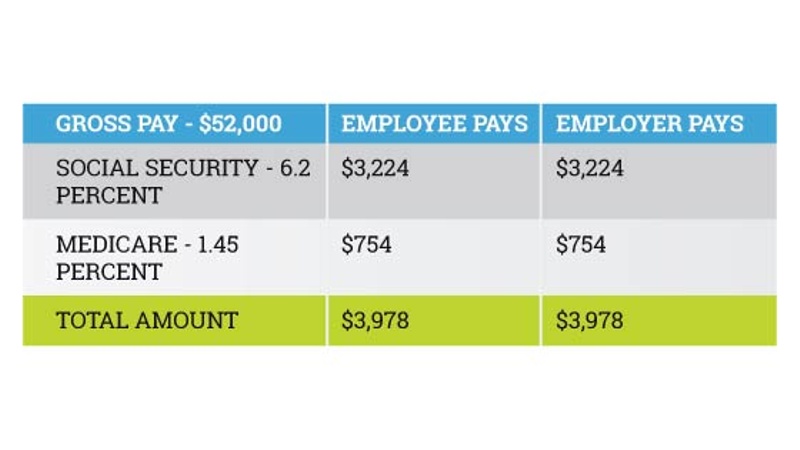
    Annual breakdown of payroll taxes for a small business employee.


    While the numbers above give you an idea of how much both you and your employee will pay in annual payroll taxes, you’ll also need to determine deductions on a per-paycheck basis. Identifying per-paycheck tax deductions will allow you to withhold the right amount from each employee’s paycheck while helping you keep track of what you owe when it’s time to pay the employer portion of payroll taxes. 

    Determining deductions on a per-paycheck basis depends on your pay frequency. There are multiple pay period options depending on your location – weekly, biweekly, semimonthly, and monthly are all fairly standard. You’ll need to divide an employee’s annual gross pay by the number of pay periods in a year and apply the appropriate FICA tax percentages to that individual paycheck. Here’s a breakdown of that same $52,000 employee on a biweekly pay period.
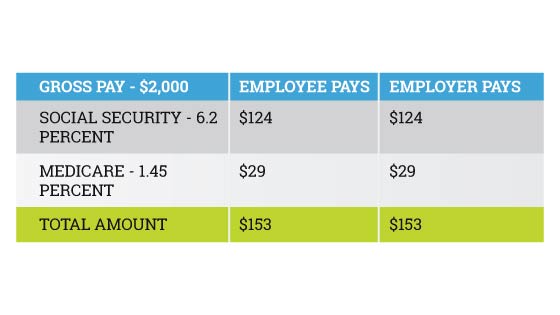
    Per paycheck breakdown of payroll taxes for a small business employee.


    How to Pay the Employer Portion of Payroll Taxes

    Calculating and withholding FICA taxes is just one part of the process. As an employer, you still need to pay those withheld and matched taxes to the IRS.

    Employers can report and pay FICA taxes through their Electronic Federal Tax Payment System (EFTPS) account. Employers must send regular payroll tax reports to the IRS through Form 941. The due dates for Form 941 are the final day of each quarter (April 30, July 31, Oct. 31, Jan. 31). 

    In terms of depositing payroll taxes, the frequency depends on how much you paid in the past year. Businesses that reported more than $50,000 in federal taxes on average must deposit taxes semiweekly. Businesses that pay on a monthly business owe these taxes by the 15th of the following month.

    New businesses or businesses that reported less than $50,000 on average only have to pay federal taxes on a monthly basis. The due dates for these payments depend on your paydays. If paychecks are due Wednesday through Friday, you need to deposit taxes by the following Wednesday. If payday falls on Saturday through Tuesday, those same taxes are due by the following Friday.


    Take the Pain out of Payroll Management

    Even if you have a grasp on calculating payroll taxes, you still have a lot of work to do. Managing payroll and tax filings can be one of the most time-consuming and challenging tasks there is for a small business owner. That’s why employers turn to GMS for payroll administration.

    When you work with GMS, you get to stop worrying about the ever-changing nature of payroll tax management and start spending time growing your business. Contact GMS today about how we can help you take control of your critical HR functions.

  • The employee performance review has been a standard business practice for decades. However, not all organizations recognize that there’s a fine line between a valuable performance review and an unhelpful one. 

    When done well, performance reviews are an incredibly powerful tool for driving employee success. When done poorly, they simply waste time and leave employees frustrated. The downsides of bad performance reviews have led some companies to shift away from performance reviews in recent years. However, it’s better to solve these issues than avoid them altogether.

    There is immense value to developing an open, honest avenue for managers to discuss an employee’s performance and opportunities for growth. Let’s break down employee appraisal tips that your business can do to create positive appraisal experiences that drive your employees to succeed.


    The True Goals of Employee Performance Reviews

    Simply put, employee performance reviews are conversations where a manager and an employee openly discuss that employee’s performance, development, and growth. This conversation is a key way to identify ways for both personal and company improvement. The word “conversation” is critical here – these appraisals should be a two-way conversation. 

    The reason why it’s important to have a conversation is that the employee should be just as engaged as the manager. Employee performance reviews are not designed for immediate fixes. If there’s a problem that requires immediate resolution, you shouldn’t wait for an appraisal. 

    Instead, performance reviews are meant to create regular opportunities for managers and employees to align their efforts and determine how they can maximize performance. As such, performance reviews give you an opportunity to work with your employees and achieve the following goals.

    • Create and review expectations, standards, and rules.
    • Educate employees about any behaviors they need improvement or modification.
    • Identify any strengths and weaknesses that weren’t already known.
    • Chart a course for the employee’s future.
    • Learn more about the employee.
    • Send a message that you care about the employee, both personally and professionally.

    7 Performance Review Tips for Managers

    By focusing on the appropriate goals, your performance reviews can help motivate team members and improve performance levels. However, those ideal goals will only go so far without proper execution.

    It’s essential to make the employee performance review process as positive of an experience as possible. The following tips can help you learn how to conduct performance reviews and build a culture of continuous improvement for your employees.


    Prepare ahead of time

    The first step toward any successful employee appraisal is preparation. Both you and your employees should come prepared to performance reviews with notes and talking points. The following items and information can also help.

    • A copy of the employee’s personnel file.
    • Documentation from past reviews, including previously set goals, objectives, and notes of interest from prior conversations.
    • Feedback and notes from supervisors or coworkers.
    • Relevant performance data and customer feedback.
    • SWOT analysis.

    A shared agenda will also help set a positive, constructive tone for the meeting. Some employees will go into a review expecting an interrogation that will directly impact their future compensation. Giving them an agenda and questions to think about will help them be in a mindset for growth instead of being tightlipped and careful about the information they share. 

    You can also prepare by asking employees up for review to share any topics they want to discuss. This gesture not only allows the employee to change the agenda to be more valuable for them, but also shows that you’re ready to listen. That two-way connection will encourage employees to contribute more to the review and own their path for professional improvement.


    Speak carefully and ask the right questions

    Your choice of words make a big difference. The right words and tone can help motivate your employees. Meanwhile, less friendly phrases will only make them dread these occasions in the future. 

    In terms of your message, try to focus on specific language that makes employees think in positive terms. For example, emphasize that the goal of each review is to solve problems and identify ways to help both the employee and the company grow. This constructive approach can keep employees engaged and look forward to the future. 

    The questions you ask are a major part of this process as well. These queries should mirror the same positive approach. The following questions are great ways to emphasize the future and and create steps for improvement.

    • What goals do you have for the next quarter, year, or other period of time?
    • What accomplishments are you most proud of from your work?
    • What goals do you want to set for your own development?
    • Are there any hurdles that we need to solve together?
    • What can I do to improve as your manager?

    Listen as much as you speak

    Even if you know that performance reviews should be a two-way conversation, it can be easy to end up talking most of the review. A two-way conversation should never feel like an interrogation or like only one party is talking. Employees may be hesitant to share too much information out of fear of saying something wrong. 

    It’s important to make sure that everyone being reviewed not only feels comfortable enough to share genuine thoughts, but also know that you’re actively interested in what they’re saying. Make sure to ask them about topics where they can lead the conversation. When an employee has interesting feedback, ask a follow up question to delve into the topic even further. You should also repeat back what you heard from them to confirm that you listened to their points and can clarify if there’s any misunderstanding. These practices will help you gather more critical information and show employees that the reviews are an ongoing conversation and not a one-sided affair.


    Give specific examples for both good work and areas of improvement

    Vague or generic criticism doled out during performance appraisals is only going to frustrate and disenchant employees. The best way to provide genuine critical feedback is to have concrete examples for good achievements and areas of improvement.

    One major benefit of using specific examples is that they provide very clear examples of exemplary or subpar work. Exact examples provide teachable moments of what can be done to improve that provide more weight than general feedback. 

    Examples also have the benefit of showing that you and your management team are paying attention. Whether you’re identifying ways for the employee to improve or providing accolades for good work, it shows the employee that his or her work hasn’t gone unnoticed. That level of attention gives your feedback more weight and helps your workers feel like they aren’t invisible. These employee performance tips ensure that your input leads to a good outcome for both the employee and the individual when giving feedback.


    Track employee progress

    In order to maximize the benefit of performance meetings, it’s essential to track that your efforts make a difference. You should do your best to find measurable goals and evaluate your employees’ progress over time. When you review these goals, try to answer the following questions

    • Do you see positive progression for measurable goals?
    • Has employee performance improved, declined, or stayed steady?
    • Has employee morale increased, decreased, or stayed steady?
    • Is the employee more confident than they were in past reviews?

    Over time, you should see employees continue to grow in their roles. If you’re not seeing positive results, you may want to change the goals or try a different approach toward maintaining professional growth.


    Have next steps for after the meeting

    The performance review is just one step in a long process. Once the appraisal concludes, you and your employee should review everything that was discussed and complete the following:

    • Review notes from what was discussed during the meeting
    • Determine and define next steps 

    A performance conversation shouldn’t end when the meeting is over. After the conversation concludes, managers and employees should review notes, define next steps, and follow up with shared comments and feedback. Without these items, performance conversations feel unresolved. If you want your review to actually improve performance, it’s vital to create an action plan and follow through on that plan.


    Make performance reviews a regular exercise

    The conversation between management and employees doesn’t need to be an infrequent occasion. Performance conversations should be a regular event to help encourage improvement. Why wait another 12 months to try and focus on growth when regular feedback can help improve your company even sooner?

    Once you finish a performance review, try and schedule the next conversation as soon as possible. The cadence of these meetings will differ depending on your organization, but quarterly or monthly appraisals are good places to start. These regular meetings will not only keep the conversation going, but also show your employees that you care about their development.

    It’s also important to note that conversations shouldn’t be limited to just performance reviews. Constructive discussions can happen outside of scheduled appraisals. An open-door policy can help employees feel more comfortable talking about potential issues or paths to improvement at other times. This level of openness can help you make continuous performance a part of your culture instead of an unhelpful annual event.


    Set Up Your Employees for Success

    Your employees are your greatest asset. However, ongoing employee management is a major challenge, especially when there’s only so much time in the day. That’s why GMS works with businesses to help employers with everything from performance management to payroll administration.

    As a PEO, we help small businesses take control of critical HR management functions so that they can spend their time on other key business tasks. Contact GMS today about how we can save you time, money, and plenty of headaches by helping you take control of critical HR functions.

  • If you own a small business, there’s a good chance you need to carry workers’ compensation insurance to cover any work-related injuries or illnesses. Requirements for workers’ compensation coverage vary by state, with some states requiring businesses with as few as one or two employees to carry workers’ compensation insurance. Applicable companies that don’t comply will face penalties ranging from fines to criminal charges.

    Of course, carrying workers’ compensation insurance has some financial challenges as well. Between premiums and other factors, managing workers’ compensation has a direct impact on your business’ bottom line. Let’s break down how workers’ compensation affects your business and what you can do to lower your financial burden.

    An employee using safety training to reduce workers’ comp costs and claims for small businesses.


    How Much Does Workers Comp Cost?

    Workplace accidents and illnesses are costly, but those costs can come in different forms. There are two main ways that affect how much workers’ compensation costs.

    • Your workers’ compensation premiums
    • Hidden costs

    Workers’ compensation premiums

    The most well-known cost related to workers’ compensation are workers’ comp insurance premiums. Your base workers’ compensation premiums are heavily dependent on your business. There are three main factors that impacts your premium.

    • Class codes
    • Experience modification rate
    • Total payroll

    Your classification code identifies the business type and estimated cost of your workers’ compensation rate. Meanwhile, your experience modification rate – also known as an ex mod or an EMR – is a number that represents how your business compares to other businesses with similar employee classifications. A mod below one means your business has a good history of claims and will lower your base rate. In general, more claims or more severe claims will raise your EMR.

    These numbers are used to determine your base workers’ compensation rate. That rate is then applied against your payroll to determine how much you owe in workers’ compensation premiums. 


    The hidden costs of workers’ compensation

    While it’s easy to see how much your workers’ comp premiums cost your business, it’s harder to identify other potential for losses. There are two potential issues that can end up costing your business in the long run.

    • Lost work
    • Employee costs

    Depending on the nature of your business, your EMR can prevent you from making money. For example, a construction company with an EMR that’s too high may not be allowed to bid for certain jobs. As such, you may end up losing out on a great opportunity because your claims history scares off potential clients.

    Another potential issue is that workplace accidents and illnesses directly impact your employees. If your employees feel unsafe or that their health and wellbeing isn’t a priority, they can become unhappy at work. That disenchantment can make them less productive or leave for different opportunities. Either situation can directly impact your bottom line.


    How to Reduce Your Workers’ Comp Costs

    There are two key strategies that you can use to not only lower your workers’ compensation premiums, but also mitigate the hidden costs you may face in the future.

    • Have a safety culture
    • Claims management

    Have a safety culture 

    It’s no surprise that the best way to reduce workers’ compensation costs is to reduce or avoid injuries that lead to claims. The best way to reduce workers’ compensation claims is to embrace a culture of workplace safety.

    Proper education and training is an extremely effective way to reduce your rates. By limiting the number of claims – as well as the severity of injuries – you will lower your workers’ compensation costs over time. However, that process can only begin by committing to a couple of key practices.

    • Risk assessments
    • Safety training

    Risk assessments

    It’s hard to prevent issues if you don’t know what causes them. Risk assessments are designed to identify any hazards that put people in the workplace in potential danger. According to the American Society of Safety Professionals, this process involves an examination of several factors.

    • Tangible and intangible sources of risk
    • Threats and opportunities
    • Causes and events
    • Consequences and their impact on objectives
    • Limitations of knowledge and reliability of information
    • Vulnerabilities and capabilities
    • Changes in external and internal context
    • Indicators of emerging risks
    • Time-related factors
    • Biases, assumptions, and beliefs of those involved

    Assessing these potential hazards allows your business to not only fix existing issues, but also take measures to limit future problems as well. Those changes will make your workplace a safer place and in the event that OSHA knocks on your door that you’re doing what you can to protect the people at your workplace.


    Safety training

    While assessing and addressing risks is one step toward developing a culture of safety, training is another. Proper training and safety measures can be the difference between some nasty bruises and fatality. That’s why it’s critical to train all your employees on the following.

    • Safety and health policies, goals, and procedures
    • Functions of the safety program
    • Proper contacts for any questions or concerns about the program
    • How to report hazards, injuries, illnesses, and close calls/near misses
    • What to do in an emergency

    Claims management

    In an ideal world, no business would ever need to manage any claims. The reality of the situation is that there’s always a possibility that someone will have an accident. When that happens, the way you respond can help lower your workers’ compensation costs in the future.

    While safety programs and other preventative measures can mitigate the number and severity of these accidents, it’s essential to properly manage any claims that do arise at your workplace. That’s why it’s important to focus on a few vital best practices.

    • Timely reporting (not to exceed 24 hours from injury/accident)
    • Post-accident investigations
    • Return-to-work programs

    Timely reporting

    The quicker you report an accident, the better. Prompt claims management allows you to handle any incidents right away. 

    According to the National Council on Compensation Insurance, delayed injury reporting can increase your claim costs by up to 51 percent. There are a couple of reasons for this increase. For example, the injured individual may seek medical attention that goes toward the workers’ compensation claim. That treatment may have been deemed unnecessary if the claim had been reported and handled from the beginning. By reporting and managing the claim early, you can control any extra costs that will complicate the situation.


    Post-accident investigation

    Once an accident occurs, it’s critical to investigate the situation and take any appropriate action. This investigation should include the following objectives.

    • Identify the root cause of the injury.
    • Aid in mitigating all jobsite hazards.
    • Assist clients in the development of an internal incident investigation process.
    • Interview witnesses, photograph scenes, and gather vital information.
    • Generate a written investigation report for documentation.
    • Recommend corrective actions to prevent future accidents/injuries.

    Taking these actions help your business in a couple of different ways. First, it helps you solve existing issues and limit accidents in the future. By changing your culture and having a solid foundation regarding safety, your business will be prepared if and when OSHA knocks on your door.


    Return-to-work programs

    The cost of accidents can extend far beyond OSHA intervention. Return to work programs allow you to make sure that any injured employees get the care they need and know that you have their best interests in mind.

    The goal of a return-to-work program is to keep injured employees engaged and help them return to their roles as quickly as possible. It’s not uncommon for injured employees to feel detached from the company while on leave. With a return-to-work program, nurse case managers can keep employees involved and make them feel like they’re still a part of the business. With this level of care and attention, employees are less likely to sue, more likely to come back quicker, and can stay involved in the day-to-day safety culture.


    Reduce Workplace Injuries Through Education, Training, and Claims Management

    Prevention and claims management is your best tool when it comes to reducing your workers’ compensation costs. However, it’s hard to develop a culture of workplace safety without some assistance. 

    When you need to control your workers’ compensation costs, GMS can help. When you partner with GMS, you’re also getting a partner that can help you reduce claims and oversee the claims management process. Contact GMS today to talk to our team about how we can help you reduce your workers’ compensation costs.