• Receiving notice of an IRS audit can be stressful for any business owner. While many small businesses will never experience an audit, certain filing errors, reporting inconsistencies, and compliance issues can increase the likelihood of attracting IRS attention.

    The good news is that most audit risks can be reduced through accurate recordkeeping, proper payroll administration, and proactive tax compliance practices.

    Understanding the most common audit triggers can help you identify potential issues before they become costly problems.

    Key Takeaways

    • IRS audits are often triggered by inconsistencies, reporting errors, and documentation issues.
    • Payroll tax mistakes, worker misclassification, and excessive deductions can increase audit risk.
    • Maintaining accurate records is one of the best ways to prepare for potential IRS inquiries.
    • Businesses that consistently review compliance processes are better positioned to avoid costly penalties.
    • Working with experienced HR, payroll, and compliance professionals can help reduce audit-related risks.

    What Causes the IRS To Audit a Small Business?

    Many business owners assume audits happen randomly, but most audits are triggered by specific issues identified through IRS review processes.

    The IRS uses various systems to compare information reported on tax returns with other documentation, including payroll records, W-2s, 1099s, and third-party filings.

    When discrepancies appear, those issues may trigger additional review.

    While no business is completely immune from audits, understanding the most common red flags can help employers reduce unnecessary risk.

    1. Reporting Consistently Large Business Losses

    It’s not unusual for businesses to experience a loss, especially during startup phases or challenging economic periods.

    However, repeatedly reporting substantial losses year after year may attract additional scrutiny.

    The IRS may want to determine whether the business is legitimately operating for profit or functioning as a hobby activity.

    Business owners should ensure they maintain documentation that supports reported expenses, revenue, and operational activities.

    2. Excessive Business Deductions

    Deductions play an important role in reducing taxable income, but unusually large deductions compared to similar businesses or revenue levels may raise questions.

    Common areas that may receive additional scrutiny include:

    • Travel expenses
    • Meals and entertainment
    • Vehicle expenses
    • Home office deductions
    • Marketing expenses
    • Professional services

    The key is maintaining clear records that support every claimed deduction.

    3. Worker Misclassification

    One of the most significant compliance risks for employers involves classifying workers incorrectly.

    Businesses sometimes classify workers as independent contractors when they should be treated as employees.

    Misclassification can affect:

    • Payroll taxes
    • Overtime eligibility
    • Benefits obligations
    • Workers’ compensation coverage
    • Unemployment taxes

    If the IRS determines workers were improperly classified, businesses may face back taxes, penalties, and interest.

    4. Payroll Tax Errors

    Payroll tax compliance remains one of the most common areas where businesses encounter IRS issues.

    Potential red flags include:

    • Late tax deposits
    • Incorrect payroll tax filings
    • Underreported wages
    • Mismatched payroll records
    • Failure to remit payroll taxes

    Because payroll taxes are considered trust fund taxes, IRS enforcement in this area can be particularly aggressive.

    5. Large Cash Transactions

    Businesses that operate primarily in cash often face greater audit risk simply because cash transactions can be more difficult to verify.

    Industries such as restaurants, retail stores, salons, and certain service businesses may receive increased scrutiny when reported income appears inconsistent with expected activity levels.

    Maintaining accurate sales records and documenting all deposits can help reduce concerns.

    6. Significant Changes in Income

    Large fluctuations in income from one year to the next are not automatically problematic.

    However, substantial increases or decreases may prompt additional review if the changes appear unusual based on historical filing patterns.

    Business owners should maintain records that explain major shifts, such as:

    • Rapid growth
    • Economic downturns
    • Acquisitions
    • New service offerings
    • Staffing changes

    7. Math Errors and Reporting Mistakes

    Sometimes the simplest mistakes create the biggest problems.

    Calculation errors, missing forms, incorrect taxpayer identification numbers, and inconsistent reporting can all increase the likelihood of IRS correspondence.

    Reviewing tax documents thoroughly before filing can help reduce preventable issues.

    8. Claiming Excessive Home Office Deductions

    The home office deduction is a legitimate tax benefit for qualifying business owners.

    However, problems arise when businesses claim spaces that do not meet IRS requirements or overstate expenses associated with the deduction.

    To qualify, the space generally must be used regularly and exclusively for business purposes.

    Detailed documentation is essential.

    9. Missing or Incomplete Records

    One of the most common challenges businesses face during audits is producing adequate documentation.

    The IRS may request records including:

    • Payroll reports
    • Tax filings
    • Expense documentation
    • Bank statements
    • Employee records
    • Vendor invoices
    • Contracts and agreements

    Businesses that maintain organized records are typically able to respond more efficiently to audit inquiries.

    Why Payroll and HR Compliance Matter During an Audit

    Many employers think audits focus exclusively on income taxes.

    In reality, payroll and workforce-related issues can create significant compliance challenges.

    Problems involving:

    • Employee classification
    • Wage reporting
    • Payroll tax deposits
    • Employee reimbursements
    • Benefits administration

    can all contribute to audit findings and financial penalties.

    As businesses grow, these responsibilities often become increasingly complex.

    How Can Small Businesses Reduce IRS Audit Risk?

    While audits can’t be prevented entirely, businesses can take steps to reduce potential red flags.

    Maintain Accurate Records

    Keep detailed documentation for income, expenses, payroll, benefits, and tax filings.

    Review Worker Classifications

    Periodically evaluate whether employees and independent contractors are classified correctly.

    Monitor Payroll Tax Compliance

    Ensure payroll taxes are calculated, reported, and deposited properly.

    Conduct Internal Compliance Reviews

    Regular reviews can help identify potential issues before government agencies do.

    Work With Trusted Advisors

    Experienced payroll, HR, tax, and compliance professionals can help businesses navigate changing regulations and avoid common mistakes.

    Preparing Your Business Before Problems Arise

    Most audit risks don’t stem from a single major mistake.

    More often, they result from a series of small errors, missing records, or overlooked compliance requirements that accumulate over time.

    The strongest defense against an audit issue is maintaining accurate records, implementing reliable processes, and addressing potential concerns before they escalate.

    Businesses that proactively manage payroll, HR, tax reporting, and compliance obligations are often better positioned to handle IRS inquiries and reduce the likelihood of costly penalties.

    A Professional Employer Organization (PEO) can help businesses strengthen compliance efforts through payroll administration, HR support, risk management guidance, employee recordkeeping assistance, and workforce management expertise.

    Want to simplify payroll, HR, and compliance responsibilities? Contact GMS to learn how we can help protect your business and reduce administrative risk.

    Frequently Asked Questions

    How common are IRS audits for small businesses?

    Most small businesses are not audited each year, but certain filing patterns and compliance issues may increase the likelihood of additional IRS review.

    Can payroll mistakes trigger an audit?

    Payroll tax errors, underreported wages, missed deposits, and worker classification issues can all increase audit risk and may result in penalties if not addressed.

    How long should small businesses keep tax records?

    Record retention requirements can vary depending on the situation and applicable regulations. Business owners should consult tax professionals regarding documentation retention policies relevant to their organization.

    Can a PEO help reduce compliance risk?

    A PEO can assist with payroll administration, tax reporting, HR compliance, employee documentation, and workforce management processes that help businesses reduce administrative and compliance challenges.


  • In a perfect world, small business owners wouldn’t have to worry about growing compensation budgets. Unfortunately, difficult or uncertain circumstances such as economic downturns, pandemics, or other major events can put a major financial strain on your company. 

    These situations can call for creative solutions, and compensation costs are a natural place to start shedding expenses. Payroll expenses typically fall between 15 to 30 percent of gross revenue, with exceptions for more or less labor-intensive industries. Of course, making compensation-based changes requires a delicate balance between securing the financial stability of your business without losing valued employees. 

    Whether you want to stabilize business expenses or need to cut costs, it’s important to take the right measures to keep your business strong during difficult times. Let’s break down what you can do to manage compensation costs.

    An employee receiving a paycheck following compensation management adjustments during difficult times. 

    3 Potential Compensation Management Strategies to Cut Costs

    There are a variety of approaches that you can take toward cutting or simply controlling your compensation expenditures. These strategies can be a temporary solution or permanent decision depending on your exact needs.

    • Manage current and future wages and salaries
    • Adjust or eliminate perks and incentives
    • Lay off or furlough employees

    Some routes will offer more cost savings than others, while others may create notable employee relations issues. Ultimately, you’ll need to carefully consider each of the following options and decide which makes the most sense for your business.

    Manage current and future wages and salaries

    According to the Bureau of Labor Statistics, wages and salaries accounted for 70 percent of employee compensation costs for private employers. The ability to cut or control these expenditures can make a major difference for businesses navigating through uncertain times. There are a few different routes your business can take in terms of managing wages and salaries:

    • Hiring freezes
    • Pay freezes
    • Wage adjustments

    Hiring freezes

    A hiring freeze is one of the first steps a business can take to control compensation costs. Simply put, a hiring freeze means that your business will not add any additional personnel. Hiring freezes are temporary in nature, but can last for months depending on the situation at hand. 

    One major advantage of hiring freezes is that it lessens the impact of compensation control on your existing employees. Unlike other solutions, the employees don’t feel the direct impact financially. However, this also means that hiring freezes won’t actively save your company money as much as allowing you to avoid adding on additional compensation costs. If you’re looking to simply control your expenditures while you wait out uncertain times, a hiring freeze can be a smart move.

    Pay freezes

    Like a hiring freeze, a pay freeze allows you to control compensation costs instead of cutting them. However, pay freezes apply to existing salaries and hourly rates as opposed to adding new members to your team. 

    If you give out regular raises or promotions, a pay freeze would put those increases on hiatus, effectively allowing you to maintain your current expenditures for wages and salaries. Of course, this route can be unpopular with employees because it does restrict their ability to make more money in the short term. However, it can be a much more amenable approach than other cost-saving solutions.

    Wage adjustment

    Another route you can go is to reduce compensation cuts by adjusting hours or salaries. For hourly employees, you can have employees work fewer hours in order to keep compensation costs down. There are a few different ways this strategy can work out.

    • Reduce number of days worked per week
    • Reduce the number of hours worked per day
    • Enact alternating work weeks
    • Offer voluntary days for employees who would rather take time off than work

    Each of these options can offer some financial reprieve, although it does mean that your employees will have less time to complete tasks. You’ll also want to review your local laws to make sure you follow any predictive scheduling laws. Some areas require a minimum notice period for changes in hours, days, and times worked, so make sure you give your employees proper notice if you decide to adjust work hours.

    If reducing work hours isn’t enough, you can opt to enact pay reductions for salaried employees. There are a few different routes you can go with this decision.

    • You can reduce pay by a same percentage for every single employee.
    • You can set different percentages for different tiers of employees based on job levels, organizational hierarchy, or some other groupings (make sure you have a legitimate business justification for each group to avoid any discrimination complaints).

    Pay reductions are an effective way to cut costs during difficult times, but it comes with the caveat that nobody likes making less money. As such, pay reductions are typically used only when it’s essential to cut costs. If pay reductions are a necessary step, one way to offset some displeasure is to show that everyone is impacted by the cuts, including leadership. Typically, higher-wage earners – including yourself – will take a percentage to help offset and protect lower-wage earners. While this is certainly not an enjoyable decision, it can show some solidarity between leadership roles and lower-wage workers.

    Pay reductions also come with some legal considerations that may impact your ability to enact these kinds of cost-cutting measures. As with hours adjustments, your local or state laws may require you to provide advance notice on pay cuts, which may require written notice along with signed acknowledgements from each employee. Any pay reduction should not drop hourly workers below the acceptable minimum wage. The Fair Labor Standards Act (FLSA) sets the federal minimum wage at $7.25 per hour, while many states and regions have higher rates necessary for minimum payment requirements. You’ll also need to make sure that your company navigates overtime pay correctly, especially for any employees who become non-exempt due to pay reductions.

    Adjust or eliminate perks and incentives

    While perks and incentives may not make up as much of your compensation costs as base wages and salaries, they can still add a notable amount to your expenses. Eliminating or adjusting these extra items can make quite a difference for financial stability.

    In terms of perks, evaluate what types of extra bonuses your employees may receive as a result of working for your company. Typical examples of minor perks include free lunches, tickets to events, and other monetary awards or gifts that employees can enjoy just by being part of your workforce. While these perks add to the overall experience of your business, they can quickly become non-essential in difficult times. As such, eliminating or adjusting these perks can be an initial step toward stabilizing finances that would be more popular than cutting salaries.

    Another cost-saving option is to end or adjust any bonuses and incentives employees can earn. Either option isn’t likely to be met with enthusiasm, but a reduction in bonus percentages or lengthening merit cycles for performance goals can be a much more agreeable solution for employees than more drastic cost-cutting solutions. If you do decide to adjust or end any of these bonuses or incentives, it’s important to time your announcement appropriately. Waiting until shortly before these payouts will not go over well with employees, so try to make any changes well before a payout period.

    Layoffs and furloughs

    Depending on the situation, you may need to cut more than just costs. Layoffs and furloughs are an unfortunate reality that many businesses must face during difficult times. However, they may be a necessary step if business slows down due to unexpected circumstances.

    Employee layoffs are a much more immediate form of cutting compensation costs. This measure effectively severs your ties with an employee, saving you from paying out wages, health insurance, payroll taxes, and any other costs associated with that worker. Of course, this also means that you may permanently lose this employee for good, even after your business bounces back.

    If you need to make difficult compensation cuts but still want to retain certain employees, a furlough is a more attractive option. Furloughed employees are still technically employed by your company. This relationship means that you send your employees home without pay, but they are still entitled to group health coverage, retirement plans, and any other such benefits offered by your business. Furloughed employees can also apply for unemployment, so they can still have some form of incoming revenue and benefits while they aren’t working for your company – and aren’t as tempted to leave for another business.

    In general, a furlough is designed to be a temporary situation. Some furloughs are designed to last for a set amount of time, while others may be indefinite until you decide it’s time to resume regular operations. Once the furlough is over, the affected employees can return to work and resume their normal duties.

    How to Communicate Compensation Cuts to Employees

    Running a business is already a difficult job – trying times only make it that much harder for both you and your employees. While certain compensation management strategies may not be the most pleasant news to share, it’s critical that you clearly communicate these decisions with your employees and help them understand exactly why they were made.

    Changes in compensations affects employees both professionally and personally. Lost wages, incentives, and jobs has a direct impact on each person’s family and plans for the future. While these decisions are made to stabilize your business, it’s important to recognize that these actions can have long-lasting consequences for everyone involved.

    This delicate balance between protecting the business and respecting your employees is why it’s crucial that you communicate these decisions directly with everyone involved. Make sure to be open, transparent, and empathetic when you deliver the news to everyone. Employees should be able to not only recognize the severity of the situation, but also that you understand how difficult this news is for everyone.

    It’s also important to maintain communication after you announce your initial plans. Frequent, clear updates is one of the best ways to support your employees during trying times. Let them know that you and other people in leadership positions are ready to listen to their concerns and ideas. By sharing regular updates and open communication, you can provide a necessary sense of security and stability while everyone works through these difficult times.

    Prepare Your Business for the Future

    Some events are impossible to predict, but there are always measures you can take to help protect your employees from difficult times. Fortunately, you don’t have to go through this process alone. 

    Group Management Services partners with small business owners to take on the administrative burden of HR management and make their businesses simpler, safer, and stronger. Contact GMS today to talk to one of our experts about how we can help you manage payroll, benefits, and other key HR functions. 

  • On Aug. 8, 2020, President Trump signed an executive order to allow employees to defer a portion of payroll taxes until 2021. Since news of the order broke, business owners have sought additional clarity on how this payroll tax will work and how it will impact their responsibilities as employers. Let’s break down some of the specifics of the proposed pay tax deferral and what those details mean for small business owners.

    A paycheck with tax deductions affected by the payroll tax deferral executive order.

    What Does the New Payroll Tax Deferral Change?

    In short, the executive order allows employees who make less than $4,000 every two weeks (equivalent to less than $104,000 per year) to defer part of their payroll tax payment until 2021. According to the order, employees would have the choice to opt-in for this tax deferral. If an employee elects to defer payments, the employer must honor this decision.

    Payroll taxes are defined as the FICA taxes taken out of each paycheck to fund Social Security and Medicare programs. The executive memo signed by Trump only refers to the Social Security portion of these taxes, which makes up 6.2 percent of each paycheck. As such, an employee can defer up to $2,232 depending on that person’s salary.

    While both employees and employers pay these payroll taxes, the payroll tax deferral only impacts what the employee owes in taxes. Typically, both employers and employees contribute 6.2 percent of an employee’s wages in Social Security tax. Employers would still have to pay their share of these taxes even if the employee opts to defer their portion until 2021.

    When Will This Deferral be in Effect?

    According to the executive memo, employees can defer their payment of Social Security taxes starting Sept. 1, 2020. The deferral period continues through Dec. 31, 2020, giving employees a four-month window to push back their share of Social Security tax.

    Will These Deferrals be Forgiven?

    As of yet, it appears that employees who defer their Social Security taxes will still need to pay back the deferred amount in 2021. While the President signed the executive order to defer these taxes, it’s important to note that he can only delay the payment dates.

    Only Congress has the ability to reduce taxes, meaning that the executive order in question is simply a means to push back payment of these taxes without action from Congress. As such, employees who opt to defer these taxes should prepare to owe upwards of $2,232 in 2021.

    How Does This Deferral Impact Employers?

    While the payroll tax deferral only applies to employees’ share of Social Security taxes, the deferral will still have a direct impact on employers. According to the order, employers must honor employee requests to defer their taxes and update their payroll process to accommodate these deferrals.

    In addition to payroll system changes, there may be additional complications for employers. Employers are legally responsible for withholding payroll taxes, including an employee’s share of Social Security tax. It’s currently uncertain whether deferring these taxes would complicate IRS requirements. As of Aug. 27, 2020, the IRS and U.S. Treasury Department still have not offered guidance regarding the executive order, effectively leaving business owners in a bind.

    In addition, it’s also unclear if employers could ultimately be liable to pay back deferred taxes in 2021 in certain situations. The uncertainties surrounding the executive order is a notable concern and will require clarification from the IRS and other government bodies to allow employers to fully understand how the payroll tax deferral will impact them.

    How Can Small Business Owners Prepare for the Payroll Tax Deferral?

    To start, you’ll want to educate your employees about the current terms of the payroll tax deferral. The decision of whether or not to opt out is up to them, but make sure that they know that whatever taxes they defer will still need to be repaid in 2021 barring Congressional action.

    You’ll also want to pay close attention to any new information from the IRS or other appropriate agencies that will help clarify employers’ responsibilities. It’s difficult to navigate these types of changes, but new details will help you and your employees understand exactly where they stand with the deferral.

    While traversing these types of orders and legislative changes are tricky, you don’t have to face these questions alone. GMS can help you stay up to date with complicated payroll tax laws and other critical HR responsibilities. Contact GMS today to find out how a PEO can make your business simpler, safer, and stronger.

  • When you own a small business, you have several responsibilities that you need to oversee throughout the year. Payroll tax management is one of the more notable obligations that are on your plate. Unfortunately, it’s not necessarily obvious how to estimate payroll taxes for a small business.

    While it’s not the most enjoyable job, it’s critical that you calculate payroll taxes correctly. Every employer must withhold payroll taxes from each paycheck, so proper handling of these deductions is important to both your employees and the government. This responsibility is a lot of pressure for a small business owner who isn’t familiar with how to withhold payroll taxes. That’s why we’ve put together a breakdown of how to calculate payroll taxes for your small business.

    A small business owner learning how to calculate payroll taxes.

    What Payroll Taxes Do Employers Pay?

    Payroll taxes are one part of what the IRS considers as employment taxes. The term “employment taxes” actually refers to a variety of taxes that are directly connected to your employees. These taxes include:

    • Federal and state income taxes
    • Federal Insurance Contribution Act (FICA) taxes
    • Federal Unemployment Tax Act (FUTA) taxes
    • Additional Medicare tax
    • Self-employment tax

    While some people confuse payroll taxes with income tax, the term “payroll taxes” specifically refers to FICA taxes. These FICA taxes are made up of a combination of Social Security and Medicare taxes, both of which are deducted from employee paychecks to fund their respective programs. Altogether, FICA taxes account for a total flat rate of 7.65 percent that’s split between Social Security and Medicare.

    These taxes are deducted from employee paychecks, but employees aren’t the only people who contribute these percentages to Social Security and Medicare. Both employees and employers are responsible for paying them, and the employer payroll tax percentage is the same as what employees owe. As such, your business needs to match the flat percentage deducted from each paycheck.


    How to Calculate FICA Taxes

    The bad news about calculating payroll taxes is that you’re going to have to do some math. The good news is that the math for calculating FICA taxes is much easier than estimating federal income taxes. 

    The reason why FICA taxes are much more manageable to calculate is that they’re flat percentages. As of 2021, the combined FICA tax rate is 7.65 percent of an employee’s gross pay. That rate is split into the following percentages:

    • Social Security tax – 6.2 percent
    • Medicare tax – 1.45 percent

    Of course, payroll deductions aren’t always that easy. There are a couple of exceptions to the base rates that can affect your calculations for both Social Security and Medicare taxes if an employee makes more than a certain wage threshold.


    Calculating Social Security taxes

    In general, calculating Social Security taxes is straightforward – just multiply an employee’s gross pay by 6.2 percent. The resulting number should be deducted from an employee’s paychecks and matched by the employer. However, there is an annual limit to how much employees and employers contribute to Social Security taxes. 

    Every year, the Social Security Administration sets a wage base for Social Security taxes. Essentially, employers and employees only have to pay these taxes up to a certain dollar amount. The taxable maximum is set at $142,800 for 2021, which means that Social Security taxes only count toward the first $142,800 an employee makes in a year. For example, an employee who makes $150,000 wouldn’t pay Social Security taxes on the final $7,200 in gross pay.


    Additional Medicare tax

    As with Social Security taxes, there are certain wage thresholds that will impact your exact calculations. Unlike Social Security, these thresholds can mean that individuals pay more in Medicare taxes. 

    There are no annual Medicare tax limits. Instead, employees who earn more than certain amounts have to pay an additional Medicare tax rate of 0.9 percent. Those wage thresholds are: 

    • $200,000 for employees who are single
    • $250,000 for a married employee who files jointly
    • $125,000 for employees who are married, but file separately

    It’s important to note that the additional Medicare tax only applies to wages earned above the set thresholds. For example, an employee who is single and earns $250,000 would owe 1.45 percent on the first $200,000 and a combined 2.35 percent on the subsequent $50,000.

    Another key detail is that employers are not required to match any additional 0.9 percent contributions. Instead, they would only contribute the standard 1.45 percent. However, employers should still withhold the additional 0.9 percent Medicare tax from employee paychecks. Employees should also file Form 8959 if they meet the requirements for additional Medicare tax.


    Payroll Tax Deductions Examples

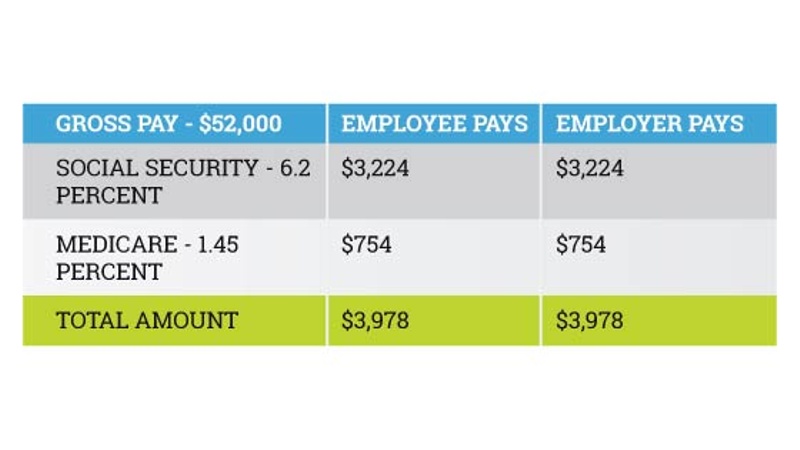
    Instructions on FICA tax calculations are nice, but sometimes it’s best to see an example on how to break down these calculations. Let’s start by assuming you have an employee who makes $52,000 in gross pay a year. Here’s a quick breakdown of the annual payroll tax responsibilities for that employee.

    Annual breakdown of payroll taxes for a small business employee.


    While the numbers above give you an idea of how much both you and your employee will pay in annual payroll taxes, you’ll also need to determine deductions on a per-paycheck basis. Identifying per-paycheck tax deductions will allow you to withhold the right amount from each employee’s paycheck while helping you keep track of what you owe when it’s time to pay the employer portion of payroll taxes. 

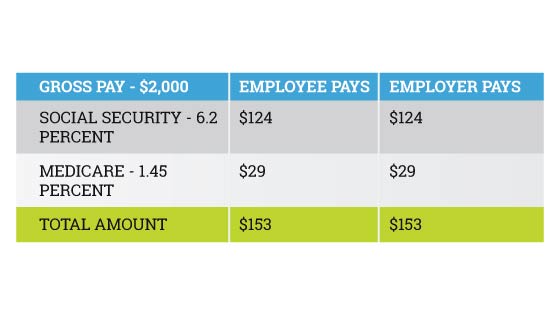
    Determining deductions on a per-paycheck basis depends on your pay frequency. There are multiple pay period options depending on your location – weekly, biweekly, semimonthly, and monthly are all fairly standard. You’ll need to divide an employee’s annual gross pay by the number of pay periods in a year and apply the appropriate FICA tax percentages to that individual paycheck. Here’s a breakdown of that same $52,000 employee on a biweekly pay period.

    Per paycheck breakdown of payroll taxes for a small business employee.


    How to Pay the Employer Portion of Payroll Taxes

    Calculating and withholding FICA taxes is just one part of the process. As an employer, you still need to pay those withheld and matched taxes to the IRS.

    Employers can report and pay FICA taxes through their Electronic Federal Tax Payment System (EFTPS) account. Employers must send regular payroll tax reports to the IRS through Form 941. The due dates for Form 941 are the final day of each quarter (April 30, July 31, Oct. 31, Jan. 31). 

    In terms of depositing payroll taxes, the frequency depends on how much you paid in the past year. Businesses that reported more than $50,000 in federal taxes on average must deposit taxes semiweekly. Businesses that pay on a monthly business owe these taxes by the 15th of the following month.

    New businesses or businesses that reported less than $50,000 on average only have to pay federal taxes on a monthly basis. The due dates for these payments depend on your paydays. If paychecks are due Wednesday through Friday, you need to deposit taxes by the following Wednesday. If payday falls on Saturday through Tuesday, those same taxes are due by the following Friday.


    Take the Pain out of Payroll Management

    Even if you have a grasp on calculating payroll taxes, you still have a lot of work to do. Managing payroll and tax filings can be one of the most time-consuming and challenging tasks there is for a small business owner. That’s why employers turn to GMS for payroll administration.

    When you work with GMS, you get to stop worrying about the ever-changing nature of payroll tax management and start spending time growing your business. Contact GMS today about how we can help you take control of your critical HR functions.