• Payroll forms can put a lot of pressure on business owners. When you’re in charge of a small business, it’s up to you to make sure that these forms are not only completed accurately, but on time as well. If you’re not careful, the penalties can range from $50 per faulty form all the way up to hundreds of thousands of dollars for notable violations.

    One of the biggest struggles of managing payroll forms is simply knowing which forms apply to your business and what they do. We’ve compiled a list of payroll forms that you’ll likely need to know for your small business and how they work.
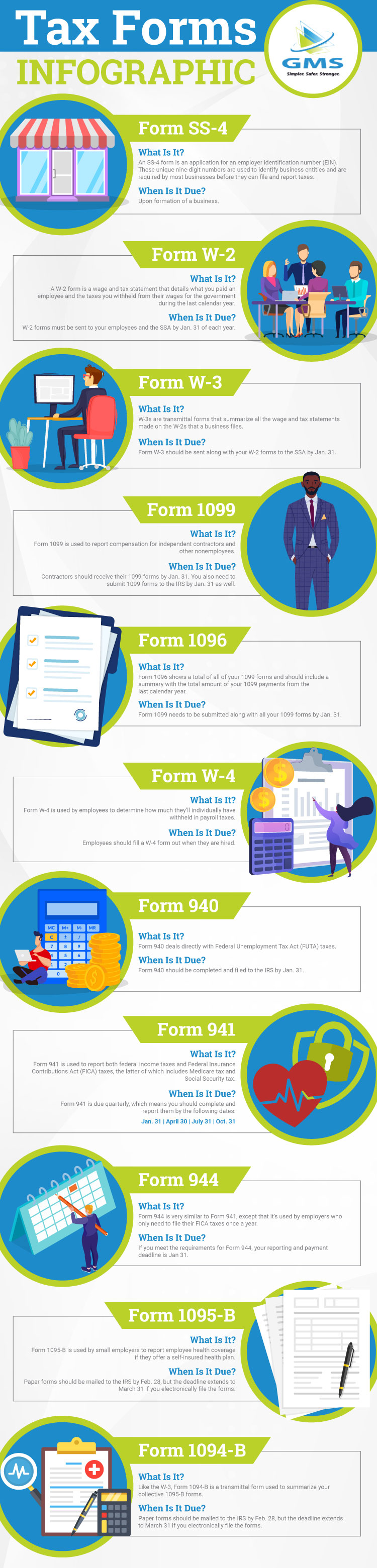
    Form SS-4

    What is it?

    An SS-4 form is an application for an employer identification number (EIN). These unique nine-digit numbers are used to identify business entities and are required by most businesses before they can file and report taxes.

    When is it due?

    Unless you’re just about to start your business and haven’t paid anyone yet, you likely already have an EIN. There are some situations where you may need a new EIN, which the IRS has listed on its site. Aside from those scenarios, you won’t have to worry about refiling form SS-4 once you have your EIN.  

    Form W-2

    What is it?

    A W-2 form is a wage and tax statement that details what you paid an employee and the taxes you withheld from their wages for the government during the last calendar year. W-2s need to be completed for any employee who worked for you in the past year and copies should be sent to the Social Security Administration (SSA) and the employee listed on the W-2. In addition, you should hold onto a copy of each W-2 for at least years.

    When is it due?

    W-2 forms must be sent to your employees and the SSA by Jan. 31 of each year. Most state governments set the deadline at Jan. 31 as well, but make sure to check with your specific state tax agency in case your state’s date differs. 

    You can also request extensions to file forms with the SSA and distribute forms to your employees. For an SSA extension, you’ll need to fill out Form 8809 and submit it to the IRS between Jan. 1 and Jan. 31. The IRS will then either deny your request or grant you a single 30-day extension. 

    As for distribution to employees, you must mail a letter to the IRS to request an extension. The letter must explain why you need an extension, your name, business address, EIN, and signature. If approved, the IRS will grant you either a 15- or a 30-day extension.

    Form W-3

    What is it?

    W-3 forms are closely related to W-2s. Essentially, W-3s are transmittal forms that summarize the all the wage and tax statements made on the W-2s that a business files. In short, if you fill out 10 W-2 forms for your 10 employees, Form W-3 should represent a total of all 10 W-2s.

    When is it due?

    Form W-3 should be sent along with your W-2 forms to the SSA by Jan. 31. However, you don’t need to send W-3s out to your employees.

    Form 1099

    What is it?

    Form 1099 is used to report compensation for independent contractors and other nonemployees. If you pay a contractor more than $600 in a year, you need to report how much you paid them to both the contractor and the IRS so that these wages can be evaluated for tax purposes.

    When is it due?

    Contractors should receive their 1099 forms by Jan. 31. You also need to submit 1099 forms to the IRS by Jan. 31 as well.

    Form 1096

    What is it?

    Remember how the SSA requires a Form W-3 to show a total of all your W-2 forms? Form 1096 has the same relationship with your 1099 forms and should include a summary with the total amount of your 1099 payments from the last calendar year.

    When is it due?

    Form 1099 needs to be submitted along with all your 1099 forms by Jan. 31.

    Form W-4

    What is it?

    Form W-4 is used by employees to determine how much they’ll individually have withheld in payroll taxes. On this form, your employees will note how many withholding allowances apply to them. These allowances will allow you to determine the amount of payroll taxes each employee will have withheld from their paychecks.

    When is it due?

    Form W-4 doesn’t have an annual due date like other payroll forms. Instead, employees should fill a W-4 form out when they are hired. The IRS does recommend that employees submit a new W-4 form each year to account for any financial or personal changes, but it’s not mandatory. In this case, simply continue to withhold taxes based on an employee’s original Form W-4 until he or she provides a new one.

    Form 940

    What is it?

    Form 940 deals directly with Federal Unemployment Tax Act (FUTA) taxes. Your business must pay FUTA taxes if you meet the following requirements:

    • You paid at least $1,500 in wages in any calendar quarter during the past two years
    • You had one or more employees for at least some part of a day in any 20 or more different weeks during the past two years

    FUTA taxes are based on employee wages, but are only paid by the employer and not the employee, so make sure not to withhold FUTA taxes from employee wages. These taxes are paid quarterly and then reported once a year through Form 940.

    When is it due?

    Form 940 should be completed and filed to the IRS by Jan. 31. However, the IRS will extend the filing due date to Feb. 10 if you pay all your FUTA taxes on time.

    Form 941

    What is it?

    Form 941 is used to report both federal income taxes and Federal Insurance Contributions Act (FICA) taxes, the latter of which includes Medicare tax and Social Security tax. If your business’ quarterly tax liability is between less than $2,500, you can also use Form 941 to make tax deposits as well. If your liability is more than $2,500, the IRS requires that you follow a deposit schedule.

    When is it due?

    Form 941 is due quarterly, which means you should complete and report them by the following dates:

    • Jan. 31
    • April 30
    • July 31
    • Oct. 31

    Form 944

    What is it?

    Form 944 is very similar to Form 941, except that it’s used by employers who only need to file their FICA taxes once a year. The IRS grants an exemption for small employers whose annual liability for social security, Medicare, and withheld federal income taxes is $1,000 or less for the year. If your business falls within those limits, you get to file Form 944 instead of Form 941.

    When is it due?

    If you meet the requirements for Form 944, your reporting and payment deadline is Jan 31.

    Form 1095-B

    What is it?

    Form 1095-B is used by small employers to report employee health coverage if they offer a self-insured health plan. With a self-insured plan, employers pay medical bills instead of just a premium, so the IRS requires Form 1095-B to verify that individuals on your plan had minimum essential coverage. If you offer a fully-insured plan, your health insurance provider will fill out and file Form 1095-A for you.

    When is it due?

    A copy of Form 1095-B should be filed for each full-time employee covered by your plan. Individual forms should be mailed to corresponding employees by Jan. 31. The filing deadline for the IRS differs depending on how you send Form 1095-B to them. Paper forms should be mailed to the IRS by Feb. 28, but the deadline extends to March 31 if you electronically file the forms. It’s also important to keep a copy of each employee’s forms.

    Form 1094-B

    What is it?

    Like the W-3, Form 1094-B is a transmittal form used to summarize your collective 1095-B forms. This form is very simple and only requires some basic company information and a total for the number of 1095-B forms you will submit along with Form 1094-B.

    When is it due?

    The deadlines for 1094-B are the same as Form 1095-B. The only difference is that employees do not receive 1094-B.

    Place an Emphasis on Proper Payroll Management

    Payroll forms can be tricky, but they’re just one part of the payroll puzzle. Payroll administration is comprised of many different steps and responsibilities that can have major impacts on your business. To see just how much can go into the payroll process, check out our guide on what it takes to manage payroll for a small business.

    Even when you have a good understanding of each payroll form, the time and effort it takes to complete them and manage your payroll can put a serious dent in your schedule. That’s why many owners turn to GMS to handle payroll administration for their small business. Our experts take an active approach to managing your payroll so that you can spend your time growing your business instead of struggling with forms and tax calculations.

    Want to find out how GMS can save you time and money while strengthening your business’ HR functions? Contact GMS today to talk to one of our experts about your business.
  • Receiving notice of an IRS audit can be stressful for any business owner. While many small businesses will never experience an audit, certain filing errors, reporting inconsistencies, and compliance issues can increase the likelihood of attracting IRS attention.

    The good news is that most audit risks can be reduced through accurate recordkeeping, proper payroll administration, and proactive tax compliance practices.

    Understanding the most common audit triggers can help you identify potential issues before they become costly problems.

    Key Takeaways

    • IRS audits are often triggered by inconsistencies, reporting errors, and documentation issues.
    • Payroll tax mistakes, worker misclassification, and excessive deductions can increase audit risk.
    • Maintaining accurate records is one of the best ways to prepare for potential IRS inquiries.
    • Businesses that consistently review compliance processes are better positioned to avoid costly penalties.
    • Working with experienced HR, payroll, and compliance professionals can help reduce audit-related risks.

    What Causes the IRS To Audit a Small Business?

    Many business owners assume audits happen randomly, but most audits are triggered by specific issues identified through IRS review processes.

    The IRS uses various systems to compare information reported on tax returns with other documentation, including payroll records, W-2s, 1099s, and third-party filings.

    When discrepancies appear, those issues may trigger additional review.

    While no business is completely immune from audits, understanding the most common red flags can help employers reduce unnecessary risk.

    1. Reporting Consistently Large Business Losses

    It’s not unusual for businesses to experience a loss, especially during startup phases or challenging economic periods.

    However, repeatedly reporting substantial losses year after year may attract additional scrutiny.

    The IRS may want to determine whether the business is legitimately operating for profit or functioning as a hobby activity.

    Business owners should ensure they maintain documentation that supports reported expenses, revenue, and operational activities.

    2. Excessive Business Deductions

    Deductions play an important role in reducing taxable income, but unusually large deductions compared to similar businesses or revenue levels may raise questions.

    Common areas that may receive additional scrutiny include:

    • Travel expenses
    • Meals and entertainment
    • Vehicle expenses
    • Home office deductions
    • Marketing expenses
    • Professional services

    The key is maintaining clear records that support every claimed deduction.

    3. Worker Misclassification

    One of the most significant compliance risks for employers involves classifying workers incorrectly.

    Businesses sometimes classify workers as independent contractors when they should be treated as employees.

    Misclassification can affect:

    • Payroll taxes
    • Overtime eligibility
    • Benefits obligations
    • Workers’ compensation coverage
    • Unemployment taxes

    If the IRS determines workers were improperly classified, businesses may face back taxes, penalties, and interest.

    4. Payroll Tax Errors

    Payroll tax compliance remains one of the most common areas where businesses encounter IRS issues.

    Potential red flags include:

    • Late tax deposits
    • Incorrect payroll tax filings
    • Underreported wages
    • Mismatched payroll records
    • Failure to remit payroll taxes

    Because payroll taxes are considered trust fund taxes, IRS enforcement in this area can be particularly aggressive.

    5. Large Cash Transactions

    Businesses that operate primarily in cash often face greater audit risk simply because cash transactions can be more difficult to verify.

    Industries such as restaurants, retail stores, salons, and certain service businesses may receive increased scrutiny when reported income appears inconsistent with expected activity levels.

    Maintaining accurate sales records and documenting all deposits can help reduce concerns.

    6. Significant Changes in Income

    Large fluctuations in income from one year to the next are not automatically problematic.

    However, substantial increases or decreases may prompt additional review if the changes appear unusual based on historical filing patterns.

    Business owners should maintain records that explain major shifts, such as:

    • Rapid growth
    • Economic downturns
    • Acquisitions
    • New service offerings
    • Staffing changes

    7. Math Errors and Reporting Mistakes

    Sometimes the simplest mistakes create the biggest problems.

    Calculation errors, missing forms, incorrect taxpayer identification numbers, and inconsistent reporting can all increase the likelihood of IRS correspondence.

    Reviewing tax documents thoroughly before filing can help reduce preventable issues.

    8. Claiming Excessive Home Office Deductions

    The home office deduction is a legitimate tax benefit for qualifying business owners.

    However, problems arise when businesses claim spaces that do not meet IRS requirements or overstate expenses associated with the deduction.

    To qualify, the space generally must be used regularly and exclusively for business purposes.

    Detailed documentation is essential.

    9. Missing or Incomplete Records

    One of the most common challenges businesses face during audits is producing adequate documentation.

    The IRS may request records including:

    • Payroll reports
    • Tax filings
    • Expense documentation
    • Bank statements
    • Employee records
    • Vendor invoices
    • Contracts and agreements

    Businesses that maintain organized records are typically able to respond more efficiently to audit inquiries.

    Why Payroll and HR Compliance Matter During an Audit

    Many employers think audits focus exclusively on income taxes.

    In reality, payroll and workforce-related issues can create significant compliance challenges.

    Problems involving:

    • Employee classification
    • Wage reporting
    • Payroll tax deposits
    • Employee reimbursements
    • Benefits administration

    can all contribute to audit findings and financial penalties.

    As businesses grow, these responsibilities often become increasingly complex.

    How Can Small Businesses Reduce IRS Audit Risk?

    While audits can’t be prevented entirely, businesses can take steps to reduce potential red flags.

    Maintain Accurate Records

    Keep detailed documentation for income, expenses, payroll, benefits, and tax filings.

    Review Worker Classifications

    Periodically evaluate whether employees and independent contractors are classified correctly.

    Monitor Payroll Tax Compliance

    Ensure payroll taxes are calculated, reported, and deposited properly.

    Conduct Internal Compliance Reviews

    Regular reviews can help identify potential issues before government agencies do.

    Work With Trusted Advisors

    Experienced payroll, HR, tax, and compliance professionals can help businesses navigate changing regulations and avoid common mistakes.

    Preparing Your Business Before Problems Arise

    Most audit risks don’t stem from a single major mistake.

    More often, they result from a series of small errors, missing records, or overlooked compliance requirements that accumulate over time.

    The strongest defense against an audit issue is maintaining accurate records, implementing reliable processes, and addressing potential concerns before they escalate.

    Businesses that proactively manage payroll, HR, tax reporting, and compliance obligations are often better positioned to handle IRS inquiries and reduce the likelihood of costly penalties.

    A Professional Employer Organization (PEO) can help businesses strengthen compliance efforts through payroll administration, HR support, risk management guidance, employee recordkeeping assistance, and workforce management expertise.

    Want to simplify payroll, HR, and compliance responsibilities? Contact GMS to learn how we can help protect your business and reduce administrative risk.

    Frequently Asked Questions

    How common are IRS audits for small businesses?

    Most small businesses are not audited each year, but certain filing patterns and compliance issues may increase the likelihood of additional IRS review.

    Can payroll mistakes trigger an audit?

    Payroll tax errors, underreported wages, missed deposits, and worker classification issues can all increase audit risk and may result in penalties if not addressed.

    How long should small businesses keep tax records?

    Record retention requirements can vary depending on the situation and applicable regulations. Business owners should consult tax professionals regarding documentation retention policies relevant to their organization.

    Can a PEO help reduce compliance risk?

    A PEO can assist with payroll administration, tax reporting, HR compliance, employee documentation, and workforce management processes that help businesses reduce administrative and compliance challenges.

  • On Aug. 8, 2020, President Trump signed an executive order to allow employees to defer a portion of payroll taxes until 2021. Since news of the order broke, business owners have sought additional clarity on how this payroll tax will work and how it will impact their responsibilities as employers. Let’s break down some of the specifics of the proposed pay tax deferral and what those details mean for small business owners.

    A paycheck with tax deductions affected by the payroll tax deferral executive order.

    What Does the New Payroll Tax Deferral Change?

    In short, the executive order allows employees who make less than $4,000 every two weeks (equivalent to less than $104,000 per year) to defer part of their payroll tax payment until 2021. According to the order, employees would have the choice to opt-in for this tax deferral. If an employee elects to defer payments, the employer must honor this decision.

    Payroll taxes are defined as the FICA taxes taken out of each paycheck to fund Social Security and Medicare programs. The executive memo signed by Trump only refers to the Social Security portion of these taxes, which makes up 6.2 percent of each paycheck. As such, an employee can defer up to $2,232 depending on that person’s salary.

    While both employees and employers pay these payroll taxes, the payroll tax deferral only impacts what the employee owes in taxes. Typically, both employers and employees contribute 6.2 percent of an employee’s wages in Social Security tax. Employers would still have to pay their share of these taxes even if the employee opts to defer their portion until 2021.

    When Will This Deferral be in Effect?

    According to the executive memo, employees can defer their payment of Social Security taxes starting Sept. 1, 2020. The deferral period continues through Dec. 31, 2020, giving employees a four-month window to push back their share of Social Security tax.

    Will These Deferrals be Forgiven?

    As of yet, it appears that employees who defer their Social Security taxes will still need to pay back the deferred amount in 2021. While the President signed the executive order to defer these taxes, it’s important to note that he can only delay the payment dates.

    Only Congress has the ability to reduce taxes, meaning that the executive order in question is simply a means to push back payment of these taxes without action from Congress. As such, employees who opt to defer these taxes should prepare to owe upwards of $2,232 in 2021.

    How Does This Deferral Impact Employers?

    While the payroll tax deferral only applies to employees’ share of Social Security taxes, the deferral will still have a direct impact on employers. According to the order, employers must honor employee requests to defer their taxes and update their payroll process to accommodate these deferrals.

    In addition to payroll system changes, there may be additional complications for employers. Employers are legally responsible for withholding payroll taxes, including an employee’s share of Social Security tax. It’s currently uncertain whether deferring these taxes would complicate IRS requirements. As of Aug. 27, 2020, the IRS and U.S. Treasury Department still have not offered guidance regarding the executive order, effectively leaving business owners in a bind.

    In addition, it’s also unclear if employers could ultimately be liable to pay back deferred taxes in 2021 in certain situations. The uncertainties surrounding the executive order is a notable concern and will require clarification from the IRS and other government bodies to allow employers to fully understand how the payroll tax deferral will impact them.

    How Can Small Business Owners Prepare for the Payroll Tax Deferral?

    To start, you’ll want to educate your employees about the current terms of the payroll tax deferral. The decision of whether or not to opt out is up to them, but make sure that they know that whatever taxes they defer will still need to be repaid in 2021 barring Congressional action.

    You’ll also want to pay close attention to any new information from the IRS or other appropriate agencies that will help clarify employers’ responsibilities. It’s difficult to navigate these types of changes, but new details will help you and your employees understand exactly where they stand with the deferral.

    While traversing these types of orders and legislative changes are tricky, you don’t have to face these questions alone. GMS can help you stay up to date with complicated payroll tax laws and other critical HR responsibilities. Contact GMS today to find out how a PEO can make your business simpler, safer, and stronger.

  • When you own a small business, you have several responsibilities that you need to oversee throughout the year. Payroll tax management is one of the more notable obligations that are on your plate. Unfortunately, it’s not necessarily obvious how to estimate payroll taxes for a small business.

    While it’s not the most enjoyable job, it’s critical that you calculate payroll taxes correctly. Every employer must withhold payroll taxes from each paycheck, so proper handling of these deductions is important to both your employees and the government. This responsibility is a lot of pressure for a small business owner who isn’t familiar with how to withhold payroll taxes. That’s why we’ve put together a breakdown of how to calculate payroll taxes for your small business.

    A small business owner learning how to calculate payroll taxes.

    What Payroll Taxes Do Employers Pay?

    Payroll taxes are one part of what the IRS considers as employment taxes. The term “employment taxes” actually refers to a variety of taxes that are directly connected to your employees. These taxes include:

    • Federal and state income taxes
    • Federal Insurance Contribution Act (FICA) taxes
    • Federal Unemployment Tax Act (FUTA) taxes
    • Additional Medicare tax
    • Self-employment tax

    While some people confuse payroll taxes with income tax, the term “payroll taxes” specifically refers to FICA taxes. These FICA taxes are made up of a combination of Social Security and Medicare taxes, both of which are deducted from employee paychecks to fund their respective programs. Altogether, FICA taxes account for a total flat rate of 7.65 percent that’s split between Social Security and Medicare.

    These taxes are deducted from employee paychecks, but employees aren’t the only people who contribute these percentages to Social Security and Medicare. Both employees and employers are responsible for paying them, and the employer payroll tax percentage is the same as what employees owe. As such, your business needs to match the flat percentage deducted from each paycheck.


    How to Calculate FICA Taxes

    The bad news about calculating payroll taxes is that you’re going to have to do some math. The good news is that the math for calculating FICA taxes is much easier than estimating federal income taxes. 

    The reason why FICA taxes are much more manageable to calculate is that they’re flat percentages. As of 2021, the combined FICA tax rate is 7.65 percent of an employee’s gross pay. That rate is split into the following percentages:

    • Social Security tax – 6.2 percent
    • Medicare tax – 1.45 percent

    Of course, payroll deductions aren’t always that easy. There are a couple of exceptions to the base rates that can affect your calculations for both Social Security and Medicare taxes if an employee makes more than a certain wage threshold.


    Calculating Social Security taxes

    In general, calculating Social Security taxes is straightforward – just multiply an employee’s gross pay by 6.2 percent. The resulting number should be deducted from an employee’s paychecks and matched by the employer. However, there is an annual limit to how much employees and employers contribute to Social Security taxes. 

    Every year, the Social Security Administration sets a wage base for Social Security taxes. Essentially, employers and employees only have to pay these taxes up to a certain dollar amount. The taxable maximum is set at $142,800 for 2021, which means that Social Security taxes only count toward the first $142,800 an employee makes in a year. For example, an employee who makes $150,000 wouldn’t pay Social Security taxes on the final $7,200 in gross pay.


    Additional Medicare tax

    As with Social Security taxes, there are certain wage thresholds that will impact your exact calculations. Unlike Social Security, these thresholds can mean that individuals pay more in Medicare taxes. 

    There are no annual Medicare tax limits. Instead, employees who earn more than certain amounts have to pay an additional Medicare tax rate of 0.9 percent. Those wage thresholds are: 

    • $200,000 for employees who are single
    • $250,000 for a married employee who files jointly
    • $125,000 for employees who are married, but file separately

    It’s important to note that the additional Medicare tax only applies to wages earned above the set thresholds. For example, an employee who is single and earns $250,000 would owe 1.45 percent on the first $200,000 and a combined 2.35 percent on the subsequent $50,000.

    Another key detail is that employers are not required to match any additional 0.9 percent contributions. Instead, they would only contribute the standard 1.45 percent. However, employers should still withhold the additional 0.9 percent Medicare tax from employee paychecks. Employees should also file Form 8959 if they meet the requirements for additional Medicare tax.


    Payroll Tax Deductions Examples

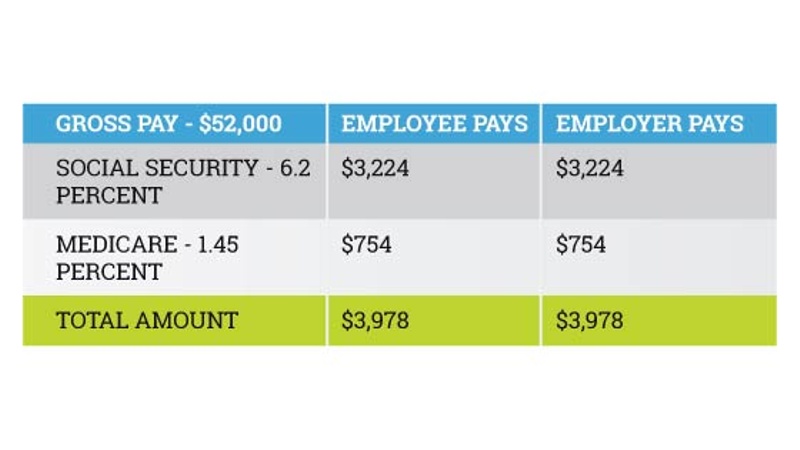
    Instructions on FICA tax calculations are nice, but sometimes it’s best to see an example on how to break down these calculations. Let’s start by assuming you have an employee who makes $52,000 in gross pay a year. Here’s a quick breakdown of the annual payroll tax responsibilities for that employee.

    Annual breakdown of payroll taxes for a small business employee.


    While the numbers above give you an idea of how much both you and your employee will pay in annual payroll taxes, you’ll also need to determine deductions on a per-paycheck basis. Identifying per-paycheck tax deductions will allow you to withhold the right amount from each employee’s paycheck while helping you keep track of what you owe when it’s time to pay the employer portion of payroll taxes. 

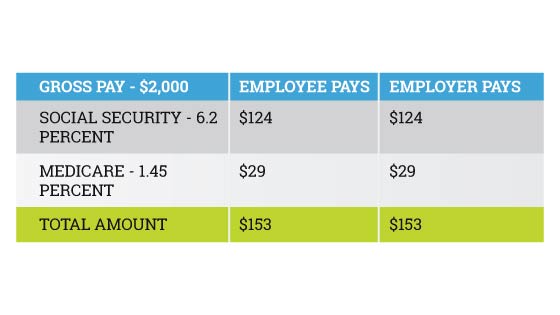
    Determining deductions on a per-paycheck basis depends on your pay frequency. There are multiple pay period options depending on your location – weekly, biweekly, semimonthly, and monthly are all fairly standard. You’ll need to divide an employee’s annual gross pay by the number of pay periods in a year and apply the appropriate FICA tax percentages to that individual paycheck. Here’s a breakdown of that same $52,000 employee on a biweekly pay period.

    Per paycheck breakdown of payroll taxes for a small business employee.


    How to Pay the Employer Portion of Payroll Taxes

    Calculating and withholding FICA taxes is just one part of the process. As an employer, you still need to pay those withheld and matched taxes to the IRS.

    Employers can report and pay FICA taxes through their Electronic Federal Tax Payment System (EFTPS) account. Employers must send regular payroll tax reports to the IRS through Form 941. The due dates for Form 941 are the final day of each quarter (April 30, July 31, Oct. 31, Jan. 31). 

    In terms of depositing payroll taxes, the frequency depends on how much you paid in the past year. Businesses that reported more than $50,000 in federal taxes on average must deposit taxes semiweekly. Businesses that pay on a monthly business owe these taxes by the 15th of the following month.

    New businesses or businesses that reported less than $50,000 on average only have to pay federal taxes on a monthly basis. The due dates for these payments depend on your paydays. If paychecks are due Wednesday through Friday, you need to deposit taxes by the following Wednesday. If payday falls on Saturday through Tuesday, those same taxes are due by the following Friday.


    Take the Pain out of Payroll Management

    Even if you have a grasp on calculating payroll taxes, you still have a lot of work to do. Managing payroll and tax filings can be one of the most time-consuming and challenging tasks there is for a small business owner. That’s why employers turn to GMS for payroll administration.

    When you work with GMS, you get to stop worrying about the ever-changing nature of payroll tax management and start spending time growing your business. Contact GMS today about how we can help you take control of your critical HR functions.