2025 W-2 Forms are now available in your GMS Connect employee portal here.

  • With the soaring costs of healthcare in the U.S., many citizens feel they are left with little to no alternatives when it comes to significant surgeries and procedures. This has helped propel many to look into the latest trend of “medical tourism” in an effort to get the operations they need without breaking the bank.

    Citizens may be uneasy about the idea of receiving care outside of the United States, but there are some great facilities and specialists in other countries where the same level of treatment—or even better in some cases—can be received at a fraction of the price. That was the case for GMS employee Christine Mace when her husband Dan required hip surgery back in 2016.

    Health City Cayman Islands, a medical tourism destination.

    Finding Affordable Treatment Through a Medical Concierge

    Dan had been dealing with the pain for years and was willing to take any action necessary to resolve the issue.

    He had seen several doctors in the states, who eventually advised he would be required to have hip surgery to fix the issue. During a consultation with a specialist from Akron, Dan inquired when the doctor thought he’d need surgery on his other hip. The doctor’s reply was “in a couple years.”

    Chris Mace’s accounting background kicked in. She started researching the astronomical costs for a hip surgery in the U.S. and worried this would have a significant negative impact on the health insurance rates of her co-workers. She began researching alternatives to alleviate Dan’s pain. One day, Dan found an article in Parade Magazine about the idea of “medical tourism.” 

    Chris set up a meeting with GMS’ VP of Benefits, Beth Kohmann, to discuss other possibilities. The two contacted Akeso, a company who has a division specifically dedicated to assist in this process as a “Medical Concierge.” 

    Experts from Akeso discussed the problems Dan was having and began to do their research. They found that the Cayman Islands had a facility, Health City Hospitals, with some of best orthopedic and cardiac surgeons in the world. 

    Before he could even have his initial consult, Dan would first need to proceed with a full physical as well as a dental evaluation. This was a requirement of the Cayman facility so there would be no risk of bringing in a patient with existing infections that could detrimentally affect any other patients receiving treatment at their facility. The hospital boasts a 100 percent infection-free reputation. In that time, it was discovered that Dan had a Periodontal disease, and the pre-certification process helped assure the issue could be resolved without any severe affects to his dental health, an added bonus in the process. 

    Once they passed all the requirements, a meeting was set up with Dan, Chris, Beth Kohmann, and the potential surgeon from the Cayman hospital, Dr. Alwin Almeda. 

    Dan arrived shortly after their set time, and painfully walked to his seat at the table. The doctor focused on his gait and the clear pain shown on his face. By the time Dan was able to sit down, the doctor apologized and told Dan he would need to have him walk paces in front of the camera once again. 

    Between the evaluation of his gait, as well as the X-rays obtained here in the states, Dr. Almeda was able to identify the issue. He asked if Dan had ever been able to cross his legs or sit cross legged on the floor. Dan replied that he had never been able to do so, not even as a child. Dan was stunned because no one had ever asked him that before. Dr. Almeda identified the issue as Femoroacetabular Impingement (FAI). Dan then asked the doctor when he thought the other hip would need surgery, to which the doctor replied, “NEVER!” The impingement was only in the right hip, and the left hip showed no signs of needing repair. (Note – this doctor was using the same scans taken as the Akron doctor.)

    When asked about his pain level on a standard 1-10 scale, Dan replied that his pain was at a 12. Dr. Almeda then informed Dan that he was a candidate because his level of pain matched what the doctor saw on the scan. The doctor then asked Dan why it had taken him so long to seek medical treatment to resolve his discomfort. Dan’s reply was “Fear and cost.” The doctor then replied that money should never be the reason someone is robbed of the finest quality of life they deserve. Dan knew this was the guy to resolve his issue. Dr. Almeda agreed that since Dan was cleared of all possible infections, he qualified as a patient at the facility.

    Traveling Outside the U.S. for Medical Treatment

    The Akeso rep listed off dates for Dan and Chris to travel to the Cayman Islands. They quickly set up plans to travel down a couple weeks later on Feb. 4 with the surgery on that following Saturday, Feb. 6.

    Akeso set up first-class airfare for the trip down. Once Dan and Chris arrived, they had a rental car already set up. Chris quickly realized when they got to the rental that cars travel on the opposite side of the road, which led to a friendly police escort the rest of the way to the hospital. 

    Health City Cayman Islands was born from the vision of Dr. Devi Shetty, a renowned heart surgeon who was Mother Teresa’s personal physician, and supported by Narayana Health Group of Hospitals. This brain trust founded Health City Cayman Islands as part of an effort to bring low-cost, high-quality medicine and care to the Cayman Islands and nearby outposts in Central and South America.  

    According to the Maces, the hospital was comprised of staff mostly from India. At home, they would not have the same financial opportunity that Health City provided. On top of fair compensation, employees have their housing and food paid for, and the organization even pays for them to travel back to their home country for one month each year. 

    “You could tell how much they genuinely cared about their patients and improving their quality of life,”  Chris said.

    A hospital and rehabilitaiton center in the Cayman Islands that was suggested by Akeso’s medical concierge division.

    The Medical Tourism Experience

    The staff walked them through the process and advised they would need to return for tests Friday and the surgery would be all set for Saturday. Dan was admitted into the hospital that Friday evening. The Maces were not prepared for what they saw when they entered his private hospital room. The room was approximately 30-by-30 feet with a beautiful garden view, huge private bathroom, living area, and desk. They explained that Dan would actually have his first therapy sessions right there in his room. Chris set up her office in the room and was able to work remotely while Dan was in surgery. All they had to do now was wait for the big day. 

    Their exemplary experience continued. The doctor paged Chris after the surgery was completed to tell her everything went as planned, and it was a success. After cutting into the hip, Dr. Almeda advised that the ball in the hip broke into three pieces because of the severity of the deterioration. It was also found, during testing, that Dan’s legs were not the same length. Dr. Almeda explained that since the surgery went so smoothly and he was already “in there,” he used bone putty to build up the pelvic bone, prior to installing the new prosthetic hip. The doctor felt that making both legs the same length would help Dan’s back, knee, and ankle pain. Dan was thrilled to find out he was an inch taller after the surgery! There was no additional cost for that part of the surgery. 

    Dr. Almeda accompanied Chris and Dan into recovery and stayed with them for three hours, discussing the entire process, viewing scans, and helping Dan stand that very same day. He helped alleviate any concerns they had moving forward. 

    Health City Cayman Islands kept Dan in the hospital until the following Thursday. After being discharged from the hospital, Chris and Dan went to the private residence to continue the recovery process. Chris went into the bedroom to do some organizing, leaving Dan watching TV. While in the bedroom, she suddenly heard Dan saying something directly behind her. She turned and realized he was up and walking without his walker. He was already so comfortable, that he didn’t even realize what he was doing. 

    They went back and forth to the hospital for PT for the remainder of their trip. Chris was treated to first-class dining at the hospital, which held a satellite kitchen from a four-star restaurant on the other side of the island. 

    When all was said and done, the whole experience came to a total of around $11,000 as compared to about $86,000 for just the hip surgery itself in the U.S. That cost included their first-class air fare to and from the island, a rental car, gas reimbursement, a $100-a-day food stipend, private residence on the beach, the hospital stay and surgery, and the PT that was required thereafter. A $3,600 refund towards deductible was also included in the deal. 

    Consider Alternative Health Options with the Medical Concierge Industry

    The idea of undergoing a life-changing surgery is overwhelming on its own. Then there are the consultations, scheduling, financial concerns, health insurance review, recovery, physical therapy, and so on. It is clear why people like Chris and Dan Mace have become advocates of Akeso, Health City Cayman Islands, and the medical concierge industry as a whole.

    Your employees are your most important asset. By partnering with a PEO like GMS, you can get insight into these types of programs through the experts of our Benefits Department to make sure your people get the care they need at the price they deserve. We can help lay out all your options to keep your group well informed and healthy, while helping save you time and money in other areas from Payroll to Human Resources and Risk Management. Contact GMS today to talk to our experts about how we can help your business.
  • As we brace ourselves for undeniable regulatory changes within the healthcare industry, often we neglect conversation about the shortcomings of our current system to ensure we don’t repeat the same mistakes. Although many would agree that the intentions of the ACA (“Expand access to health insurance, protect patients against arbitrary actions by insurance companies, and reduce costs”) were created with social good in mind, experts are strident that the mechanisms used to create this social good have failed to correct the economic epidemic that currently infects our healthcare system. 

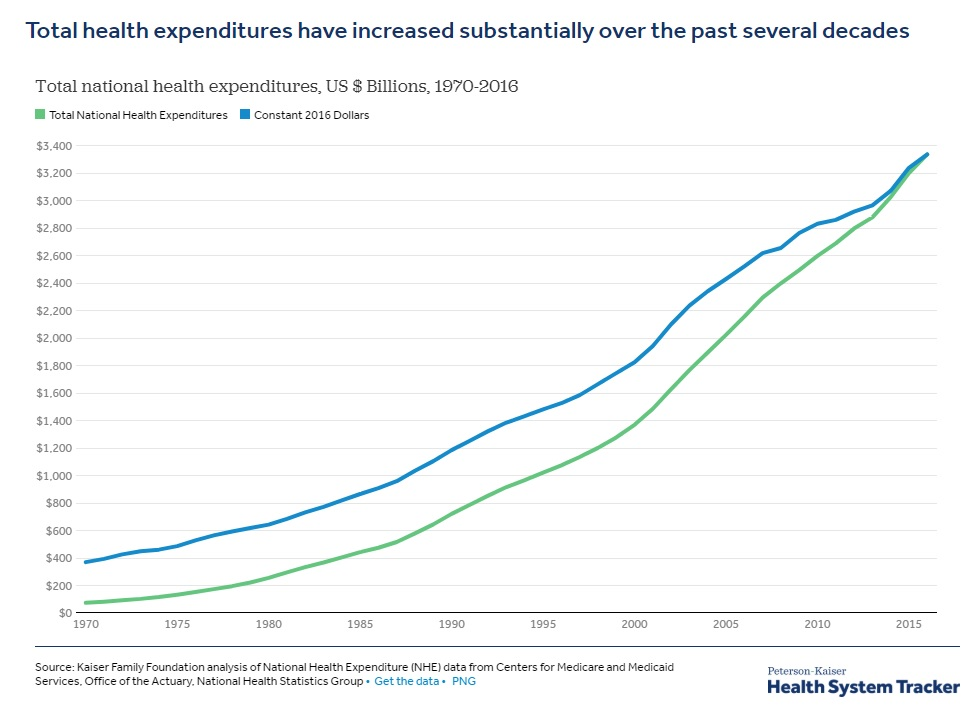
    If you think “economic epidemic” is a hyperbolic term to use in this context, think again. As referenced in my previous blog post about the continuing battle to repeal the ACA, the U.S. domestic healthcare system costs around $3.3 trillion to the American economy each year. What’s less known is that this figure is projected to continue rising as it has almost every year since the 1960s. 

    Chart of how total health expenditures have increased over time. 

    Some are projecting the U.S. to hit bankruptcy as early as the year 2035 if this trend continues to grow as exponentially as it has the past few decades. With baby boomers entering their elder years and both millennials and generation X set to surpass the population totals of the boomers by 2028 (Millennials in ’19 and Gen X in ’28), we can expect the requirements of our nation’s healthcare program to rise as well. Now is the time for change. As I alluded to earlier in this piece, we need to be cognizant of our past mistakes to ensure they aren’t repeated down the road with financially dire consequences. 

    The MLR Rule: Medical-Loss Ratio

    The MLR rule is a lesser known mandate to the public that was included in ACA implementation. Some will argue that it had positive intentions in how our insurers spend premium dollars, which isn’t incorrect in theory, but it has a troubling method in which it determines how the rule is executed. 

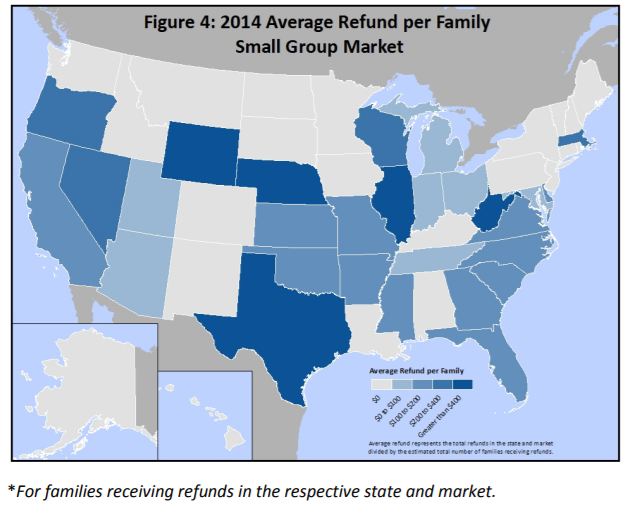
    In short, the MLR rule for small employers dictates that insurers must spend 80% of every premium dollar (it’s 85% for large employers) toward actual medical expenses, claims, and quality improvement. This percentage does not include items such as advertising, administrative costs, and profit to which the remaining 20-15% of premiums are spent. There are provisions in place that when insurers fail to satisfy at least an 80% loss ratio they must issue rebates back to consumers. These rebates totaled $469 million dollars in 2014, with 29.86% of those rebates attributed to the small group (under 500 employees) market. 

    Map of the average refund per family in the small group market. 

    Image via the Centers for Medicare & Medicaid Services

    Many insurers will build in features such as risk assessments, screenings, and coaching hotlines to ensure their “medical expenses” reach the MLR threshold regardless of whether their consumers are likely to use those enhancements or not. 

    The failings of this rule are relatively simple to point out in economic terms: if an insurer’s profits are dictated by a fixed percentage of product costs—in this case we’re speaking of “cost” as medical premiums—the business/insurer has every incentive to see the overall cost of its product rise, thus increasing profit margins. 

    As we diagnose some of the issues included in the ACA and what to avoid in future reform policies, I think this percentage based MLR rule must be exiled. Our economy can’t afford to maintain the rate of rising healthcare costs with large insurers incentivized to maintain a similar mantra. I think we can achieve a healthy balance between the two, but improved consumer-centric policies must serve as the catalyst.

    Current Solutions for Businesses: Self-Funding 

    Although the tone of this article may seem slightly cynical, I promise it’s not meant to be. However, I do think it’s necessary to be transparent of the flaws within our current system. There are alternative options for businesses looking to get ahead of the upcoming reform trend before it hits home in the coming years.

    One solution is self-funding, which was included in the ACA as an alternative funding source outside of fully funded group insurance and is immune to the MLR rule. The immunity to MLR and other provisions within the ACA allow self-funded groups to control healthcare spending by accessing live claims data, become risk rated, and earn back unused premium at the end of their policy year. Since most self-funded groups aren’t managed by a large carrier, but rather the business itself or a reinsurer with similar interests as the group, premium costs are more easily maintained to fit an appropriate fiscal trend without the controversial incentives found nestled within the ACA. 

    With GMS specializing in level-funding, a form of self-funding, we feel that the transparency of our healthcare consultants and creative product solutions align us with the goals of many employers. Continue to follow GMS benefit related blog posts to stay on top of current healthcare advances and reach out to your local office to learn more about the healthcare solutions we can create together.

  • A handful of GMS employees were honored to sponsor and participate in the 3rd Annual Rezod Construction Golf Outing, raising funds for Constructions Angels. It was heartbreaking to hear some stories from Construction Angels, but there was a sense of comfort in knowing an organization exists to help families on the back end of a work-site fatality and that there are ways that businesses can reduce workplace risks.

    Constructions workers working in a safe worksite of a businesses investing in risk management services.

    The Construction Angels Plan

    There are 14 fatalities each day in the United States in the construction industry. Construction Angels is a national non-profit organization created to facilitate access to financial services for immediate surviving family members of a construction worker who has lost his or her life while working on a job site. Founder Kristi Ronyak came from a family that was involved in the construction world and found herself in the same industry, but in a different capacity. Construction Angels is currently present in Florida (where it was established), Georgia, Ohio, and Michigan, but it continues to grow nationally. 

    REZOD’s Involvement

    When Rezod President Rich Mason found out about Construction Angels, he wanted to support the cause and help extend its presence in the state. Mason, and several employees at Rezod, have seen worksite claims and worked closely with GMS on risk management. Through the use of safety programs and risk specialists at GMS, Rezod has successfully worked to minimize exposure on each and every job and make safety part of the company’s culture. 

    GMS and the Construction Industry

    Currently, GMS has around 1,300 clients. Of those clients, 23 percent are in the construction industry. According to OSHA, there were 5,190 fatalities on the job in 2016, 991 or 21.1 percent of which were in construction. These stats show how significant it is to make safety a top priority. Construction Angels has done great work to aid these families after these tragic events, but we all have the same goal in working to address these safety issues on the forefront to minimize the risk of these events ever taking place. 

    What You Can Do to Manage Risk

    By working with GMS’ safety department, along with our HR and risk management specialists, companies can minimize exposure in the workplace and protect their most valuable assets. You can never predict the future, so it’s vital to ensure that your risk is under control each and every day. Contact GMS to see how we can help make your business simpler, safer and stronger.

  • Health insurance comes with many responsibilities for small business owners. Regardless of whether you’re trying to cut health insurance costs or reward specific employees, you may wonder exactly how those responsibilities affect who you offer health insurance coverage. Can you pick and choose who can be a part of your health plan, or are there federal regulations involved? As you may expect, there are some rules you need to follow.

    Employees at a company that offers group health insurance coverage.

    Do I Have to Offer Health Insurance to Everyone?

    If you’re a small business owner, the answer depends on if you decide to offer health insurance to your employees. Businesses with fewer than 50 full-time employees aren’t required to offer health coverage, although many do because good health insurance is an attractive benefit for employees. Once you decide to offer health coverage, you must offer it to all full-time equivalent employees. As we noted in our post on small business health insurance requirements, full-time equivalent employees include those who meet “an average of 30 hours of service per week for a calendar month or at least 130 hours of service in a month.”

    It’s important to note that this means that you aren’t required to offer health coverage to part-time employees. You can choose to include part-time workers in your plan, but the setup is the same as it is with the full-time employees; if you offer coverage to one part-time worker, you will be required to offer it to all part-time workers.


    Benefits PDF


    Do I Have to Offer the Same Health Insurance to Everyone?

    While you can’t pick and choose which individual employees get health insurance and which don’t, you don’t necessarily have to offer all your workers the same level of health insurance. As an employer, you can offer varying levels of benefits based on employee-based classifications. These distinctions include:

    • Full-time vs. part-time (if part-time is even offered health coverage)
    • Different geographic locations
    • Date of hire or length or service
    • Job titles

    While you may be able to justify different levels of benefits through employee classifications, it can’t be for discriminatory reasons. It’s illegal to base decisions on benefits or other employment privileges on any factors protected by law. These include:

    • Race
    • Color
    • Sex
    • Religion
    • Health factors
    • National origin
    • Age
    • Disability
    • Genetic information

    Offer Group Health Insurance Coverage Through a PEO

    One of the reasons that small business owners are hesitant to invest in health insurance is that it can be expensive. Fortunately, a PEO can offer you a more cost-effective solution that can help attract and retain top talent. 

    Since Group Management Services represents multiple small businesses, we can leverage our buying power to get lower premiums on quality plans. Not only can we help you offer an attractive health insurance plan to your employees, we can also assist you with benefits management so that you get the most bang for your buck while helping you stay compliant. Contact GMS today to talk to one of our experts about how outsourcing payroll administration can benefit your business.

  • Even if you only follow on the fringes of healthcare reform, the inception of the ACA in 2010 may have shed light on the lack of bipartisan effort surrounding reform policies. Regardless of which side of the political spectrum you sit, the ACA (Patient Protection and Affordable Care Act) is widely regarded as the most impactful healthcare policy since the rollout of Medicare & Medicaid by President Lyndon B. Johnson in 1965. Irrespective of the clout this policy holds in the eyes of leaders within our domestic healthcare system, it has not operated within its short eight-year tenure without controversy.  

    The debate surrounding the longevity of this policy continued last Thursday (June 7, 2018) in unprecedented manner as the Justice Department filed a briefing recommending that the U.S. District Court of Texas (Fort Worth Division) rule the insurance reform provisions of the ACA unconstitutional.

    Book of recent updates in healthcare reform.

    How We Got Here

    To understand the severity of the proposed lawsuit, we must briefly glance at NFIB v. Sebelius, a previous legal decision surrounding the ACA which cleared a path for the above briefing to be filed.

    In 2012, a group of 13 states, a pair of individual plaintiffs, and the National Federation of Independent Businesses filed a motion (in the District court of Northern Florida) that the ACA was unconstitutional. According to Supreme Court multimedia archive Oyez, “The plaintiffs argued that: (1) the individual mandate exceeded Congress’ enumerated powers under the Commerce Clause; (2) the Medicaid expansions were unconstitutionally coercive; and (3) the employer mandate impermissibly interfered with state sovereignty.“ The conclusion of the suit resulted in the Supreme Court backing the ACA under the precedence that the individual mandate “is an appropriate use of Congress’ power under the taxing Clause and is, therefore, constitutional” according to a case brief for NFIB v. Sebelius.

    The important take away from this dispute is that the ACA was backed by Congress under the idea that the individual mandate was a tax and that it was “severable” from other provisions included in the ACA. This means that the judgement of one mandate within the ACA can be siloed and will not affect the policy as a whole. 

    The Filing at a Glance

    On Dec. 22, 2017, the individual mandate was repealed as a part of the Tax Cuts and Jobs Act of 2017 written in by President Trump and his administration. In ordinance with the repeal, many right-wing-leaning states have proposed the idea that an individual mandate (as of today, the requirement to have qualifying medical insurance still exists) without a penalty to do so (previously written in as a tax) is unconstitutional. The process of proving unconstitutionality within the ACA is based on “inseverability.” In short, if one mandate within the ACA is unconstitutional, the entire ACA is then unconstitutional and should be eradicated. 

    Now as defined above, the unique nature of this case is that the Department of Justice not only supports this idea but is urging the District Supreme Court to render the ACA invalid without reference to the previously approved filing of severability in 2012. The inconsistencies in the law from 2012 to current are unnerving to many analysts following this case. The provisions have been approved by Congress and signed into federal law and are not meant to be easily challenged or rehashed within a legal setting with such overarching consequences. In 2016, the domestic healthcare system within the U.S. reached $3.3 trillion dollars annually and accounted for 17.9 percent of the Gross Domestic Product. The security of such would be woefully undefined if the ACA (and mandates within it) were to be diminished without proper recourse or without a proper replacement. 

    Impacts of a Successful Repeal 

    The major concerns surrounding the impending decision are ones that largely propelled the positive social opinion of the ACA. Namely, the pre-existing conditions clause that prevented individuals with chronic illnesses from being denied coverage through ACA exchanges. The current “community rating” system of the ACA is also at risk if this motion goes without congressional defense.

    With or without the most polarizing and divisive reform policy of the last five decades, the future of our domestic healthcare system is cloudy at best. Only informed citizens having insightful conversations will spur positive change. If until now you’ve been asleep at the wheel regarding healthcare reform, this briefing should serve as a wake-up call.

    Small business owners are especially vulnerable to the ongoing healthcare uncertainty. It’s difficult to keep up with the ACA and other key policies that can affect your business. At Group Management Services, we provide owners with access to quality health insurance coverage at reasonable rates and keep them informed about changes in policies that can impact their business. Contact GMS today to talk to one of our experts about how we can help your business through these uncertain times.

  • Who doesn’t love payday? For many employees, payday makes them feel better than Christmas. As a small business owner, you have the freedom to decide how to handle payroll at your organization. Talk about a huge responsibility. It’s important to get it right, as payroll done wrong can cost a small business owner time and money. 

    There are a few different methods for distributing employee pay, but savvy business owners find that electronic payroll methods like direct deposit and payroll cards streamline the process and keep employees satisfied. We explored the different types of payment methods to help you determine the best payroll solution for your business.

     Small business owner determining employee pay.

    Direct Deposit

    Direct deposit lets you put your employees’ wages directly into their checking or savings account. Because everything is handled digitally, employees don’t need to be present to receive their pay. The convenience of direct deposit for both employers and employees has made it the most common payment method in the U.S., with 82 percent of employees receiving their pay this way, according to a survey by the National Automated Clearing House Association (NACHA)

    Direct deposit can help save time since you don’t have to fill out and distribute checks each pay period. Online payroll software can further help streamline this process and save money. With software, payroll simply needs to be reviewed before submitting it to be deposited in your employees’ bank accounts. Without software, small business owners are responsible for paying fees for setup and for every transaction.

    For direct deposit, you’ll need to gather your employees’ banking information at the time of hire. Of course, it only works if employees have bank accounts. According to the Federal Deposit Insurance Corporation (FDIC), nearly 20 percent of American households are “underbanked,” meaning they either don’t have or actively use a bank account. If you choose direct deposit as your primary payment method, you’ll need to provide an alternative option for those who don’t bank.

    Payroll Card

    Payroll cards are another form of electronic payment that lets you automatically load an employee’s wages directly onto a prepaid card at each pay period. Employees can then either use the card directly to make purchases or withdraw cash at ATMs.

    With payroll cards, employees don’t need to have a banking account, making it a viable alternative to direct deposit. It also helps save businesses time and money compared to writing or printing paychecks. The benefits for both employers and employees are why payroll cards have become a growing trend, with the use of payroll cards expected to increase by about 43 percent by 2022, according to a study by Aite Group.

    Other Types of Payment Methods

    Paychecks and cash are two outdated forms of payment methods that simply aren’t worth the hassle or added costs. For employers, writing or printing paychecks can be an extremely time-consuming task, especially depending on the frequency of your payroll. 

    Additionally, you’ll have to factor in the cost of purchasing blank checks, and/or printing supplies like check stock, ink, and a printer that has the capability to print with magnetic ink to read, process, and print bank account and routing numbers on the checks.  Switching to paperless can cut these costs. A report in Business News Daily states that “businesses save between $2.87 and $3.15 per pay run by paying employees electronically, such as via direct deposit, instead of via paper check.” The report also points out that online pay stubs save an additional $1.20.

    The amount of recordkeeping that comes with paying in cash can also be a nightmare for small businesses. Cash payments could make the IRS suspicious that you aren’t taking out the correct tax amounts, making you susceptible to an audit. Even if you are in compliance, IRS audits cost significant time and money.

    For both methods, employees need to be present in order to receive pay, which could be a problem if employees are out sick or on vacation. According to CareerBuilder, nearly 80 percent of Americans live paycheck to paycheck, so a delay in pay could really hurt your employees financially.

    Save Time Through Payroll Services

    While we’re thankful electronic payment methods have replaced checks and cash, managing payroll and tax filings can still be a time-consuming and challenging task for small business owners. 

    Need assistance? Outsourcing payroll administration to a professional employer organization (PEO) like Group Management Services (GMS) can help save you time and give you peace of mind. From electronic payroll processing to software to taxes, GMS takes an active approach managing payroll, so you can spend the extra, time, money, and energy growing your business. In addition to payroll services, GMS offers a full suite of HR services that compliment payroll administration, including human resources, risk management, employee benefits, and more.

    Contact GMS today to see how we can help manage payroll at your organization.

  • The last election cycle may have added to the number of states with legalized marijuana, but is your business ready for it? Michigan became the 10th state to legalize recreational marijuana this past midterm election, ushering in the creation of the Michigan Regulation and Taxation of Marihuana Act (MRTMA). As more states adopt these measures, it’s a good time to consider how legal marijuana affects your business and what you can do to protect yourself.

    A small business owner and an employee reviewing marijuana policies in the employee handbook.

    What Does Legalized Marijuana Mean for Small Business Owners?

    While MRTMA does legalize the use of recreational marijuana, it doesn’t do so at the expense of business owners. In fact, the new law doesn’t change much in terms of an employer’s ability to maintain the same drug and alcohol policy that was in place before the law. Per the MRTMA itself, the act still allows employers to do the following:

    • Ban conduct allowed by this act in any workplace or on company property
    • Discipline, discharge, or take other adverse employment actions against an employee for violations of a workplace drug policy or for working while under the influence
    • Refuse to hire a person after failing a pre-employment drug test or take adverse action against an existing employee in terms of tenure, terms, conditions, or employment privileges for working under the influence

    There’s also the fact that recreational marijuana is still illegal in terms of federal law, which has generally trumped state laws in marijuana-related cases so far. While Michigan’s new law and federal law in general doesn’t reign in an employer’s ability to maintain a drug-free workplace, that doesn’t mean that you shouldn’t takes steps to protect your business. It’s up to you to set clear guidelines that make your company’s policies are clear to your employees.

    What You Can Do to Protect Your Company

    Institute a Drug-Free Workplace Policy

    Regardless of whether you’re in a state like Michigan that has legalized recreational marijuana or not, it’s good to establish a written drug-free workplace policy (DFWP). This policy should make it clear that employees should never have any illicit substances on company grounds.

    Consider Drug Testing

    If you plan to test your employees for drug use, you need to have your policy carefully outlined to make sure that your employees have a clear understanding of your drug testing policy. This includes expectations and rules associated with each type of test, such as when they can happen, testing timelines and steps, and what’s expected of the employees. The types of drug test include:

    • Pre-employment tests for applicants
    • Probable cause tests for reasonable suspicion
    • Arbitrary tests on set dates (such as work anniversaries)
    • Random tests

    Of course, how you administer these tests can vary depending on your state. For example, Michigan has no law addressing drug testing regulations for private employers if your policies are not found to be discriminatory or violate any other legal provision. Other states may have set regulations for what types of test can be done and how those tests and conducted. OHS, Inc. provides abstracts of each state’s workplace drug testing laws, although it’s good to check local laws yourself to make sure you’re in compliance with any necessary rules and regulations.

    Set Discipline Standards

    In a way, marijuana can be treated the same way as alcohol; employees can’t come to work impaired, and they’ll be in trouble if they do. You’ll want to set firm policies to protect your business in case there are any incidents, but you should also consider whether your state has any protections in place for marijuana users, especially for places where medical marijuana is allowed.

    Of course, these potential protections can vary greatly based on your location. The Society for Human Resource Management notes that employers in Vermont and Minnesota “can’t fire someone for the first failed drug test if the employee agrees to complete a rehabilitation program.” The Small Business Association of Michigan highlights a Maine law that “prohibits adverse actions against employees for using marijuana outside of work.” Federal law may generally prevail, but adjusting your discipline standards to fit local laws can help you avoid costly legal battles while still affording your company some protection.

    It’s also crucial that, no matter how you decide to discipline employees for failed drug tests, you treat everyone equally. If you use a failed test as the basis for firing one employee but refrain from punishing a separate long-term employee, the fired employee could argue that your inconsistent application of your own rules was discriminatory. That could lead to litigation and a long, costly headache that could be avoided.

    Another good item to include is some language involving what it means if an employee attempts to delay a test or outright refuses to take one. If you decide to drug test employees, you should include a clear definition of “refusing to test” to offer you some protection. If you find that an employee is too evasive about drug testing and should be dismissed.

    Prepare Your Business for Marijuana Laws

    It’s not going to get any easier trying to figure out how marijuana laws will impact your business. Between new states adding legal marijuana and various regulations, it can be an absolute headache to keep track of everything your business should do to protect itself unless you’re an expert. If an employee gets hurt while under the influence of marijuana, the process can be even more complicated. Because of that, it’s best to turn to an expert to make sure you stay on top of federal and state marijuana laws.

    A Professional Employer Organization like GMS can help you navigate through confusing, ever-changing regulations and update your handbooks to protect your business. We have experts in multiple locations across the country, including at our Detroit officeContact us today to talk to one of our experts about how we can help you prepare for marijuana regulation and strengthen your business in other ways.

  • What do you do when a worker gets injured on the job? It’s important to make sure your employees are protected in the case of a job-related injury, while also making sure that your business is protected. 

    Every company is susceptible to workplace injuries. In 2017, the U.S. Bureau of Labor Statistics reported about 2.8 million nonfatal workplace injuries, ranging from slips, trips, and falls to muscle strains.

    As an employer, finding ways to contain costs in all areas of your business are crucial, but there is a fine line between saving money and ensuring the health and recovery of your employees in these situations. One way to set yourself up for the best possible result of a workers’ compensation claim is to utilize a nurse case manager.

     A nurse case manager can help reduce the cost of worker’s compensation claims.

    Role of a Nurse Case Manager in Workers Compensation

    A nurse case manager helps address the medical needs of your employee, while keeping open communication between all parties involved. According to mPower by Mitchell, a group of technology leaders and insurance industry experts, “Engaging a nurse case manager on a claim can save an average of $6,100 in medical and indemnity costs, resulting in an 8:1 ROI.” 

    Group Management Services (GMS) understands the importance of having a nurse case manager who is closely involved in moving claims forward while focusing on your employee’s health and recovery. Here’s how our in-house nurse case manage can reduce costs:


    GMS In-House Nurse Case Manager Others
    Provides prompt medical review of complicated industrial injuries Take a “wait and see” approach
    Fast tracks claims on Day One to an in-house case manager dedicated toward a positive claim resolution Employees are misinformed by unqualified outside sources
    Spots “transitional duty opportunities” for a swift return to work Incur replacement labor costs
    Reduces likelihood of attorney involvement Open themselves up to “Ambulance Chasers”
    Focus on improving morale and encouraging positive outcomes for all parties Poor company morale leading to “copycat” claims
    Collaborates team approach in working hand-in-hand with GMS claim examiners Potential for errors in paperwork without a qualified professional
    Corresponds with medical personnel to improve efficiency of treatment in identifying all work-related conditions Delayed care drives costs and increases frustration
    Controls medical tests and coordinates care to improve Late diagnosis can lead to less efficient treatment and delayed recovery
    Identifies red flags for fraud and potential Rx abuse Increased costs and opiate addiction risks
     
    As you can see, when you have someone closely involved to moving the claim forward and focusing on your employee’s health and recovery, everyone wins. Helmsman Management Services, a subsidiary of Liberty Mutual Insurance, compiled the injury data from over 40,000 claims and found that claims involving a nurse case manager had:
    • 16 percent lower future medical costs
    • 15 percent lower overall claim costs
    • 12 percent faster claims resolution
    In addition to cost savings, when you partner with GMS for workers’ compensation claims management, you’ll be able to leave the details to us. GMS will oversee the process of claims management and work closely with carriers to ensure your best interests are always at the forefront. We’ll help with claims investigation, claims certification, hearing representation, and merit rate predictions, so you can keep the focus on growing your business.
     

    More Than a Risk Management Company

    An in-house nurse case manager is just one of the ways GMS can help save you time and money when it comes to the administrative functions of running your business and managing your employees. When you partner with GMS, our experts can assure you have everything covered when it comes to payroll, human resources, risk management, and employee benefits. Contact us today to learn more. 

  • As a small business owner, you’re in control of your business. However, things that you can’t control can impact your business as well. 

    Certain laws and executive orders can potentially require you to change certain processes and policies to protect your company. It’s important to keep an eye out for any news that can lead you to review current practices and make changes, such as when Michigan Gov. Gretchen Whitmer signed an executive order to increase protections that prohibit anti-LGBTQ discrimination in January of 2019. Whether your business is in Michigan or not, it’s a good time to consider how orders like these can impact your day-to-day operations.

    A job applicant being interviewed by a small business following non-discrimatory hiring practices. 

    What Does This Mean for Your Small Business?

    For most businesses, Whitmer’s order won’t change all that much. Outgoing Gov. Rick Snyder signed a directive in December of 2018 that, per the Detroit Free Press, “barred state contractors from discriminating against gay or transgender employees,” with exceptions for churches and religiously-affiliated organizations. The new order removes that exception, but that still puts most small business owners in the same spot as before.

    The bigger takeaway from this order is that it’s a part of a bigger trend across the U.S. to extend protections to people seeking employment, whether it’s because of sexual orientation and gender identity or another reason. In addition, LGBTQ and gender discrimination claims are expensive. The U.S. Equal Employment Opportunity Commission (EEOC) enforces discrimination laws on a federal level and has forced offending employers to pay out more than $3.3 million in monetary relief. As discrimination laws evolve across the country, it’s important to be proactive about potential changes instead of waiting for an issue to arise.

    How You Can Protect Your Business During the Hiring Process

    Discrimination is a matter of hiring–or not hiring–a candidate for reasons that aren’t based on an applicant’s qualifications. Each state’s anti-discrimination laws can differ, but the best way to avoid potential issues is to have a hiring process in place that treats everyone equally and documents interviews so that you can protect yourself from any anti-discrimination claims.

    Establish Set Interview Questions

    If you don’t already, create a regimented interview process with standard interview questions that you ask every candidate. This will help you give each applicant an equal opportunity to make their case for the job. You also need to be careful about the questions you ask. Making direct inquiries that impact gender, race, age, or other protected criteria can lead to trouble. 

    For example, the Yale Office of Career Strategy notes that inquiries about family information status are potentially illegal in a job interview. A question as simple as “Are you married?” can be viewed as a way to probe for personal information or to even determine a candidate’s sexual orientation, even if it was an innocent attempt at conversation.

    Don’t Treat Some Candidates Differently than Others During the Interview Process

    No matter the opening, it’s important to conduct every interview the same way no matter who sits in front of you. Use your set list of questions and provide the same type of feedback. Follow-up questions can certainly vary depending on certain responses or specific qualifications, but it’s good to give everyone the same chance to answer the same base list of questions.

    Take Notes and Document the Results

    As you go through the interview, make sure to write detailed notes about a candidate’s responses for future evaluation. Not only are these notes useful if you have to compare a couple of close candidates, it creates a record of what was said in case an applicant tries to make a discrimination claim. In this case, you can present information on why you hired one candidate over another based on their responses and your notes. 

    If possible, it’s also good to conduct interviews with another colleague so that he or she can take notes as well. Not only will this give you another person to help during the interview, it gives you a second set of recorded notes to use in case any claims are filed.

    Keep Your Hiring Practices Ahead of the Curve 

    Finding and hiring the right job candidates is stressful. When you add in anti-discrimination considerations and other potential pitfalls that you can face in the hiring process, it can be overwhelming. Rules and regulations will continue to change over time, but there is a way that you can be proactive and protect your business.

    As a Professional Employer Organization, GMS can be the partner you need to shoulder the administrative burden and strengthen your business’ HR functions. Our team of experts allow you to outsource everything from payroll administration to employee recruitment and training programs. In turn, you not only save the time necessary to run your business, you gain the advantage of working with a group that can keep you up to date on any issues that may impact your company.

    Ready to keep your business ahead of the curve? Contact our Detroit office or one of our other locations across the country to talk to one of our experts about how we can help you strengthen your business today.

  • Running a business comes with more responsibility than most people realize. The administrative requirements to stay compliant while growing a successful business can overwhelm most. Some business owners will hire office managers, an HR generalist, interns, etc., but some completely put off the HR needs of their company. This can cause major issues down the line with compliance issues, payroll dilemmas, job description disputes, and the list goes on.

    The Professional Employer Organization (PEO) industry exists to help business owners outsource their back-office functions to focus on the real reason they developed their company, which is to generate revenue. 

    A happy small business owner who outsources key business functions to a PEO. 

    Five Indicators That it Might be Time to Partner with a PEO

    The administrative functions of running your business have become overwhelming

    If you’re trying to find more hours in the day for you and your staff, using a PEO may be a good way for you to free up time. Many growing businesses find it hard to maintain efficient administrative processes as they expand. GMS can help streamline the payroll process, handle compliance issues, assist with employee recruitment, provide salary analysis, and much more.

    You aren’t 100 percent confident that your business is compliant with State and Federal regulations

    Face it, the business of being a business owner has become more and more complicated with rising costs and liabilities of having employees. Just through the Affordable Care Act alone, there have been about 900 new regulations enacted in recent years. Are you aware of all the changes? GMS provides the HR expertise with a designated and certified account manager attached to an HRIS platform to ensure compliance with all federal and state employment regulations.

    You lack the financial resources to develop a full HR department

    Building an HR department can be time-consuming and expensive. The median salary for a Human Resource Manager is $110,112 per the Bureau of Labor Statistics. Depending on the need, an in-house department can involve hiring an HR Director, using a payroll company, securing an EPLI policy, paying a 401(k) audit fee, and paying attorney fees, all of which can add up quickly. GMS can often provide a broad array of services and qualified experts without having to hire internally.

    You want to focus more on the growth of your business

    Outsourcing the daily administrative aspects of running your business frees you up to focus your attention on growing your business. You retain full control over decision-making, employee responsibilities, core job functions and requirements, hiring decisions, and the structure of your organization. While GMS can offer input in these areas, you remain in control of all final decisions. This is the foundation of the co-employment relationship that GMS creates with its clients.

    You’re in a high-risk industry

    Small businesses can be paralyzed by compliance requirements with labor laws, tax reporting, and workers’ compensation insurance. The list of acronyms – like FSLA, FMLA, EEOC, HIPPA, PPACA, FUTA, and SUTA – are enough to cover the entire alphabet while overwhelming any business owner. If you have employees, you must provide them with workers’ compensation insurance that will pay wages and medical expenses in the event of hours lost because of workplace injuries. By partnering with a PEO, you can rest assured that your business and your employees are protected.

    Ease Your Workload and Strengthen Your Business at the Same Time with a PEO 

    Businesses are created from a passion, and that passion doesn’t usually include handling all the administrative functions required to keep your business running. GMS takes those burdens off the business owner, so they can focus on the core functions of their business. Contact us today to see how we can make your business simpler, safer, and stronger!