• With the soaring costs of healthcare in the U.S., many citizens feel they are left with little to no alternatives when it comes to significant surgeries and procedures. This has helped propel many to look into the latest trend of “medical tourism” in an effort to get the operations they need without breaking the bank.

    Citizens may be uneasy about the idea of receiving care outside of the United States, but there are some great facilities and specialists in other countries where the same level of treatment—or even better in some cases—can be received at a fraction of the price. That was the case for GMS employee Christine Mace when her husband Dan required hip surgery back in 2016.

    Health City Cayman Islands, a medical tourism destination.

    Finding Affordable Treatment Through a Medical Concierge

    Dan had been dealing with the pain for years and was willing to take any action necessary to resolve the issue.

    He had seen several doctors in the states, who eventually advised he would be required to have hip surgery to fix the issue. During a consultation with a specialist from Akron, Dan inquired when the doctor thought he’d need surgery on his other hip. The doctor’s reply was “in a couple years.”

    Chris Mace’s accounting background kicked in. She started researching the astronomical costs for a hip surgery in the U.S. and worried this would have a significant negative impact on the health insurance rates of her co-workers. She began researching alternatives to alleviate Dan’s pain. One day, Dan found an article in Parade Magazine about the idea of “medical tourism.”

    Chris set up a meeting with GMS’ VP of Benefits, Beth Kohmann, to discuss other possibilities. The two contacted Akeso, a company who has a division specifically dedicated to assist in this process as a “Medical Concierge.”

    Experts from Akeso discussed the problems Dan was having and began to do their research. They found that the Cayman Islands had a facility, Health City Hospitals, with some of best orthopedic and cardiac surgeons in the world.

    Before he could even have his initial consult, Dan would first need to proceed with a full physical as well as a dental evaluation. This was a requirement of the Cayman facility so there would be no risk of bringing in a patient with existing infections that could detrimentally affect any other patients receiving treatment at their facility. The hospital boasts a 100 percent infection-free reputation. In that time, it was discovered that Dan had a Periodontal disease, and the pre-certification process helped assure the issue could be resolved without any severe affects to his dental health, an added bonus in the process.

    Once they passed all the requirements, a meeting was set up with Dan, Chris, Beth Kohmann, and the potential surgeon from the Cayman hospital, Dr. Alwin Almeda.

    Dan arrived shortly after their set time, and painfully walked to his seat at the table. The doctor focused on his gait and the clear pain shown on his face. By the time Dan was able to sit down, the doctor apologized and told Dan he would need to have him walk paces in front of the camera once again.

    Between the evaluation of his gait, as well as the X-rays obtained here in the states, Dr. Almeda was able to identify the issue. He asked if Dan had ever been able to cross his legs or sit cross legged on the floor. Dan replied that he had never been able to do so, not even as a child. Dan was stunned because no one had ever asked him that before. Dr. Almeda identified the issue as Femoroacetabular Impingement (FAI). Dan then asked the doctor when he thought the other hip would need surgery, to which the doctor replied, “NEVER!” The impingement was only in the right hip, and the left hip showed no signs of needing repair. (Note – this doctor was using the same scans taken as the Akron doctor.)

    When asked about his pain level on a standard 1-10 scale, Dan replied that his pain was at a 12. Dr. Almeda then informed Dan that he was a candidate because his level of pain matched what the doctor saw on the scan. The doctor then asked Dan why it had taken him so long to seek medical treatment to resolve his discomfort. Dan’s reply was “Fear and cost.” The doctor then replied that money should never be the reason someone is robbed of the finest quality of life they deserve. Dan knew this was the guy to resolve his issue. Dr. Almeda agreed that since Dan was cleared of all possible infections, he qualified as a patient at the facility.

    Traveling Outside the U.S. for Medical Treatment

    The Akeso rep listed off dates for Dan and Chris to travel to the Cayman Islands. They quickly set up plans to travel down a couple weeks later on Feb. 4 with the surgery on that following Saturday, Feb. 6.

    Akeso set up first-class airfare for the trip down. Once Dan and Chris arrived, they had a rental car already set up. Chris quickly realized when they got to the rental that cars travel on the opposite side of the road, which led to a friendly police escort the rest of the way to the hospital.

    Health City Cayman Islands was born from the vision of Dr. Devi Shetty, a renowned heart surgeon who was Mother Teresa’s personal physician, and supported by Narayana Health Group of Hospitals. This brain trust founded Health City Cayman Islands as part of an effort to bring low-cost, high-quality medicine and care to the Cayman Islands and nearby outposts in Central and South America.

    According to the Maces, the hospital was comprised of staff mostly from India. At home, they would not have the same financial opportunity that Health City provided. On top of fair compensation, employees have their housing and food paid for, and the organization even pays for them to travel back to their home country for one month each year.

    “You could tell how much they genuinely cared about their patients and improving their quality of life,” Chris said.

    A hospital and rehabilitaiton center in the Cayman Islands that was suggested by Akeso’s medical concierge division.

    The Medical Tourism Experience

    The staff walked them through the process and advised they would need to return for tests Friday and the surgery would be all set for Saturday. Dan was admitted into the hospital that Friday evening. The Maces were not prepared for what they saw when they entered his private hospital room. The room was approximately 30-by-30 feet with a beautiful garden view, huge private bathroom, living area, and desk. They explained that Dan would actually have his first therapy sessions right there in his room. Chris set up her office in the room and was able to work remotely while Dan was in surgery. All they had to do now was wait for the big day.

    Their exemplary experience continued. The doctor paged Chris after the surgery was completed to tell her everything went as planned, and it was a success. After cutting into the hip, Dr. Almeda advised that the ball in the hip broke into three pieces because of the severity of the deterioration. It was also found, during testing, that Dan’s legs were not the same length. Dr. Almeda explained that since the surgery went so smoothly and he was already “in there,” he used bone putty to build up the pelvic bone, prior to installing the new prosthetic hip. The doctor felt that making both legs the same length would help Dan’s back, knee, and ankle pain. Dan was thrilled to find out he was an inch taller after the surgery! There was no additional cost for that part of the surgery.

    Dr. Almeda accompanied Chris and Dan into recovery and stayed with them for three hours, discussing the entire process, viewing scans, and helping Dan stand that very same day. He helped alleviate any concerns they had moving forward.

    Health City Cayman Islands kept Dan in the hospital until the following Thursday. After being discharged from the hospital, Chris and Dan went to the private residence to continue the recovery process. Chris went into the bedroom to do some organizing, leaving Dan watching TV. While in the bedroom, she suddenly heard Dan saying something directly behind her. She turned and realized he was up and walking without his walker. He was already so comfortable, that he didn’t even realize what he was doing.

    They went back and forth to the hospital for PT for the remainder of their trip. Chris was treated to first-class dining at the hospital, which held a satellite kitchen from a four-star restaurant on the other side of the island.

    When all was said and done, the whole experience came to a total of around $11,000 as compared to about $86,000 for just the hip surgery itself in the U.S. That cost included their first-class air fare to and from the island, a rental car, gas reimbursement, a $100-a-day food stipend, private residence on the beach, the hospital stay and surgery, and the PT that was required thereafter. A $3,600 refund towards deductible was also included in the deal.

    Consider Alternative Health Options with the Medical Concierge Industry

    The idea of undergoing a life-changing surgery is overwhelming on its own. Then there are the consultations, scheduling, financial concerns, health insurance review, recovery, physical therapy, and so on. It is clear why people like Chris and Dan Mace have become advocates of Akeso, Health City Cayman Islands, and the medical concierge industry as a whole.

    Your employees are your most important asset. By partnering with a PEO like GMS, you can get insight into these types of programs through the experts of our Benefits Department to make sure your people get the care they need at the price they deserve. We can help lay out all your options to keep your group well informed and healthy, while helping save you time and money in other areas from Payroll to Human Resources and Risk Management. Contact GMS today to talk to our experts about how we can help your business.

  • As we brace ourselves for undeniable regulatory changes within the healthcare industry, often we neglect conversation about the shortcomings of our current system to ensure we don’t repeat the same mistakes. Although many would agree that the intentions of the ACA (“Expand access to health insurance, protect patients against arbitrary actions by insurance companies, and reduce costs”) were created with social good in mind, experts are strident that the mechanisms used to create this social good have failed to correct the economic epidemic that currently infects our healthcare system.

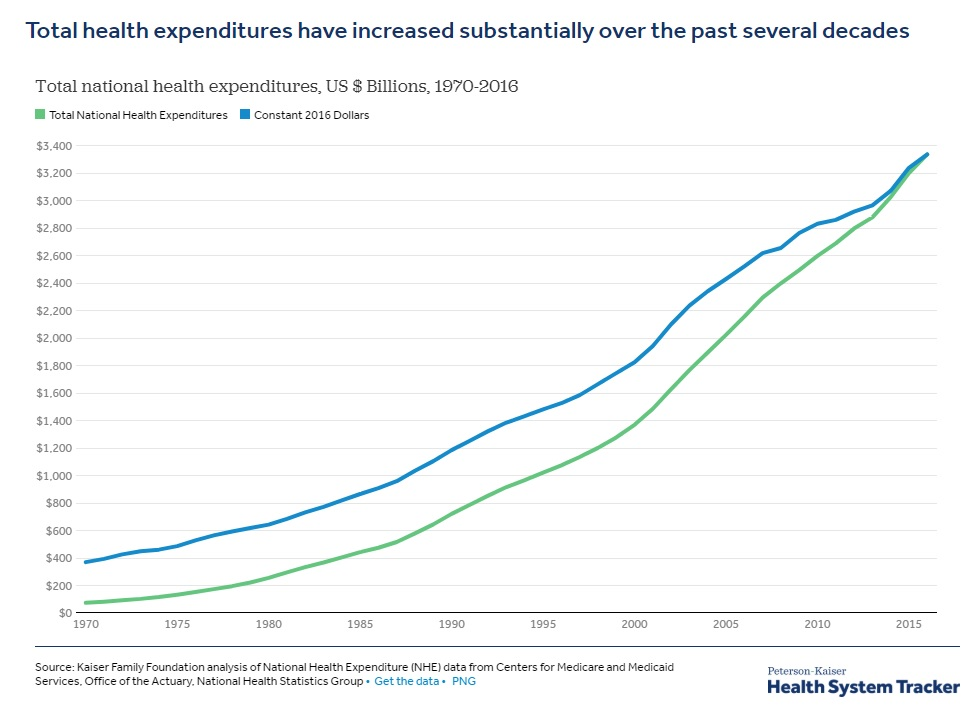
    If you think “economic epidemic” is a hyperbolic term to use in this context, think again. As referenced in my previous blog post about the continuing battle to repeal the ACA, the U.S. domestic healthcare system costs around $3.3 trillion to the American economy each year. What’s less known is that this figure is projected to continue rising as it has almost every year since the 1960s.

    Chart of how total health expenditures have increased over time.

    Some are projecting the U.S. to hit bankruptcy as early as the year 2035 if this trend continues to grow as exponentially as it has the past few decades. With baby boomers entering their elder years and both millennials and generation X set to surpass the population totals of the boomers by 2028 (Millennials in ’19 and Gen X in ’28), we can expect the requirements of our nation’s healthcare program to rise as well. Now is the time for change. As I alluded to earlier in this piece, we need to be cognizant of our past mistakes to ensure they aren’t repeated down the road with financially dire consequences.

    The MLR Rule: Medical-Loss Ratio

    The MLR rule is a lesser known mandate to the public that was included in ACA implementation. Some will argue that it had positive intentions in how our insurers spend premium dollars, which isn’t incorrect in theory, but it has a troubling method in which it determines how the rule is executed.

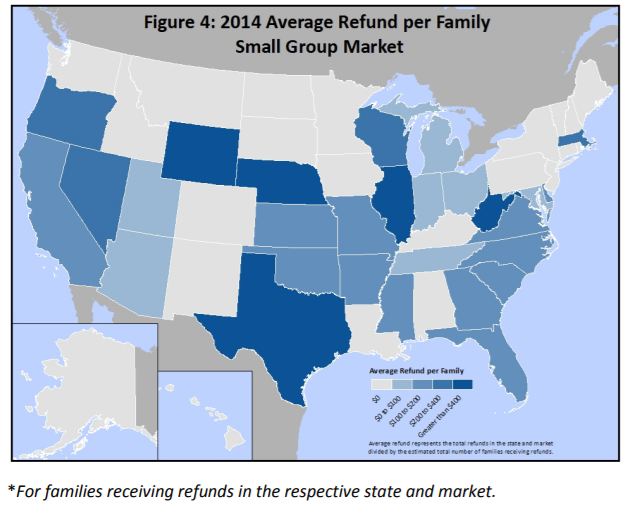
    In short, the MLR rule for small employers dictates that insurers must spend 80% of every premium dollar (it’s 85% for large employers) toward actual medical expenses, claims, and quality improvement. This percentage does not include items such as advertising, administrative costs, and profit to which the remaining 20-15% of premiums are spent. There are provisions in place that when insurers fail to satisfy at least an 80% loss ratio they must issue rebates back to consumers. These rebates totaled $469 million dollars in 2014, with 29.86% of those rebates attributed to the small group (under 500 employees) market.

    Map of the average refund per family in the small group market.

    Image via the Centers for Medicare & Medicaid Services

    Many insurers will build in features such as risk assessments, screenings, and coaching hotlines to ensure their “medical expenses” reach the MLR threshold regardless of whether their consumers are likely to use those enhancements or not.

    The failings of this rule are relatively simple to point out in economic terms: if an insurer’s profits are dictated by a fixed percentage of product costs—in this case we’re speaking of “cost” as medical premiums—the business/insurer has every incentive to see the overall cost of its product rise, thus increasing profit margins.

    As we diagnose some of the issues included in the ACA and what to avoid in future reform policies, I think this percentage based MLR rule must be exiled. Our economy can’t afford to maintain the rate of rising healthcare costs with large insurers incentivized to maintain a similar mantra. I think we can achieve a healthy balance between the two, but improved consumer-centric policies must serve as the catalyst.

    Current Solutions for Businesses: Self-Funding

    Although the tone of this article may seem slightly cynical, I promise it’s not meant to be. However, I do think it’s necessary to be transparent of the flaws within our current system. There are alternative options for businesses looking to get ahead of the upcoming reform trend before it hits home in the coming years.

    One solution is self-funding, which was included in the ACA as an alternative funding source outside of fully funded group insurance and is immune to the MLR rule. The immunity to MLR and other provisions within the ACA allow self-funded groups to control healthcare spending by accessing live claims data, become risk rated, and earn back unused premium at the end of their policy year. Since most self-funded groups aren’t managed by a large carrier, but rather the business itself or a reinsurer with similar interests as the group, premium costs are more easily maintained to fit an appropriate fiscal trend without the controversial incentives found nestled within the ACA.

    With GMS specializing in level-funding, a form of self-funding, we feel that the transparency of our healthcare consultants and creative product solutions align us with the goals of many employers. Continue to follow GMS benefit related blog posts to stay on top of current healthcare advances and reach out to your local office to learn more about the healthcare solutions we can create together.

  • Health insurance comes with many responsibilities for small business owners. Regardless of whether you’re trying to cut health insurance costs or reward specific employees, you may wonder exactly how those responsibilities affect who you offer health insurance coverage. Can you pick and choose who can be a part of your health plan, or are there federal regulations involved? As you may expect, there are some rules you need to follow.

    Employees at a company that offers group health insurance coverage.

    Do I Have to Offer Health Insurance to Everyone?

    If you’re a small business owner, the answer depends on if you decide to offer health insurance to your employees. Businesses with fewer than 50 full-time employees aren’t required to offer health coverage, although many do because good health insurance is an attractive benefit for employees. Once you decide to offer health coverage, you must offer it to all full-time equivalent employees. As we noted in our post on small business health insurance requirements, full-time equivalent employees include those who meet “an average of 30 hours of service per week for a calendar month or at least 130 hours of service in a month.”

    It’s important to note that this means that you aren’t required to offer health coverage to part-time employees. You can choose to include part-time workers in your plan, but the setup is the same as it is with the full-time employees; if you offer coverage to one part-time worker, you will be required to offer it to all part-time workers.


    Benefits PDF


    Do I Have to Offer the Same Health Insurance to Everyone?

    While you can’t pick and choose which individual employees get health insurance and which don’t, you don’t necessarily have to offer all your workers the same level of health insurance. As an employer, you can offer varying levels of benefits based on employee-based classifications. These distinctions include:

    • Full-time vs. part-time (if part-time is even offered health coverage)
    • Different geographic locations
    • Date of hire or length or service
    • Job titles

    While you may be able to justify different levels of benefits through employee classifications, it can’t be for discriminatory reasons. It’s illegal to base decisions on benefits or other employment privileges on any factors protected by law. These include:

    • Race
    • Color
    • Sex
    • Religion
    • Health factors
    • National origin
    • Age
    • Disability
    • Genetic information

    Offer Group Health Insurance Coverage Through a PEO

    One of the reasons that small business owners are hesitant to invest in health insurance is that it can be expensive. Fortunately, a PEO can offer you a more cost-effective solution that can help attract and retain top talent.

    Since Group Management Services represents multiple small businesses, we can leverage our buying power to get lower premiums on quality plans. Not only can we help you offer an attractive health insurance plan to your employees, we can also assist you with benefits management so that you get the most bang for your buck while helping you stay compliant. Contact GMS today to talk to one of our experts about how outsourcing payroll administration can benefit your business.

  • Even if you only follow on the fringes of healthcare reform, the inception of the ACA in 2010 may have shed light on the lack of bipartisan effort surrounding reform policies. Regardless of which side of the political spectrum you sit, the ACA (Patient Protection and Affordable Care Act) is widely regarded as the most impactful healthcare policy since the rollout of Medicare & Medicaid by President Lyndon B. Johnson in 1965. Irrespective of the clout this policy holds in the eyes of leaders within our domestic healthcare system, it has not operated within its short eight-year tenure without controversy.

    The debate surrounding the longevity of this policy continued last Thursday (June 7, 2018) in unprecedented manner as the Justice Department filed a briefing recommending that the U.S. District Court of Texas (Fort Worth Division) rule the insurance reform provisions of the ACA unconstitutional.

    Book of recent updates in healthcare reform.

    How We Got Here

    To understand the severity of the proposed lawsuit, we must briefly glance at NFIB v. Sebelius, a previous legal decision surrounding the ACA which cleared a path for the above briefing to be filed.

    In 2012, a group of 13 states, a pair of individual plaintiffs, and the National Federation of Independent Businesses filed a motion (in the District court of Northern Florida) that the ACA was unconstitutional. According to Supreme Court multimedia archive Oyez, “The plaintiffs argued that: (1) the individual mandate exceeded Congress’ enumerated powers under the Commerce Clause; (2) the Medicaid expansions were unconstitutionally coercive; and (3) the employer mandate impermissibly interfered with state sovereignty.“ The conclusion of the suit resulted in the Supreme Court backing the ACA under the precedence that the individual mandate “is an appropriate use of Congress’ power under the taxing Clause and is, therefore, constitutional” according to a case brief for NFIB v. Sebelius.

    The important take away from this dispute is that the ACA was backed by Congress under the idea that the individual mandate was a tax and that it was “severable” from other provisions included in the ACA. This means that the judgement of one mandate within the ACA can be siloed and will not affect the policy as a whole.

    The Filing at a Glance

    On Dec. 22, 2017, the individual mandate was repealed as a part of the Tax Cuts and Jobs Act of 2017 written in by President Trump and his administration. In ordinance with the repeal, many right-wing-leaning states have proposed the idea that an individual mandate (as of today, the requirement to have qualifying medical insurance still exists) without a penalty to do so (previously written in as a tax) is unconstitutional. The process of proving unconstitutionality within the ACA is based on “inseverability.” In short, if one mandate within the ACA is unconstitutional, the entire ACA is then unconstitutional and should be eradicated.

    Now as defined above, the unique nature of this case is that the Department of Justice not only supports this idea but is urging the District Supreme Court to render the ACA invalid without reference to the previously approved filing of severability in 2012. The inconsistencies in the law from 2012 to current are unnerving to many analysts following this case. The provisions have been approved by Congress and signed into federal law and are not meant to be easily challenged or rehashed within a legal setting with such overarching consequences. In 2016, the domestic healthcare system within the U.S. reached $3.3 trillion dollars annually and accounted for 17.9 percent of the Gross Domestic Product. The security of such would be woefully undefined if the ACA (and mandates within it) were to be diminished without proper recourse or without a proper replacement.

    Impacts of a Successful Repeal

    The major concerns surrounding the impending decision are ones that largely propelled the positive social opinion of the ACA. Namely, the pre-existing conditions clause that prevented individuals with chronic illnesses from being denied coverage through ACA exchanges. The current “community rating” system of the ACA is also at risk if this motion goes without congressional defense.

    With or without the most polarizing and divisive reform policy of the last five decades, the future of our domestic healthcare system is cloudy at best. Only informed citizens having insightful conversations will spur positive change. If until now you’ve been asleep at the wheel regarding healthcare reform, this briefing should serve as a wake-up call.

    Small business owners are especially vulnerable to the ongoing healthcare uncertainty. It’s difficult to keep up with the ACA and other key policies that can affect your business. At Group Management Services, we provide owners with access to quality health insurance coverage at reasonable rates and keep them informed about changes in policies that can impact their business. Contact GMS today to talk to one of our experts about how we can help your business through these uncertain times.

  • A recent article written by the Wall Street Journal outlines some startling financial data in regard to our domestic health insurers and their cryptic billing process established by CMS (Center for Medicare/Medicaid Services). Although GMS typically focuses on the private insurance markets—as they are the most relevant for businesses—examining the continued failures of CMS may provide some insight as to why our domestic healthcare system operates so poorly and why prices for both public and private health insurance markets are sky-rocketing.

    Costs associated with the U.S. healthcare system.

    A Look into the Market’s Rising Prices

    Medicare is a socially-funded program meant to provide health benefits for tax-paying citizens age 65 and older and permanently-disabled individuals of all ages. Medicare, a majority of the CMS which also splits some funding with state and federal Medicaid programs, is typically divided into four parts, coined Medicare parts:

    • A (Hospital insurance)
    • B (Supplementary Medical insurance)
    • C (Medicare Advantage)
    • D (Medicare prescription drug benefit(s))

    Medicare is funded primarily by tax-payers and Medicare subscribers who are required to pay a monthly premium to utilize the benefits provided through CMS policies.

    What most citizens don’t know is that CMS is the largest buyer of healthcare policies in the world and files enough fraud, waste, and abuse statistics to land itself within the Fortune’s 500 top 50 based solely on the amount of money lost each year. That’s right, the fraud waste and abuse of Medicare in 2017 was enough to top revenue for entire organizations like Best Buy, Disney, and Fed-Ex. The figure also dwarfs the full budgets for programs like Homeland Security, the EPA, and NASA by tens of billions of dollars, if not more.

    As astonishing as those statement may be, these trends have continued almost every quarter, year, and decade since 1965:

    Healthcare loss trends.

    Contributing to this $60 billion eyesore is an antiquated billing system that largely remains confidential. What the WSJ highlighted (and what we’ll continue to discuss for the remainder of this article) are the overpayments made to Medicare Part-D insurers for inaccurate estimations of cost for upcoming fiscal years (FY). As detailed above, Part-D handles the Rx benefits for Medicare subscribers and is interestingly administered 100 percent by private insurers.

    These “overpayments” surpassed the $9 billion mark from 2006-2015 and were paid out to private insurers on top of existing revenue for administering these Part-D plans. The question as to how $9 billion seemingly slipped through taxpayers’ hands and into the revenue stream of top-insurers is what’s intriguing… or maybe infuriating is the right word to use here.

    The Bidding Process for Private Insurers

    In order to address that question, we’ll need to take a brief look into the bidding process for these private insurers and how re-payments by CMS are made on an annual basis.

    Every summer Part-D insurers send detailed cost-projections for what it would take to fund all Medicare Part-D subscribers’ prescription costs for the following year (about 40 million people). These projections are split into two main categories: Direct Subsidies and Reinsurance Subsidies.

    Direct Subsidies contain projections for the majority of services through Part-D. When insurers submit these bids and real costs fall below what was originally projected, CMS allows insurers keep a portion of the difference. Keep in mind that these “projections or bids” are what Medicare bills to taxpayers to ensure proper coverage. In this case, insurers are seemingly incentivized to inflate their bids (by an obvious but overlooked billing loophole) knowing they’ll get to keep some of what isn’t used by the Medicare Part-D population while taxpayers get to bear the financial brunt of these egregious errors.

    Reinsurance Subsidies are siloed for Medicare subscribers that have extremely high-costing medications. These high-costing medications, sometimes referred to as “specialty” meds, can often times be upwards of $5,000 for a 30-day supply. Humira, a popular drug that’s used to treat Rheumatoid Arthritis among other chronic illnesses and is often advertised on television, will run you about $6,409 for a 28-day supply without applicable medical or prescription insurance. For these subsidies, insurers must pay back any overages in cost projections should they fall above what was actually spent. However, if insurers’ projections fall below what was actually spent, Medicare will fund the remaining amount.

    Imagine you’re the controlling party for one of these large private insurers. If you could legally receive billions of dollars simply by “over-projecting” one of your bids and legally save billions of dollars by undercutting a different bid with the sum of those earnings or savings being pushed off to the subscribers you’re insuring and American tax-payers, what would you chose?

    The Grave Reality of the U.S. Healthcare System

    Given the above details, the first question that comes to mind might sound something like this: “So Medicare Part-D allows 100 percent administration of a federally subsidized program by private insurance companies, but also allows said companies to submit their own budget forecasts and allows them to keep some of that allocated money if they’re wrong in creating those budgets?” With an 11 percent error rate in 2016 Medicare payments, it’s not hard to see how this staggering $9 billion figure is only a fraction of what the programs wastes annually. Applying these malpractices to a $3.5 trillion-dollar industry (the United States healthcare system, which is showing steady annual spending growth and will likely eat over 25 percent of the GDP within the next decade) and the grave reality of what’s at stake is easily recognizable.

    I would highly encourage anyone interested to read more about the WSJ’s findings, but will conclude with the following:

    As the economic epidemic of our healthcare system continues to worsen, it’s articles like this from the WSJ that bring to light how much taxpayer money is truly wasted through an irresponsibly administered system like CMS. The issues found here can be replicated time and time again throughout various programs in our healthcare system and are a big piece of why healthcare costs, specifically insurance premiums, continue to climb.

    Although it’s not always enjoyable to put these concerning statistics and unsavory business practices in frame for our readers, the transparency that GMS owes to our clientele will always reign. If you’re interested in working with realistic brokers to create modern solutions for your group’s health plan, contact GMS to speak with a dedicated healthcare professional.

  • In the past, business owners in Michigan had the option of whether they wanted to offer paid sick leave for their employees. However, Michigan adopted the Earned Sick Time Act (ESTA) Sept. 5, 2018, making it the 11th state to have a mandatory paid sick leave law in effect. Within a few months, the state’s legislature amended the bill, adopting the Paid Medical Leave Act (PMLA) as a modified version of the initial act that will go into effect starting March of 2019.

    With all the changes in Michigan’s paid sick leave laws, it’s time for business owners in the state to take stock of exactly what the PMLA requires of them, if they should reevaluate their paid leave policies, and what they need to do to be compliant with the new law.

    An employee staying home through her company’s paid sick leave policy.

    What the Paid Medical Leave Act Does

    The short answer is simple: staring in March, employees in Michigan will accrue paid sick time based on the amount of time they work.

    Which Businesses are Affected

    While the ESTA originally impacted all businesses to some degree, the PMLA only covers employers with 50 or more individuals. However, small employers with fewer than 50 individuals may offer paid medical leave if they choose to do so.

    Which Employees are Affected

    The ESTA had a broader definition of eligible employees, which included full-time employees, part-time employees, independent contractors, and temps. The PMLA limits the scope of which employees are eligible for paid sick leave with a dozen exclusions listed out in the senate bill.

    • An individual who is exempt from overtime requirements under section 13(a)(1) of the fair labor standards act, 29 USC 213(a)(1)
    • An individual who is not employed by a public agency, as that term is defined in section 3 of the fair labor standards act, 29 USC 203, and who is covered by a collective bargaining agreement that is in effect
    • An individual employed by the United States government, another state, or a political subdivision of another state
    • An individual employed by an air carrier as a flight deck or cabin crew member that is subject to title II of the railway labor act, 45 USC 151 to 188
    • An employee as described in section 201 of the railway labor act, 45 USC 181
    • An employee as defined in section 1 of the railroad unemployment insurance act, 45 USC 351
    • An individual whose primary work location is not in Michigan
    • An individual whose minimum hourly wage rate is determined under section 4b of the improved workforce opportunity wage act, 2018 PA 337, MCL 408.934b
    • An individual described in section 29(1)(l) of the Michigan employment security act, 1936 (Ex Sess) PA 1, MCL 421.29
    • An individual employed by an employer for 25 weeks or fewer in a calendar year for a job scheduled for 25 weeks or fewer
    • A variable hour employee as defined in 26 CFR 54.4980H-1
    • An individual who worked, on average, fewer than 25 hours per week during the immediately preceding calendar year

    How Time is Accrued

    Both the ESTA and PMLA agreed that eligible employees are set to earn paid medical leave as soon as the act goes into effect March 2019. However, the FMLA changes the rate of accrual from one hour per every 30 hours to one per every 35 hours of service time. It also limits accrual to only one hour of paid sick leave in a calendar week.

    In addition, the FMLA lowers the cap for paid leave to 40 hours per year instead of the ESTA’s 72. Time can be carried over into the next year, but usage is still capped at 40 hours. The PMLA also added an allowance for employers to add a waiting period of 90 calendar days before new hires can use paid sick leave.

    How Time is Used

    In terms of use, employees have a lot of wiggle room. Foreseeable leave, such as planned surgeries, procedures, etc., require up to seven days of notice. However, a sudden illness is not foreseeable, which means employees only need to give notice of sick leave as soon as reasonably possible. Earned paid leave can be used in one-hour increments, although the PMLA does permit employers to set a different increment policy in their employee handbooks.

    Another notable difference between the PMLA and the ESTA is that the amended bill gives employers more freedom to request documentation. Per the PMLA, employers can require reasonable documentation when employees use paid leave for absences of less than three days. In addition, employees have at least three days to provide the necessary documentation for absences.

    What it Means for Your Business

    If you have a business in Michigan and that business has fewer than 50 individuals, the PMLA won’t directly affect you. However, the act is part of a growing trend of more states adopting some form of required paid sick leave. This trend can serve as an opportunity to attract and retain better talent.

    Whether or not paid sick leave is mandatory for your business, you can still make it feel like a benefit for your employees. According to Access Perks, 88 percent of employees named sick leave as one of the most desirable PTO benefits. By offering paid sick leave—especially one that goes beyond any legally-required minimums—you can make your business more attractive to potential job candidates while rewarding your current employees.

    It is important to note that some business owners may be concerned that employees may abuse paid sick leave. However, that may not necessarily be the case. Monster notes that absenteeism did not notably increase when a paid sick leave law was passed in San Francisco and that the same employees who were likely to falsely call in sick in the past are the same who would abuse paid leave when it’s offered.

    In fact, Access Perks notes that “89 percent of employees come to work sick with 19 percent admitting to doing this more than once a month.” By giving your employees the opportunity to take paid sick leave, they’ll be more inclined to use it when they really need it instead of forcing themselves to come to work and infecting other employees.

    How to Protect Your Business

    Regardless of your paid leave policy, you’ll need to adjust your policies and employee handbook. An outdated handbook can open you up to liability concerns, so it’s important to have your paid leave policy laid out so that employees have a clear understanding of the rules. It also allows you to have documentation in place to protect you from any legal claims against your company.

    Another way to be safe is to work with experts who can help you roll out a new paid sick leave policy or any other program. As a Professional Employer Organization, GMS can help you establish an attractive benefits package and update your handbook appropriately. We can also help you stay ahead of new legislation or upcoming changes that may impact your business so you can act ahead of time.

    Whether you need help with a paid leave policy or some other important business need, our Detroit branch or one of our other locations across the country can assist with risk management, outsourcing payroll, benefits administration, and other key HR functions. Contact GMS today to talk to one of our experts about how we can help your business.

  • When Donald Trump ran for the Presidency in 2016, a major plank of his platform was the repeal and replacement of the Affordable Care Act. In fact, pretty much every Republican in 2016 ran on that promise.

    In the summer of 2017, several Republican Senators and every Democrat Senator torpedoed that promise by not agreeing to a plan. Since then, this administration has made several attempts to sink the ACA where they could.

    A gavel of a judge blocking new association health plan rules meant to sink the affordable care act.

    The Trump Administration’s Attempts to Sink the ACA Through AHPs

    The first, and perhaps most powerful as far as Washington D.C. is concerned, attempt is the decision to no longer enforce the individual mandate. If you recall, there was supposed to be a financial penalty on any individual who didn’t have an insurance plan through an employer or on their own. The problem with that plan was always twofold:

    • If you weren’t working or weren’t filing taxes, there was no way for the IRS to collect that penalty.
    • In many instances, the penalty was less costly than the insurance itself.

    The administration began creating new rules for Association Health Plans (AHPs). These AHPs allowed “businesses and individuals [to] band together to create group health plans that offer less expensive coverage than the ACA.” In other words, Associations could pull together multiple employers and individuals into a larger group, offering better rates. In most cases, the trade-off was no protections for what was deemed “minimal coverage.”

    Recently, a federal judge ruled that the Trump Administration attempted an “end run” around the ACA and, in effect, violated the Affordable Care Act.

    Affordable Healthcare Options for Business Owners

    If you are a business owner and you thought these plans were a way to get out from under the considerable financial burdens of the ACA, you may be back at square one.

    Well, there may still be a multiple-employer healthcare option for you. If you would like to learn more about the large group buying power of a Professional Employer Organization (PEO), as well getting additional HR services and regulatory and tax protections, please contact GMS to talk to one of our experts today.

  • As we approach the 2020 political season, healthcare remains an eternal “hot topic” issue; one that acts as an economist’s reoccurring bad dream. Much like a bad dream, the obvious warning signs of our domestic system’s atrophy disappear into the cognition of the economist’s mind and are forgotten by mid-morning. The economist, much like the rest of the country, has an eerie feeling due to this reoccurring healthcare nightmare, but can’t quite seem to pinpoint the root of their discomfort or begin to answer the lingering paradox of “How can we make healthcare in the U.S. financially sustainable?”

    The answer to that question is a large, complex, and convoluted issue to tackle. An alternative approach is to look at our ongoing mistakes as an industry and start to peel back some of the fraud, waste, and abuse at least long enough to get our collective head above water to propose a semi-legitimate long-term solution.

    A doctor pocketing money from a staggering healthcare bill.

    Diagnosing a Questionable Healthcare Diagnosis

    Individuals, facilities, insurance entities, CMS, and providers are just some of the key players necessary to stop the financial hemorrhaging. Not often enough do we evaluate the role of the physician from an economic standpoint and their direct effect on the industry. A recently released edition of “Bill of the Month,” a crowdsourced investigation of medical bills by Kaiser Health News and NPR, allows us to do just that.

    To paraphrase the article: A New York City patient went to a PCP (Primary Care Physician) with symptoms of a head cold. About to leave on vacation, this individual thought nothing of a typical provider visit to address some minor discomforts before traveling. A throat swab, a quick round of antibiotics, and a $25 co-pay sends this patient (aka consumer, customer, client, etc.) seemingly out the door without a hitch.

    Upon returning from vacation, this healthcare consumer has a staggering $28,395.50 bill from their provider relating to the previous “head cold” visit. This physician ultimately sent the throat swab (claiming to test strep, among a myriad of other unlikely diagnoses) to a non-network lab facility with which this patient’s insurer (BCBS) did not have an established contracted rate. Normally, these tests run through an in-network provider would run the same insurer about $653 – a 191 percent price difference coordinated through the discretion of this physician.

    As I read through the article, a handful of painfully obvious questions came to mind. Namely:

    1. Why intentionally use an out-of-network lab service?

    a. The physician office had applicable and valid insurance info from the patient and could easily check for a list of in-network providers. They chose to use an out-of-network facility.

    2. Why were so many unnecessary tests run for likely influenza (common cold) diagnosis?

    a. “In my 20 years of being a doctor, I’ve never ordered any of these tests, let alone seen any of my colleagues, students, and other physicians, order anything like that in the outpatient setting,” said Dr. Ranit Mishori in Kaiser Health News. “I have no idea why they were ordered.”

    b. “There are about 250 viruses that cause the symptoms for the common cold, and even if you did know that there was virus A versus virus B, it would make no difference because there’s no treatment anyway.”

    3. Why were antibiotics prescribed for a viral infection?

    a. There’s a lesser-known, but just as frightening scenario where continued unnecessary antibiotic use within the general population will lead to widespread antibiotic resistance that will affect not only our healthcare industry but veterinarian and agricultural industries as well. Antibiotics cannot effectively treat viral infections.

    Here’s the kicker from Kaiser Health News: “The third reason for the high bill may be the connection between the lab and Kasdan’s doctor. Kasdan’s bill shows that the lab service was provided by Manhattan Gastroenterology, which has the same phone number and locations as her doctor’s office.”

    Undoubtedly, this physician or practice is getting a kickback from the lab’s profit by billing this patient’s insurer an absurd and unnecessary amount. Coincidentally, Kaiser Health News points out that “Manhattan Gastroenterology” (the out-of-network lab running these tests) “is registered as a professional corporation with the state of New York, which means it is owned by doctors.” Maybe this primary care doctor in particular?

    Now the point of this blog isn’t to uncover fraudulent billing practices. Those occur every minute of every day within our healthcare system. Rather, its aim is to point out that if we want anything close to a sustainable system for the baby-boomer generation’s progress into older age, or for the generations that follow, we’re all responsible to do our part in turning this thing around. That means you too, physicians.

    Regardless of which individual ends up settling the $28,000 bill from this PCP, the moral of the story is that billing tens of thousands of dollars to the healthcare system opposed to hundreds, by choice, are the decisions that, when multiplied and repeated over decades, gets us to where we are today: a seemingly insurmountable amount of debt. Furthermore, and most important to employers, high claims like these that could and should be otherwise avoided will ultimately lead to higher insurance premiums in future years for the employer and its employees.

    What can we (healthcare consumers) do to mitigate national healthcare debt?

    Staying informed, asking the right questions, and taking ownership of our personal health habits are surefire ways to reduce the expenditure and volatility of our health system. Working with consultants from an employer-centric company like GMS can only help educate employers on the successes and failures within our system and how those points can be used towards the advantage of those offering benefits while mitigating unnecessary financial loss.

    GMS is an employer for employers, constantly striving to provide transparency and sustainability for those we serve. Contact a local office today to begin your healthcare partnership with GMS.

  • The holidays are typically a time of joy and celebration, but they also require business owners to make some additional considerations about holiday pay. This type of pay makes it possible for employees to stay home for a selection of holidays and still get paid for those days. However, this benefit isn’t always a guarantee depending on the needs of your business.

    Are you unsure about how to handle holiday pay for your business? We broke down some common holiday pay questions to help you determine how holiday pay can affect your business and the best plan of action for your specific situation.

    A piggy bank with Christmas lights representing holiday pay.

    Do Businesses Need to Provide Holiday Pay?

    While many businesses offer holiday pay, it is not a legal requirement. According to the Department of Labor, “The Fair Labor Standards Act (FLSA) does not require payment for time not worked, such as vacations or holidays (federal or otherwise).” In essence, a holiday is treated just like any other workday. As such, employers would only pay non-exempt workers for the time they worked (exempt employees would simply receive their normal salary regardless of whether they had the holiday off or not).

    While holiday pay isn’t required, employers may opt to provide it to employees. The terms of the holiday pay is subject to an agreement between the employer and its employees, although you aren’t required to pay a premium rate specifically for holiday pay.

    Do Businesses Need to Provide Time Off for Holidays?

    As with holiday pay, employers are not required by federal law to provide time off on the holidays and may choose to close for certain holidays on their own. Holidays are considered regular workdays, so any employee who works those days is entitled to normal pay as opposed to overtime pay.

    The one exception in regards to time off for certain holidays is that employers are expected to provide reasonable accommodation for any employees that observe a religious holiday. One way to accommodate this would be to provide floating holidays that allow workers to use their time off for an observed holiday. Other options include allowing employees to take a vacation day or unpaid time off for a specific holiday unless the employer can show that their absence would create undue stress for the business.

    What are the Benefits of Offering Holiday Pay?

    There are a couple reasons why you may decide to provide holiday pay. One reason is to give workers a chance to celebrate various holidays with their family and friends without having to worry about how that time off will affect their paychecks. By offering some of these days off along with holiday pay, you can show your employees some appreciation for their hard work throughout the year.

    Another reason why you’d offer some holidays off with pay is to make your company appear more competitive in the hiring process. While a holiday may be the same as any other day in terms of pay, they can feel a lot more important to your employees. Offering those days off with pay can help make a difference when trying to attract and retain talented people.

    Are All Employees Entitled to Holiday Pay if It’s Offered by the Company?

    If you decide to offer holiday pay, you don’t have to provide it to all your employees. As long as the basis of choosing who gets holiday pay isn’t discriminatory, you can provide the benefit to some employees and not others. For example, you can opt to provide holiday pay to only full-time employees or office workers if you so choose. However, you can’t base your decision on a protected classification such as age or race.

    How Should I Set up a Holiday Pay Policy?

    Since you dictate the specifics of your holiday pay policy, it’s important to include that policy in your employee handbook and communicate it to your employees. This will allow you to clearly list the exact details of your policy if you decide to provide certain holidays off and if you choose to provide holiday pay. The details of this policy should include:

    • A list of dates designated as holidays (whether it follows the list of federal holidays or a modified list)
    • Which employees are eligible for holiday pay
    • The rate for holiday pay or if there are any bonuses attached to working a holiday
    • How a paid holiday works if they fall on a weekend

    What’s the Right Call for My Business?

    Ultimately, the decision of whether you want to provide holiday pay or not is up to you. Some businesses that employ multiple non-exempt employees may not have the funds to provide pay for days off, while others may require people to regularly work on holidays. Each case is different, so it’s best to find an option that makes sense for your business.

    Running a business involves making several important decisions. This responsibility requires a lot of time and effort from any business owner, but you don’t need to handle this load alone. At GMS, our HR experts can help you manage a variety of key business functions ranging from payroll to benefits administration. When you need assistance, we can provide the services and expertise necessary to keep your business prepared for the future.

    Ready to talk to an expert about holiday pay or any other business need? Contact GMS today to talk to us about how we can help your make your business simpler, safer, and stronger.

  • As a business owner, you have to make countless decisions about the types of benefits your business offers. From health insurance plans to PTO, your benefits package impacts your employees and your bottom line. Deciding on the type of benefits you want to offer your employees, like maternity and paternity leave, can be a tricky situation.

    Two new parents with their baby while on maternity and paternity leave from their employers.

    Is My Business Required to Offer Maternity and Paternity Leave?

    The answer to that question depends on the size of your company and its location. Maternity and paternity leave is regulated by U.S. labor law, which includes the Family and Medical Leave Act of 1993 (FMLA). This law applies to any employee who has worked for your company for at least 12 months and has logged at least 1,250 hours in that span. Any employee who meets FMLA criteria is then able to take up to 12 weeks of unpaid leave in a 12-month period for any of the following reasons.

    • The birth of a child and time to bond with that newborn child within one year of birth
    • The placement of a child for adoption or foster care and to bond with the newly placed child within one year of placement
    • A serious health condition that makes the employee unable to perform the functions of his or her job
    • To care for the employee’s spouse, son, daughter, or parent who has a serious health condition

    However, FMLA doesn’t affect every business. According to the Department of Labor, FMLA applies to “all public agencies, all public and private elementary and secondary schools, and companies with 50 or more employees” on a federal level.

    There are some states with different rules in regards to which businesses are impacted by FMLA. For example, New Jersey updated its Family Leave Act to drop its threshold to 30 employees. In addition, New Jersey offers paid family leave. These individual state laws can differ dramatically from the federal norm, so you’ll want to check your local laws to see where your company stands in terms of your parental leave obligations. If your business does not meet the employee threshold for FMLA in your state, you are not required to provide paid or unpaid leave for maternity and paternity leave.

    Should I Offer Maternity and Paternity Leave Benefits Anyway?

    Even if FMLA doesn’t apply to your business, you may want to consider some form of maternity and paternity leave for your employees. There are advantages and disadvantages associated with your various parental leave options, so it’s important to identify some factors that may impact your decision.

    The costs of offering leave

    Your parental leave policy can have different financial impacts. Not offering a leave policy is the lowest cost option, at least in terms of how it’ll impact your day-to-day operations. Conversely, paid leave means that you’re still on the hook for paying your employees while they’re out of the office. In addition, the following factors can affect your bottom line whether you offer paid or unpaid leave:

    • The impact of lost productivity while your employee is on leave
    • The cost of a temp worker to pick up the extra work
    • The cost of covering benefits while an employee is gone

    All of these factors can add up, which can make the decision to offer some form of paid or unpaid parental leave a pricy policy. However, it’s important to also consider the financial impacts of not having a formal maternity or paternity policy.

    No maternal or paternal leave policy can be a big reason as to why an employee leaves your company – or why a potential job candidate accepts a job somewhere else. If a talented employee plans on having a child at some point, he or she may look for other opportunities to cut down on the amount of stress after childbirth and afford them more time to bond with that child. In fact, a study by the Center for Women and Work at Rutgers found that women are “93 percent more likely to be working nine to 12 months after giving birth than those who didn’t take leave.”

    Not only will that departure affect your business’ productivity, replacing that employee can cost as much as half of his or her salary. If you’re in a position where you want to avoid turnover, some form of parental leave policy may be the more cost-effective solution in the long run.

    Employees want paid leave

    Just how attractive is an opportunity for paid leave to a typical employee? BenefitsNews shared the results of a survey that asked workers about the most desirable benefits outside of health insurance and retirement plans. Paid family leave eked out flexible/remote work options as the most coveted option, which can make it a very desirable option to help you attract and retain talented employees.

    The growing desire for parental leave benefits hasn’t gone unnoticed. According to SHRM, more business have offered paid parental leave in recent years. The number of business offering paid maternity leave has nearly tripled between 2014 and 2018, rising from 12 percent to 35 percent. Paid paternity leave wasn’t far behind, increasing from 12 to 29 percent in that time.

    What are Some Parental Leave Options for a Small Business?

    Now that you’ve weighed a few factors that may impact your decision on whether you should or shouldn’t offer maternity and paternity leave. There are a few different options you can take based on the needs of your company.

    • No parental leave
    • Unpaid parental leave
    • Paid parental leave
    • A combination of paid and unpaid parental leave

    So which is the best choice? Ultimately, the decision lies with what’s right for you and your company. You’ll need to balance the financial implications along with how your policy can impact your employees, which requires an internal perspective from someone who knows and understands the company.

    You’re the best person to judge which type of maternity and paternity leave policy works for your company, but you don’t have to make this call alone. At Group Management Services, we can help you determine which route may be best for your particular situation and put together a company policy to keep your employees informed (and protect you from potential claims). Contact GMS today to talk to one of our experts about how we can help you strengthen your business through employee benefits administration and other key HR functions.