• As the Coronavirus impacts businesses everywhere, Congress passed the Coronavirus Aid, Relief, and Economic Security (CARES) Act to provide some financial support during difficult times. The $2 trillion Coronavirus stimulus package contains a $349 billion lending program for small businesses, along with other means of relief.

    For small business owners, this news provides a form of respite in a difficult time. Of course, now these employers may ask how these loans work and whether they can access them. Read on to find out if your business can apply for a loan and how they impact your operations.

    Money from a CARES Act small business loan granted to a business impacted by the Coronavirus. 

    Is My Business Eligible for CARES Act Loans?

    As long as your business has fewer than 500 employees, it’s eligible for a loan. The stimulus package applies to businesses from all states and territories and even extends to self-employed individuals, independent contractors, and sole proprietors. The CARES Act does prioritize certain types of businesses, such as those in under-served and rural markets or businesses that are less than two years old.

    What Financial Assistance is Available for the Coronavirus?

    The CARES Act lays out a couple of different forms of financial relief for small businesses. The most notable of these is the $349 billion Paycheck Protection Program, which will provide partially forgiven loans depending on how businesses use them.

    Paycheck Protection Program Loans

    According to the CARES Act, businesses can receive a loan of 2.5 times the businesses’ monthly payroll up to $10 million. The exact amount your company can receive is based on how much you paid your employees between Jan. 1 and Feb. 29, plus 25 percent of that total amount. These loans have a fixed interest rate of one percent regardless of business type (the final rates, underwriting standards and other terms and conditions are to be determined). The Small Business Administration also notes that it will “forgive the portion of the loan proceeds that are used to cover the first eight weeks of payroll and certain other expenses following loan origination” if you are able to maintain your workforce.

    In addition, the CARES Act incentivizes employers for using loans for what it considers allowable purposes. By doing so, your Paycheck Protection Program loan can be forgiven and you’ll only need to pay back accrued interest on your loan if you use the loan for the following:

    • Payroll costs
    • Costs related to the continuation of group health care benefits during periods of paid sick, medical, or family leave, and insurance premiums
    • Employee salaries
    • Interest payments on any mortgage
    • Rent and utility payments
    • Interest payments on any other debt obligations that were incurred before Feb. 15, 2020

    Economic Injury Disaster Loans

    In addition to the $349 billion lending program, the CARES Act also allotted $10 Billion for the Small Business Administration’s (SBA) Economic Injury Disaster Loans (EIDLs). According to Forbes, the expanded provisions mean that:

    • EIDLS can be approved by the SBA based solely on your credit score (a prior bankruptcy won’t disqualify your business)
    • EIDLs smaller than $200,000 don’t need a personal guarantee for approval (real estate is also not required as collateral)
    • Borrowers can receive $10,000 in an emergency grant cash advance that can be forgiven if spent on paid leave, maintaining payroll, increased costs due to supply chain disruption, mortgage/lease payments, or repaying obligations that cannot be met due to revenue loss
    • EIDLs are now accessible for sole proprietors, independent contractors, tribal businesses, cooperatives, ESOPs with fewer than 500 employees, and all non-profits

    How Do I Apply for CARES Act Loans?

    If you’re want to apply for a Paycheck Protection Program loan, you can do so at any lending institution approved to participate by the SBA. You can apply for EIDLs online at the SBA website

    Contact us if you have any HR related questions on how to keep things running smoothly through these difficult times. 

  • After years of proposed changes to overtime laws, the Department of Labor (DOL)’s new updates finally went into effect at the beginning of 2020. The new salary levels make roughly 1.3 million more workers eligible for overtime pay. This news means business owners across the country may have some work to do to keep up with these changes.

    While the new standard salary level is a notable difference, it’s not the only change the DOL made. The department also revised rules for highly-compensated employees, regulations on overtime pay calculations, and other crucial details. To help, we broke down exactly what the DOL changed to help you know where your business stands and what you should do next.

    A clock tracking time for employees now eligible for overtime and papers documenting business numbers like regular rate calculations.

    Which Employees are Now Eligible for Overtime?

    Currently, the Fair Labor Standards Act sets the salary threshold for overtime at $35,568, which equates to $684 per week. Previously, the threshold was $23,660, or $455 per week. Those employees who meet the requirements set by the DOL are entitled to earn overtime pay for any hours worked past 40 in a given week. The pay for those extra hours is set at one-and-a-half times that employee’s standard rate of pay, which is the same as before. 

    In addition, highly compensated employees must now earn at least $107,432 ($684 of which must be paid weekly as either a salary or fee) instead of the old rate of $100,000. The new rules also maintain that employers can count annual (or more frequent) nondiscretionary bonuses and incentive payments as up to 10 percent of the minimum salary threshold.

    This salary threshold does not apply to all employees, however. The new rules still provide overtime protections to blue-collar workers, which means they are eligible for overtime even if they make more than $684 per week. Similarly, white-collar employees still do not receive these same overtime protections as long as they meet certain criteria for exemption. 

    In addition to meeting the new salary threshold, white-collar employees are considered exempt based on the duties they perform and if they’re paid a predetermined, fixed salary that is not subject to reduction. There were no changes to the preexisting duties tests, so owners can use the same criteria for exemption as in the past. For a detailed breakdown of those exact duties, check out our post on navigating white-collar exemptions.

    What Applies to Regular Rate Calculations for Overtime?

    Once you identify which employees are eligible for overtime pay, there’s still the matter of having to pay them for their extra hours. However, it’s not always easy to identify what affects an employee’s regular rate of pay.

    The FLSA identifies an employee’s “regular rate” as the rate that the employee is paid per hour. This doesn’t mean that the employee needs to be compensated on an hourly basis. Instead, it’s simply a calculation of how much the worker makes over the course of an hour compared to his or her salary, commission, and other compensation for all non-overtime hours worked in a workweek. As such, it’s relatively simple to calculate an employee whose compensation consists of only hourly pay – multiply that employee’s total hourly rate by the number of overtime hours worked.

    However, these calculations are much more complicated once you factor in other forms of compensation. The FLSA identifies that the rate should cover compensation that “include(s) all remuneration for employment paid to, or on behalf of, the employee,” such as bonuses, commissions and other forms of compensation. The DOL’s final rule added a list of exclusions that do not apply to overtime pay to address the confusion over what is considered part of the regular rate of pay. Per the DOL, these exclusions include:

    • The cost of providing certain parking benefits, wellness programs, onsite specialist treatment, gym access/fitness classes, employee discounts on retail goods and services, certain tuition benefits (whether paid to an employee, an education provider, or a student-loan program), and adoption assistance
    • Payments for unused paid leave, including paid sick leave or paid time off
    • Payments of certain penalties required under state and local scheduling laws
    • Reimbursed expenses including cellphone plans, credentialing exam fees, organization membership dues, and travel, even if not incurred “solely” for the employer’s benefit; and clarifies that reimbursements that do not exceed the maximum travel reimbursement under the Federal Travel Regulation System or the optional IRS substantiation amounts for travel expenses are per se “reasonable payments”
    • Certain sign-on bonuses and longevity bonuses
    • The cost of office coffee and snacks to employees as gifts
    • Discretionary bonuses, by clarifying that the label given a bonus does not determine whether it is discretionary and providing additional examples 
    • Contributions to benefit plans for accidents, unemployment, legal services, or other events that could cause future financial hardship or expense

    What Should an Owner Do About the New Overtime Rules?

    While some of the exact details have changed since the initial plans to update the overtime rules were announced back in March of 2019, our advice remains largely the same as it was that spring. First, you’ll need to evaluate your employees and identify who is now eligible for overtime and how much overtime you expect them to work (if any). If you do have employees who will now earn overtime, you’ll need to decide how you want to handle these new costs:

    • Pay newly-eligible employees overtime pay for the extra hours they accrue
    • Limit employees to 40 hours per week to prevent them from earning overtime
    • Determine how much certain employees would make in expected overtime and bump their pay to above the salary threshold if that ends up being less costly
    • Adjust salaries for new employees to account for expected overtime costs

    Each of these options has its own benefits and drawbacks, so deciding which route is best for your company largely depends on you and your workforce. Regardless of your decision, you’ll need to make sure that whatever you do ensures that your business is compliant with the new overtime rules so that you don’t open yourself up to thousands of dollars in fines and other potential penalties.

    How Can I Stay Ahead of New Regulations?

    The new overtime rules are just another major change that forces business owners to change how they manage their business. Unfortunately, you don’t always have the time or knowhow to keep up with new regulations. Fortunately, GMS can help you claim your time back and protect your business.

    As a premier PEO, GMS has the HR experts necessary to help you plan for the future and stay compliant with current laws. Our integrated HR system helps us take care of the administrative burden of payroll management, benefits administration, and other crucial human resources tasks for you so you have the time you need to focus on growing your business.

    Ready to stay ahead of new regulations and ease your administrative burden? Contact us today to talk to one of our experts about how we can strengthen your business.

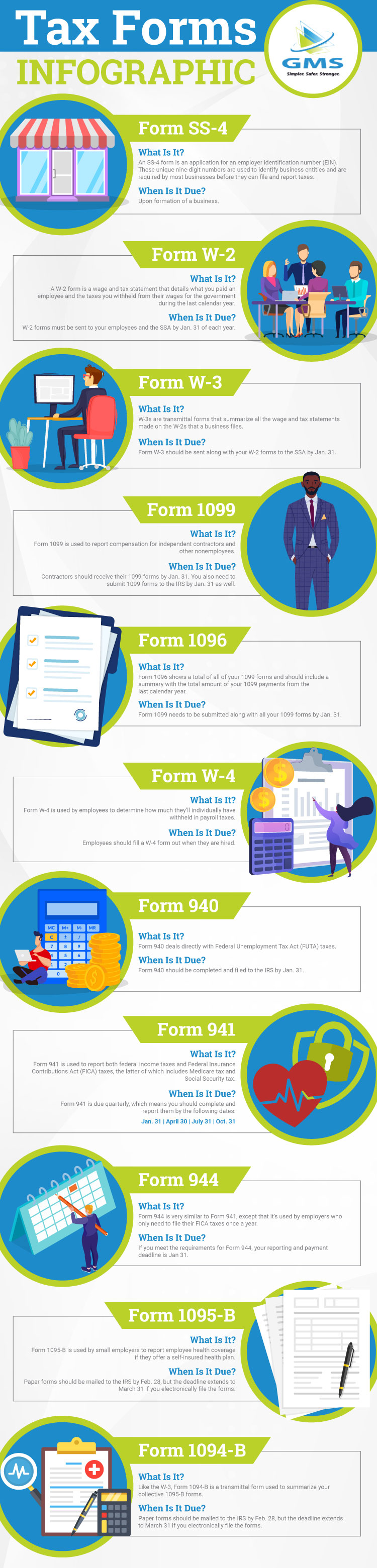
  • Payroll forms can put a lot of pressure on business owners. When you’re in charge of a small business, it’s up to you to make sure that these forms are not only completed accurately, but on time as well. If you’re not careful, the penalties can range from $50 per faulty form all the way up to hundreds of thousands of dollars for notable violations.

    One of the biggest struggles of managing payroll forms is simply knowing which forms apply to your business and what they do. We’ve compiled a list of payroll forms that you’ll likely need to know for your small business and how they work.

    Form SS-4

    What is it?

    An SS-4 form is an application for an employer identification number (EIN). These unique nine-digit numbers are used to identify business entities and are required by most businesses before they can file and report taxes.

    When is it due?

    Unless you’re just about to start your business and haven’t paid anyone yet, you likely already have an EIN. There are some situations where you may need a new EIN, which the IRS has listed on its site. Aside from those scenarios, you won’t have to worry about refiling form SS-4 once you have your EIN.  

    Form W-2

    What is it?

    A W-2 form is a wage and tax statement that details what you paid an employee and the taxes you withheld from their wages for the government during the last calendar year. W-2s need to be completed for any employee who worked for you in the past year and copies should be sent to the Social Security Administration (SSA) and the employee listed on the W-2. In addition, you should hold onto a copy of each W-2 for at least years.

    When is it due?

    W-2 forms must be sent to your employees and the SSA by Jan. 31 of each year. Most state governments set the deadline at Jan. 31 as well, but make sure to check with your specific state tax agency in case your state’s date differs. 

    You can also request extensions to file forms with the SSA and distribute forms to your employees. For an SSA extension, you’ll need to fill out Form 8809 and submit it to the IRS between Jan. 1 and Jan. 31. The IRS will then either deny your request or grant you a single 30-day extension. 

    As for distribution to employees, you must mail a letter to the IRS to request an extension. The letter must explain why you need an extension, your name, business address, EIN, and signature. If approved, the IRS will grant you either a 15- or a 30-day extension.

    Form W-3

    What is it?

    W-3 forms are closely related to W-2s. Essentially, W-3s are transmittal forms that summarize the all the wage and tax statements made on the W-2s that a business files. In short, if you fill out 10 W-2 forms for your 10 employees, Form W-3 should represent a total of all 10 W-2s.

    When is it due?

    Form W-3 should be sent along with your W-2 forms to the SSA by Jan. 31. However, you don’t need to send W-3s out to your employees.

    Form 1099

    What is it?

    Form 1099 is used to report compensation for independent contractors and other nonemployees. If you pay a contractor more than $600 in a year, you need to report how much you paid them to both the contractor and the IRS so that these wages can be evaluated for tax purposes.

    When is it due?

    Contractors should receive their 1099 forms by Jan. 31. You also need to submit 1099 forms to the IRS by Jan. 31 as well.

    Form 1096

    What is it?

    Remember how the SSA requires a Form W-3 to show a total of all your W-2 forms? Form 1096 has the same relationship with your 1099 forms and should include a summary with the total amount of your 1099 payments from the last calendar year.

    When is it due?

    Form 1099 needs to be submitted along with all your 1099 forms by Jan. 31.

    Form W-4

    What is it?

    Form W-4 is used by employees to determine how much they’ll individually have withheld in payroll taxes. On this form, your employees will note how many withholding allowances apply to them. These allowances will allow you to determine the amount of payroll taxes each employee will have withheld from their paychecks.

    When is it due?

    Form W-4 doesn’t have an annual due date like other payroll forms. Instead, employees should fill a W-4 form out when they are hired. The IRS does recommend that employees submit a new W-4 form each year to account for any financial or personal changes, but it’s not mandatory. In this case, simply continue to withhold taxes based on an employee’s original Form W-4 until he or she provides a new one.

    Form 940

    What is it?

    Form 940 deals directly with Federal Unemployment Tax Act (FUTA) taxes. Your business must pay FUTA taxes if you meet the following requirements:

    • You paid at least $1,500 in wages in any calendar quarter during the past two years
    • You had one or more employees for at least some part of a day in any 20 or more different weeks during the past two years

    FUTA taxes are based on employee wages, but are only paid by the employer and not the employee, so make sure not to withhold FUTA taxes from employee wages. These taxes are paid quarterly and then reported once a year through Form 940.

    When is it due?

    Form 940 should be completed and filed to the IRS by Jan. 31. However, the IRS will extend the filing due date to Feb. 10 if you pay all your FUTA taxes on time.

    Form 941

    What is it?

    Form 941 is used to report both federal income taxes and Federal Insurance Contributions Act (FICA) taxes, the latter of which includes Medicare tax and Social Security tax. If your business’ quarterly tax liability is between less than $2,500, you can also use Form 941 to make tax deposits as well. If your liability is more than $2,500, the IRS requires that you follow a deposit schedule.

    When is it due?

    Form 941 is due quarterly, which means you should complete and report them by the following dates:

    • Jan. 31
    • April 30
    • July 31
    • Oct. 31

    Form 944

    What is it?

    Form 944 is very similar to Form 941, except that it’s used by employers who only need to file their FICA taxes once a year. The IRS grants an exemption for small employers whose annual liability for social security, Medicare, and withheld federal income taxes is $1,000 or less for the year. If your business falls within those limits, you get to file Form 944 instead of Form 941.

    When is it due?

    If you meet the requirements for Form 944, your reporting and payment deadline is Jan 31.

    Form 1095-B

    What is it?

    Form 1095-B is used by small employers to report employee health coverage if they offer a self-insured health plan. With a self-insured plan, employers pay medical bills instead of just a premium, so the IRS requires Form 1095-B to verify that individuals on your plan had minimum essential coverage. If you offer a fully-insured plan, your health insurance provider will fill out and file Form 1095-A for you.

    When is it due?

    A copy of Form 1095-B should be filed for each full-time employee covered by your plan. Individual forms should be mailed to corresponding employees by Jan. 31. The filing deadline for the IRS differs depending on how you send Form 1095-B to them. Paper forms should be mailed to the IRS by Feb. 28, but the deadline extends to March 31 if you electronically file the forms. It’s also important to keep a copy of each employee’s forms.

    Form 1094-B

    What is it?

    Like the W-3, Form 1094-B is a transmittal form used to summarize your collective 1095-B forms. This form is very simple and only requires some basic company information and a total for the number of 1095-B forms you will submit along with Form 1094-B.

    When is it due?

    The deadlines for 1094-B are the same as Form 1095-B. The only difference is that employees do not receive 1094-B.

    Place an Emphasis on Proper Payroll Management

    Payroll forms can be tricky, but they’re just one part of the payroll puzzle. Payroll administration is comprised of many different steps and responsibilities that can have major impacts on your business. To see just how much can go into the payroll process, check out our guide on what it takes to manage payroll for a small business.

    Even when you have a good understanding of each payroll form, the time and effort it takes to complete them and manage your payroll can put a serious dent in your schedule. That’s why many owners turn to GMS to handle payroll administration for their small business. Our experts take an active approach to managing your payroll so that you can spend your time growing your business instead of struggling with forms and tax calculations.

    Want to find out how GMS can save you time and money while strengthening your business’ HR functions? Contact GMS today to talk to one of our experts about your business.

  • Managing payroll is no simple process. There are several different steps and responsibilities that you need to address, all of which make managing payroll for a small business both time-consuming and difficult. Of course, that process becomes even more stressful when the IRS comes knocking.

    While the overall odds of an IRS audit for a small business is low, there are certain factors that can greatly increase the chances that your organization is targeted. The IRS looks for a variety of red flags to identify taxpayers and businesses that are more likely to have inconsistencies in their taxes. Here are nine small business IRS audit triggers that may increase your odds of an inspection in the future.

    A person preparing for IRS small business audits. 

    Consistently Filing Payroll Taxes Late

    Late payroll tax filings can lead to more than just penalties. Regularly missing filing deadlines is a surefire way to get your small business on the IRS’ radar. It’s in your best interest to try and file your taxes in a timely manner, even if that means you’ll need a head start to get them done. Remember, it’s better to get ahead of schedule than deal with IRS headaches in the future.

    Failure to Report Taxable Income

    Late filings are one thing, complete failure is another. A failure to report your payroll taxes is just about the biggest red flag of all for the IRS. 

    Not reporting your own personal income is also another warning sign. The IRS wants to ensure that you aren’t withholding income in your calculations. If you fail to report payroll taxes or personal income, you should expect to hear from the agency at some point.

    Reporting Net Losses in Multiple Years

    If your business has reported net losses in three or more of the past five years of operation, the IRS may want a closer look at your books. The IRS typically assumes operations that  show a profit in at least three out of five years are legitimate companies. As such, the IRS may view businesses with multiple net losses in recent years as a potential offender of hobby loss rules.

    In short, the IRS wants to identify if your business has “an actual and honest profit motive” and not just a hobby that’s abusing tax deductions. The problem is that these hobby loss rules can disallow certain deductions that may have saved you money. As such, you’ll want to make sure that any deductions you claim for your business are supported with the appropriate receipts and documentation.

    Too Many Deductions

    Claiming tax deductions available to your small business is one of the simplest ways to reduce your income tax bill. However, claiming too many deductions can put you and your small business at greater risk for an IRS tax audit.

    It’s important to be careful when you choose your deductions as a small business owner. The general rule of thumb for the IRS is that your expenses should be considered “ordinary and necessary” for your line of business. If you think that a meal, stop for gas, or travel expense pushes the boundaries of ordinary and necessary, it may be safest to not make a claim. This is especially true for sole proprietors, as they are at greater risk for audits than other small business owners.

    Another potential red flag for the IRS is if you suddenly claim more deductions than you had in past years. The IRS may see a sudden increase in deductions as suspicious and may audit you to make sure this new trend is by the books. To avoid this from happening, compare your deductions from recent years to make sure you’re consistent with your deductions.

    Excessive Claims of Business Use for a Vehicle

    Car expenses can be typical for many business owners – the IRS even publishes standard mileage rates for businesses each year. However, the IRS is quick to scrutinize whenever someone claims 100 percent business use of a vehicle. If you do, you’ll want to carefully document not only your vehicle expenses, but also the purpose of your various trips. The IRS will want to know whether your business vehicle was used for legitimate business-related activities and not personal commuting expenses like driving to your office from home.

    Another potential red flag for the IRS is if you deduct expenses in multiple ways. The IRS allows you to determine deductible car expenses through the standard mileage rate or actual expense methods such as fuel, repairs, and general upkeep. While you can choose between the two deduction methods, you cannot use both in the same year. If you do, the IRS may come calling about your business deductions. 

    Net Operating Loss Carrybacks or Carry-Forwards

    It’s not uncommon for small businesses to carry forward net operating losses to reduce a company’s future tax liability. In fact, the CARES Act amended rules to allow “for a carryback of any net operating loss (NOL) arising in a taxable year beginning after Dec. 31, 2017, and before Jan. 1, 2021.” As such, small business owners have some additional flexibility to account for net operating losses.

    While these carrybacks and carryforwards are allowed, they can increase the odds of an IRS audit. The IRS will want to make sure that these transactions are up to agency standards and that everything is conducted legally. Make sure to properly document any such carrybacks or carry-forwards to make sure your business is in the clear in the case of an IRS audit.

    Giving Large Sums to Charity

    Donations are a great way to support important causes and help people in need. Unfortunately, the IRS adopts a more skeptical view of small businesses giving to charity. If your business suddenly increases the amount of money donated in a year, the IRS may want to make sure that these donations aren’t an attempt to abuse the tax code.

    One way to avoid IRS scrutiny is to maintain a steady level of donations each year. By slowly scaling up your charity efforts, the IRS will have less reason to find your donations as a suspicious way to avoid paying small business taxes.

    Cash Transactions

    Businesses that deal mostly in cash transactions are naturally bigger targets for the IRS. The explanation for this is because it’s much more difficult to verify cash income. Because of this reason, your small business may simply be more prone to IRS audits if you regularly process cash transactions.

    Large cash transactions are another sign that can trigger an audit. Purchasing new business equipment, company vehicles, or other investments with cash will potentially draw agency attention. If you can, try to pay for these business expenses using credit or debit cards to avoid IRS scrutiny. 

    If you prefer cash, just make sure to maintain detailed records of cash transactions to help in the case of an audit. You can also complete IRS Form 8300 for any receipts exceeding $10,000 within the U.S.

    Rounded Numbers and Calculation Errors

    Sometimes simple mistakes can lead to IRS scrutiny. As you may expect, mistakes on your tax filings are going to attract IRS attention. However, you may not realize that you’re making a mistake when you do the math.

    One common issue with tax returns occurs when small businesses use rounded numbers. While rounded numbers may seem convenient, the IRS will get involved if they see that a business isn’t using exact numbers to denote earnings and expenses for tax purposes. The best way to be safe from this red flag is to avoid average and round numbers and always work in decimal points unless otherwise specified in your tax filings.

    Protect Your Small Business from IRS Penalties and Other Dangers

    Filing payroll taxes is no simple process. Not only is the filing process complex, the rules regularly change from year to year to make it an even more confusing task. Fortunately, you don’t need to let payroll tax management take up too much of your busy schedule.

    When you need to free yourself from the struggles of payroll tax management, GMS can help. Our experts can not only save you valuable time, we can also help you stay up-to-date with ever-changing regulations and avoid costly penalties. Contact GMS today to talk to our team about how we can make your business’ payroll simpler, safer, and stronger.

  • In a perfect world, small business owners wouldn’t have to worry about growing compensation budgets. Unfortunately, difficult or uncertain circumstances such as economic downturns, pandemics, or other major events can put a major financial strain on your company. 

    These situations can call for creative solutions, and compensation costs are a natural place to start shedding expenses. Payroll expenses typically fall between 15 to 30 percent of gross revenue, with exceptions for more or less labor-intensive industries. Of course, making compensation-based changes requires a delicate balance between securing the financial stability of your business without losing valued employees. 

    Whether you want to stabilize business expenses or need to cut costs, it’s important to take the right measures to keep your business strong during difficult times. Let’s break down what you can do to manage compensation costs.

    An employee receiving a paycheck following compensation management adjustments during difficult times. 

    3 Potential Compensation Management Strategies to Cut Costs

    There are a variety of approaches that you can take toward cutting or simply controlling your compensation expenditures. These strategies can be a temporary solution or permanent decision depending on your exact needs.

    • Manage current and future wages and salaries
    • Adjust or eliminate perks and incentives
    • Lay off or furlough employees

    Some routes will offer more cost savings than others, while others may create notable employee relations issues. Ultimately, you’ll need to carefully consider each of the following options and decide which makes the most sense for your business.

    Manage current and future wages and salaries

    According to the Bureau of Labor Statistics, wages and salaries accounted for 70 percent of employee compensation costs for private employers. The ability to cut or control these expenditures can make a major difference for businesses navigating through uncertain times. There are a few different routes your business can take in terms of managing wages and salaries:

    • Hiring freezes
    • Pay freezes
    • Wage adjustments

    Hiring freezes

    A hiring freeze is one of the first steps a business can take to control compensation costs. Simply put, a hiring freeze means that your business will not add any additional personnel. Hiring freezes are temporary in nature, but can last for months depending on the situation at hand. 

    One major advantage of hiring freezes is that it lessens the impact of compensation control on your existing employees. Unlike other solutions, the employees don’t feel the direct impact financially. However, this also means that hiring freezes won’t actively save your company money as much as allowing you to avoid adding on additional compensation costs. If you’re looking to simply control your expenditures while you wait out uncertain times, a hiring freeze can be a smart move.

    Pay freezes

    Like a hiring freeze, a pay freeze allows you to control compensation costs instead of cutting them. However, pay freezes apply to existing salaries and hourly rates as opposed to adding new members to your team. 

    If you give out regular raises or promotions, a pay freeze would put those increases on hiatus, effectively allowing you to maintain your current expenditures for wages and salaries. Of course, this route can be unpopular with employees because it does restrict their ability to make more money in the short term. However, it can be a much more amenable approach than other cost-saving solutions.

    Wage adjustment

    Another route you can go is to reduce compensation cuts by adjusting hours or salaries. For hourly employees, you can have employees work fewer hours in order to keep compensation costs down. There are a few different ways this strategy can work out.

    • Reduce number of days worked per week
    • Reduce the number of hours worked per day
    • Enact alternating work weeks
    • Offer voluntary days for employees who would rather take time off than work

    Each of these options can offer some financial reprieve, although it does mean that your employees will have less time to complete tasks. You’ll also want to review your local laws to make sure you follow any predictive scheduling laws. Some areas require a minimum notice period for changes in hours, days, and times worked, so make sure you give your employees proper notice if you decide to adjust work hours.

    If reducing work hours isn’t enough, you can opt to enact pay reductions for salaried employees. There are a few different routes you can go with this decision.

    • You can reduce pay by a same percentage for every single employee.
    • You can set different percentages for different tiers of employees based on job levels, organizational hierarchy, or some other groupings (make sure you have a legitimate business justification for each group to avoid any discrimination complaints).

    Pay reductions are an effective way to cut costs during difficult times, but it comes with the caveat that nobody likes making less money. As such, pay reductions are typically used only when it’s essential to cut costs. If pay reductions are a necessary step, one way to offset some displeasure is to show that everyone is impacted by the cuts, including leadership. Typically, higher-wage earners – including yourself – will take a percentage to help offset and protect lower-wage earners. While this is certainly not an enjoyable decision, it can show some solidarity between leadership roles and lower-wage workers.

    Pay reductions also come with some legal considerations that may impact your ability to enact these kinds of cost-cutting measures. As with hours adjustments, your local or state laws may require you to provide advance notice on pay cuts, which may require written notice along with signed acknowledgements from each employee. Any pay reduction should not drop hourly workers below the acceptable minimum wage. The Fair Labor Standards Act (FLSA) sets the federal minimum wage at $7.25 per hour, while many states and regions have higher rates necessary for minimum payment requirements. You’ll also need to make sure that your company navigates overtime pay correctly, especially for any employees who become non-exempt due to pay reductions.

    Adjust or eliminate perks and incentives

    While perks and incentives may not make up as much of your compensation costs as base wages and salaries, they can still add a notable amount to your expenses. Eliminating or adjusting these extra items can make quite a difference for financial stability.

    In terms of perks, evaluate what types of extra bonuses your employees may receive as a result of working for your company. Typical examples of minor perks include free lunches, tickets to events, and other monetary awards or gifts that employees can enjoy just by being part of your workforce. While these perks add to the overall experience of your business, they can quickly become non-essential in difficult times. As such, eliminating or adjusting these perks can be an initial step toward stabilizing finances that would be more popular than cutting salaries.

    Another cost-saving option is to end or adjust any bonuses and incentives employees can earn. Either option isn’t likely to be met with enthusiasm, but a reduction in bonus percentages or lengthening merit cycles for performance goals can be a much more agreeable solution for employees than more drastic cost-cutting solutions. If you do decide to adjust or end any of these bonuses or incentives, it’s important to time your announcement appropriately. Waiting until shortly before these payouts will not go over well with employees, so try to make any changes well before a payout period.

    Layoffs and furloughs

    Depending on the situation, you may need to cut more than just costs. Layoffs and furloughs are an unfortunate reality that many businesses must face during difficult times. However, they may be a necessary step if business slows down due to unexpected circumstances.

    Employee layoffs are a much more immediate form of cutting compensation costs. This measure effectively severs your ties with an employee, saving you from paying out wages, health insurance, payroll taxes, and any other costs associated with that worker. Of course, this also means that you may permanently lose this employee for good, even after your business bounces back.

    If you need to make difficult compensation cuts but still want to retain certain employees, a furlough is a more attractive option. Furloughed employees are still technically employed by your company. This relationship means that you send your employees home without pay, but they are still entitled to group health coverage, retirement plans, and any other such benefits offered by your business. Furloughed employees can also apply for unemployment, so they can still have some form of incoming revenue and benefits while they aren’t working for your company – and aren’t as tempted to leave for another business.

    In general, a furlough is designed to be a temporary situation. Some furloughs are designed to last for a set amount of time, while others may be indefinite until you decide it’s time to resume regular operations. Once the furlough is over, the affected employees can return to work and resume their normal duties.

    How to Communicate Compensation Cuts to Employees

    Running a business is already a difficult job – trying times only make it that much harder for both you and your employees. While certain compensation management strategies may not be the most pleasant news to share, it’s critical that you clearly communicate these decisions with your employees and help them understand exactly why they were made.

    Changes in compensations affects employees both professionally and personally. Lost wages, incentives, and jobs has a direct impact on each person’s family and plans for the future. While these decisions are made to stabilize your business, it’s important to recognize that these actions can have long-lasting consequences for everyone involved.

    This delicate balance between protecting the business and respecting your employees is why it’s crucial that you communicate these decisions directly with everyone involved. Make sure to be open, transparent, and empathetic when you deliver the news to everyone. Employees should be able to not only recognize the severity of the situation, but also that you understand how difficult this news is for everyone.

    It’s also important to maintain communication after you announce your initial plans. Frequent, clear updates is one of the best ways to support your employees during trying times. Let them know that you and other people in leadership positions are ready to listen to their concerns and ideas. By sharing regular updates and open communication, you can provide a necessary sense of security and stability while everyone works through these difficult times.

    Prepare Your Business for the Future

    Some events are impossible to predict, but there are always measures you can take to help protect your employees from difficult times. Fortunately, you don’t have to go through this process alone. 

    Group Management Services partners with small business owners to take on the administrative burden of HR management and make their businesses simpler, safer, and stronger. Contact GMS today to talk to one of our experts about how we can help you manage payrollbenefits, and other key HR functions. 

  • On Aug. 8, 2020, President Trump signed an executive order to allow employees to defer a portion of payroll taxes until 2021. Since news of the order broke, business owners have sought additional clarity on how this payroll tax will work and how it will impact their responsibilities as employers. Let’s break down some of the specifics of the proposed pay tax deferral and what those details mean for small business owners.

    A paycheck with tax deductions affected by the payroll tax deferral executive order.

    What Does the New Payroll Tax Deferral Change?

    In short, the executive order allows employees who make less than $4,000 every two weeks (equivalent to less than $104,000 per year) to defer part of their payroll tax payment until 2021. According to the order, employees would have the choice to opt-in for this tax deferral. If an employee elects to defer payments, the employer must honor this decision.

    Payroll taxes are defined as the FICA taxes taken out of each paycheck to fund Social Security and Medicare programs. The executive memo signed by Trump only refers to the Social Security portion of these taxes, which makes up 6.2 percent of each paycheck. As such, an employee can defer up to $2,232 depending on that person’s salary.

    While both employees and employers pay these payroll taxes, the payroll tax deferral only impacts what the employee owes in taxes. Typically, both employers and employees contribute 6.2 percent of an employee’s wages in Social Security tax. Employers would still have to pay their share of these taxes even if the employee opts to defer their portion until 2021.

    When Will This Deferral be in Effect?

    According to the executive memo, employees can defer their payment of Social Security taxes starting Sept. 1, 2020. The deferral period continues through Dec. 31, 2020, giving employees a four-month window to push back their share of Social Security tax.

    Will These Deferrals be Forgiven?

    As of yet, it appears that employees who defer their Social Security taxes will still need to pay back the deferred amount in 2021. While the President signed the executive order to defer these taxes, it’s important to note that he can only delay the payment dates.

    Only Congress has the ability to reduce taxes, meaning that the executive order in question is simply a means to push back payment of these taxes without action from Congress. As such, employees who opt to defer these taxes should prepare to owe upwards of $2,232 in 2021.

    How Does This Deferral Impact Employers?

    While the payroll tax deferral only applies to employees’ share of Social Security taxes, the deferral will still have a direct impact on employers. According to the order, employers must honor employee requests to defer their taxes and update their payroll process to accommodate these deferrals.

    In addition to payroll system changes, there may be additional complications for employers. Employers are legally responsible for withholding payroll taxes, including an employee’s share of Social Security tax. It’s currently uncertain whether deferring these taxes would complicate IRS requirements. As of Aug. 27, 2020, the IRS and U.S. Treasury Department still have not offered guidance regarding the executive order, effectively leaving business owners in a bind.

    In addition, it’s also unclear if employers could ultimately be liable to pay back deferred taxes in 2021 in certain situations. The uncertainties surrounding the executive order is a notable concern and will require clarification from the IRS and other government bodies to allow employers to fully understand how the payroll tax deferral will impact them.

    How Can Small Business Owners Prepare for the Payroll Tax Deferral?

    To start, you’ll want to educate your employees about the current terms of the payroll tax deferral. The decision of whether or not to opt out is up to them, but make sure that they know that whatever taxes they defer will still need to be repaid in 2021 barring Congressional action.

    You’ll also want to pay close attention to any new information from the IRS or other appropriate agencies that will help clarify employers’ responsibilities. It’s difficult to navigate these types of changes, but new details will help you and your employees understand exactly where they stand with the deferral.

    While traversing these types of orders and legislative changes are tricky, you don’t have to face these questions alone. GMS can help you stay up to date with complicated payroll tax laws and other critical HR responsibilities. Contact GMS today to find out how a PEO can make your business simpler, safer, and stronger.

  • When you own a small business, you have several responsibilities that you need to oversee throughout the year. Payroll tax management is one of the more notable obligations that are on your plate. Unfortunately, it’s not necessarily obvious how to estimate payroll taxes for a small business.

    While it’s not the most enjoyable job, it’s critical that you calculate payroll taxes correctly. Every employer must withhold payroll taxes from each paycheck, so proper handling of these deductions is important to both your employees and the government. This responsibility is a lot of pressure for a small business owner who isn’t familiar with how to withhold payroll taxes. That’s why we’ve put together a breakdown of how to calculate payroll taxes for your small business.

    A small business owner learning how to calculate payroll taxes.

    What Payroll Taxes Do Employers Pay?

    Payroll taxes are one part of what the IRS considers as employment taxes. The term “employment taxes” actually refers to a variety of taxes that are directly connected to your employees. These taxes include:

    • Federal and state income taxes
    • Federal Insurance Contribution Act (FICA) taxes
    • Federal Unemployment Tax Act (FUTA) taxes
    • Additional Medicare tax
    • Self-employment tax

    While some people confuse payroll taxes with income tax, the term “payroll taxes” specifically refers to FICA taxes. These FICA taxes are made up of a combination of Social Security and Medicare taxes, both of which are deducted from employee paychecks to fund their respective programs. Altogether, FICA taxes account for a total flat rate of 7.65 percent that’s split between Social Security and Medicare.

    These taxes are deducted from employee paychecks, but employees aren’t the only people who contribute these percentages to Social Security and Medicare. Both employees and employers are responsible for paying them, and the employer payroll tax percentage is the same as what employees owe. As such, your business needs to match the flat percentage deducted from each paycheck.


    How to Calculate FICA Taxes

    The bad news about calculating payroll taxes is that you’re going to have to do some math. The good news is that the math for calculating FICA taxes is much easier than estimating federal income taxes. 

    The reason why FICA taxes are much more manageable to calculate is that they’re flat percentages. As of 2021, the combined FICA tax rate is 7.65 percent of an employee’s gross pay. That rate is split into the following percentages:

    • Social Security tax – 6.2 percent
    • Medicare tax – 1.45 percent

    Of course, payroll deductions aren’t always that easy. There are a couple of exceptions to the base rates that can affect your calculations for both Social Security and Medicare taxes if an employee makes more than a certain wage threshold.


    Calculating Social Security taxes

    In general, calculating Social Security taxes is straightforward – just multiply an employee’s gross pay by 6.2 percent. The resulting number should be deducted from an employee’s paychecks and matched by the employer. However, there is an annual limit to how much employees and employers contribute to Social Security taxes. 

    Every year, the Social Security Administration sets a wage base for Social Security taxes. Essentially, employers and employees only have to pay these taxes up to a certain dollar amount. The taxable maximum is set at $142,800 for 2021, which means that Social Security taxes only count toward the first $142,800 an employee makes in a year. For example, an employee who makes $150,000 wouldn’t pay Social Security taxes on the final $7,200 in gross pay.


    Additional Medicare tax

    As with Social Security taxes, there are certain wage thresholds that will impact your exact calculations. Unlike Social Security, these thresholds can mean that individuals pay more in Medicare taxes. 

    There are no annual Medicare tax limits. Instead, employees who earn more than certain amounts have to pay an additional Medicare tax rate of 0.9 percent. Those wage thresholds are: 

    • $200,000 for employees who are single
    • $250,000 for a married employee who files jointly
    • $125,000 for employees who are married, but file separately

    It’s important to note that the additional Medicare tax only applies to wages earned above the set thresholds. For example, an employee who is single and earns $250,000 would owe 1.45 percent on the first $200,000 and a combined 2.35 percent on the subsequent $50,000.

    Another key detail is that employers are not required to match any additional 0.9 percent contributions. Instead, they would only contribute the standard 1.45 percent. However, employers should still withhold the additional 0.9 percent Medicare tax from employee paychecks. Employees should also file Form 8959 if they meet the requirements for additional Medicare tax.


    Payroll Tax Deductions Examples

    Instructions on FICA tax calculations are nice, but sometimes it’s best to see an example on how to break down these calculations. Let’s start by assuming you have an employee who makes $52,000 in gross pay a year. Here’s a quick breakdown of the annual payroll tax responsibilities for that employee.

    Annual breakdown of payroll taxes for a small business employee.


    While the numbers above give you an idea of how much both you and your employee will pay in annual payroll taxes, you’ll also need to determine deductions on a per-paycheck basis. Identifying per-paycheck tax deductions will allow you to withhold the right amount from each employee’s paycheck while helping you keep track of what you owe when it’s time to pay the employer portion of payroll taxes. 

    Determining deductions on a per-paycheck basis depends on your pay frequency. There are multiple pay period options depending on your location – weekly, biweekly, semimonthly, and monthly are all fairly standard. You’ll need to divide an employee’s annual gross pay by the number of pay periods in a year and apply the appropriate FICA tax percentages to that individual paycheck. Here’s a breakdown of that same $52,000 employee on a biweekly pay period.

    Per paycheck breakdown of payroll taxes for a small business employee.


    How to Pay the Employer Portion of Payroll Taxes

    Calculating and withholding FICA taxes is just one part of the process. As an employer, you still need to pay those withheld and matched taxes to the IRS.

    Employers can report and pay FICA taxes through their Electronic Federal Tax Payment System (EFTPS) account. Employers must send regular payroll tax reports to the IRS through Form 941. The due dates for Form 941 are the final day of each quarter (April 30, July 31, Oct. 31, Jan. 31). 

    In terms of depositing payroll taxes, the frequency depends on how much you paid in the past year. Businesses that reported more than $50,000 in federal taxes on average must deposit taxes semiweekly. Businesses that pay on a monthly business owe these taxes by the 15th of the following month.

    New businesses or businesses that reported less than $50,000 on average only have to pay federal taxes on a monthly basis. The due dates for these payments depend on your paydays. If paychecks are due Wednesday through Friday, you need to deposit taxes by the following Wednesday. If payday falls on Saturday through Tuesday, those same taxes are due by the following Friday.


    Take the Pain out of Payroll Management

    Even if you have a grasp on calculating payroll taxes, you still have a lot of work to do. Managing payroll and tax filings can be one of the most time-consuming and challenging tasks there is for a small business owner. That’s why employers turn to GMS for payroll administration.

    When you work with GMS, you get to stop worrying about the ever-changing nature of payroll tax management and start spending time growing your business. Contact GMS today about how we can help you take control of your critical HR functions.