• When the Affordable Care Act passed in late 2010, one of the major tenets of the plan was the creation of healthcare exchanges in every state. These exchanges would be state-run with federal seed money used to create them. People who didn’t have coverage or had unaffordable coverage through their employers would be able to buy subsidized plans at a comparatively low cost.

    The exchanges began with the implementation of the ACA in 2014. Of the 50 states, 23 of them were run by the federal government. In late 2015, it was reported that 12 of the 23 federally-run state exchanges were shutting down due to unsustainable losses. In some areas, things have gotten worse.

    Image of healthcare exchanges. Learn about self-insured health care plans.

    Withdrawal from the Healthcare Exchanges

    Over the last couple of years, some insurance companies have begun announcing their intent to withdraw from the healthcare exchanges. In some counties, they were the last insurance company standing. According to a recent Washington Post article, dozens of counties across the country could be without any insurance companies in the exchanges. 

    According to that same article, “that leaves 35 thousand marketplace enrollees living in a county with no affordable way to purchase insurance (As it stands, people who receive subsidies can only use them to purchase coverage in the marketplace.), and 2.4 million would be left with just one insurer’s plan to choose from. That’s out of 12.2 million enrollees total.”

    What to Do Without the Healthcare Exchanges

    If you’re an employer who counted on those exchanges for your employees to get coverage, what are you to do? If you’d like to take care of your employees and offer them coverage, you can begin shopping for a group plan, but you’ve probably heard about the extremely high costs of even the most basic coverage. You can wait for Congress to step in, but partisanship appears to be at an all-time high and the prospects of a quick resolution seem remote.

    Another option is to look at self-insuring your healthcare through a level-funded plan, like the kind offered by GMS. To find out if this is something that could work for an organization of your size contact us today to talk to one of our healthcare experts about a self-insured health plan.

  • Towards the end of July, the Republican Party made a couple of attempts to repeal and replace the Affordable Care Act. When the Senate couldn’t pull together a consensus on a replacement bill, they moved forward with a straight repeal bill. Both attempts failed.

    Where does that leave a business owner who’s trying to figure what to do about healthcare? Two recent articles help shed a little light on what to expect.

    The Potential Future of Healthcare

    According to a recent Forbes article,  large employers will escape significant increases this year. They can expect something along the lines of the 5% average increases they’ve gotten the last several years. The expectation is that the 2018 renewals are where things will begin to implode.

    Unfortunately, individuals on the exchanges will see significant increases as the exchanges have been collapsing for the last few years and states are scrambling to try and prop them up for this year. Couple that with the Trump administration’s uncertainty on whether to continue subsidies, and this could lead to another issue for employers.

    If an employer is already offering healthcare, but excluding the part-time help (29 hours or less), they may see a push from those employees to be included in the group plan. Business owners will then have to decide what is best for the employees and for the business, but the situation could create some significant HR issues. Employee Benefits News lists this as one of the bigger issues arising from the uncertainty.  

    Lastly, no one is even certain how the IRS will respond to policy changes or how they will enforce them. The IRS already had issues collecting taxes on the uninsured in recent years and now have new potential hurdles.


    Prepare Your Business for Changes in Healthcare

    If your head is swimming from all of this and need help, or you’re simply looking for large group healthcare rates, consider reaching out to a Professional Employer Organization like GMS. We have a team of experts that can help you ride out these choppy waters, so contact us today to learn more about our group health coverage and other ways we can help your business.

  • Managing health insurance for a small business can get complex in a hurry, especially if you’ve never dealt with group plans before. When it comes to small business health plans, you’ll quickly find that not all health insurance plans work the same way.

    Instead of getting overwhelmed, it’s a good idea to step back, take a breath, and start with the basics. Let’s go over what you should know about small company health insurance before you start offering plans to your employees.

    Image of financial documents for group health insurance coverage.

    What’s the Difference Between Group Health Insurance and Other Types of Insurance Plans?

    Investopedia defines a group health insurance plan as “a plan that provides healthcare coverage to a select group of people.” As an employer, this is the type of plan that you would typically offer your employees as one of their major benefits.

    However, people can also opt for an individual health insurance policy. In this case, an individual person can purchase an individual health insurance policy that covers one person or that person’s family. However, these individual people can also opt to be covered by their employer’s group health plan instead, if it’s offered by the employer.

    Another key difference between group health insurance and individual plans is the how an insurer will determine your premium. Individual plan premiums are based on the medical history on an individual or a family. Group health insurance operates with a much larger group of people, which means that they will balance the risk factors of the entire group to determine your premium. This can help lower premiums by spreading the associated risks over the entire group.

    There’s also different types of group plans, such as fully-insured group health plans and self-insured plans, also known as self-funded plans. A fully-insured plan is the more traditional option, where the insurer sets premium rates for the year, collects those premiums, and pays for claims based on your plan. A self-insured plan allows a business to be in control of its own plan.

    Self-funding can be risky for small businesses worried about potential losses from claims, but it can help them save by eliminating the additional fees that insurance companies apply to their premiums. One way to get protect your business from potential losses is by investing in a stop-loss policy that allows you to evaluate savings and exposure. If that sounds intriguing to you, check out our post on why self-funded health insurance might be right for your business.

    Do I Have to Offer a Group Health Coverage?

    Yes and no, depending on your business. The Affordable Care Act (ACA) mandates that Americans have health insurance and can penalize those without coverage. However, small businesses with fewer than 50 full-time equivalent employees aren’t necessarily required to provide health insurance to its employees. Still, it can be a good idea to do so.

    According to a survey by the Society for Human Resource Management (SHRM), 95 percent of HR professionals named health care benefits as one of the benefits most important to their employees. SHRM also cites that 29 percent of employees looking to leave their job do so because they want a better overall benefits package. Quality medical insurance for small companies can serve as a great tool to retain talented members of your team and attract other skilled workers.

    What are My Responsibilities if I Offer Group Health Insurance?

    If you do offer group health insurance to your employees, you’re going to have to follow a few rules set by the ACA. To start, if you do offer a group health insurance plan to your full-time employees, you must offer it to every single one of them. You can’t pick and choose who gets coverage and who doesn’t and you can’t deny coverage to employees with preexisting conditions. You can also choose to offer coverage to part-time employees as well. Keep in mind that your employees have the option to extend their benefits to their families as well.

    Of course, there are also financial responsibilities attached to offering health care coverage.

    Other responsibilities include:

    • Covering Essential Health Benefits in the group health insurance plan
    • Offering health insurance to new employees within 90 days of their start date
    • Providing employees with a Summary of Benefits and Coverage

    Managing Group Health Insurance for Your Business

    Even once you know the basics, it can be difficult to handle your group health insurance coverage and deal with rising premiums at the same time. A Professional Employer Organization can provide you with the expertise to offer quality insurance for your employees and the buying power and cost-prevention strategies to lower those costly premiums. Contact us today to talk to one of our small business medical insurance experts about how we can help you offer a quality healthcare plan to your employees.

  • It’s always a good idea to get more information, especially when your business is investing in something as important as health care. For an employer, that extra information is essential when finding the right group health coverage.

    Even if you have a good grasp on the basics of group health insurance, it doesn’t hurt to ask a provider a few important questions before you purchase a plan for your business. Here are some key things that you should ask a provider when you’re ready to buy group health insurance coverage.

    Five Questions Small Businesses Should Ask Group Health Providers

    What are the different plan options available to my business?

    If you choose to offer health benefits, there are several types of group plans that you can offer to your employees. These plans include:

    • Fully-insured plans
    • Self-funded plans
    • Level-funded plans
    • PPO (preferred provider organization)
    • HDHP/SO (high-deductible health plan with a savings option)
    • POS (point-of-service plan)
    • HMO (health maintenance organization)

    Each one of these types of plans offer different types of benefits. As such, some plans may be better suited for your business than others. For a breakdown on the advantages and disadvantages of each type of plan, check out our post on the different types of group health insurance.

    While many businesses offer only one type of plan, that doesn’t mean that your organization is limited to a single offering. According to the Kaiser Family Foundation (KFF) 2021 Employer Health Benefits Survey, 25% of organizations offer two or more plan types in an effort to diversify and improve their overall benefits package for employees.

    What does my plan cover?

    If you’re going to purchase something, you should know what you’re getting. Make sure to ask your group health insurance provider for a detailed breakdown of what your plan covers so that you and your employees know what to expect.

    It’s also important to ask about additional benefits, such as dental and vision insurance. While some plans have add-ons for ancillary benefits, it’s not always the case. That distinction is important because nearly 90% of employees would consider a lower-paying job in exchange for better health, dental, and vision insurance. Your plan plays a pivotal role in attracting and retaining talent, so make sure your provider gives you everything you need to know about your plan coverage.


    How much will group health insurance cost me?

    According to KFF, the average annual health insurance premiums in 2021 are $7,739 for single coverage and $22,221 for family coverage. Employers contribute an average of $6,440 and $16,253 for single and family coverage respectively.

    Of course, those numbers are just the averages. Your business’ exact health insurance costs can go up or down depending on a variety of factors. The specific factors that insurance agents use to determine group health premiums include:

    • Size and health of the group
    • Average age of the group
    • An employer’s claim history
    • Type of occupation
    • Type of coverage and add-on benefits

    Who should my plan cover?

    As an employer, you do need to abide by some ground rules in terms of who is eligible for group health insurance coverage. Any business that provides health coverage must offer it to all full-time equivalent employees. However, that does mean that employers have some wiggle room in terms of part-time employees and family members.

    Simply put, employers can either decide to offer coverage to all part-time employees or none at all. The same principle applies to family members and dependents of eligible employees. Not offering coverage to these groups can help lower your costs, but may make your plan less attractive to certain employees. As such, you’ll want to iron out these details and determine which options align best with your business’ needs when buying group health insurance.

    Who can help me if I have any questions or problems?

    You shouldn’t feel like you’re stranded on an island when you have questions about health insurance. A good health insurance provider should have a team in place that can assist you with any potential questions and issues in the future.

    Ask each provider about their customer service to find out who your contacts will be and how their process works. If they don’t give you many details about who can help you, that’s a red flag that they may not have your back in the future.

    Group Health Insurance Coverage From A PEO

    It can be a tricky to find an attractive group health plan that won’t break the bank. Fortunately, a Professional Employer Organization may be able to help you find the best of both worlds.

    At GMS, we can help you choose a group health insurance plan that’s right for you and your employees. Thanks to a higher collective buying power and other cost-prevention strategies, GMS can help you lower your premiums and help you save. We also have the experts to help you make informed decisions about benefits management and oversee plan administration so that you have time to focus on the rest of your business.

    Ready to invest in quality group health insurance at a lower cost? Contact us today to talk to one of our experts about what we can do for your business.

  • Small business owners weigh many factors when deciding whether to invest in a group health insurance plan, but oftentimes the decision comes down to dollars and cents. The Kaiser Family Foundation’s 2016 Employer Health Benefits Survey notes that the high costs of insurance premiums are the primary reason why firms won’t offer health benefits. Even for business owners who do offer plans, rising insurance premiums can create a lot of stress and confusion, especially if the owner doesn’t know how these premiums are calculated and how they can manage them.

    Employers can have many questions for group health providers, and that includes exactly how much they can expect to spend. Here’s a rundown on what the insurance industry uses to calculate your group health insurance coverage premium, as well as some strategies that can lead to lower costs.

    Image of group health insurance plan premiums for small business owners.

    How are Group Health Insurance Premiums Calculated?

    According to the KFF 2016 survey, the average family coverage premium is $18,412 per year and single coverage is $6,435 per year. Of course, every business is different, so your premium may end up being higher or lower depending on a variety of factors that are used to calculate the costs for your plan. These factors include the following.

    Size and Health of the Group

    The total number of people on your group plan can impact how much you pay. This number includes not only your employees who opt in to your plan, but also any family members who also opt in to your plan through an employee. A larger group of people can help lower your premium by spreading the associated health risks of a few people over an entire group.

    However, the overall health of a group does affect your premium. While the Affordable Care Act doesn’t allow insurers to change premiums or deny insurance based on an individual’s pre-existing conditions and overall health status, the American Academy of Actuaries notes that the overall health of the group can play a role in determining premiums.

    “If a risk pool disproportionately attracts those with higher expected claims, premiums will be higher on average,” the Academy writes. This factor can work in your business’ favor, as the Academy also notes that “If a risk pool disproportionately avoids those with higher expected claims or can offset the costs of those with higher claims by enrolling a large share of lower-cost individuals, premiums will be lower.”

    Average Age of the Group

    While the ACA no longer permits insurers to use certain factors like gender to alter premiums, it still allows insurers to consider age in premium determinations. According to independent actuarial and consulting firm Milliman, “rating by age is still allowed under the law as long as the ratio of the highest-cost adult age band to the lowest-cost adult age band does not exceed 3:1.” In a group plan, this means the average age of your group can play a part in what you pay.

    An Employer’s Claims History

    All those visits to the doctor can add up. Insurance providers use the number of total claims and how expensive those claims are to determine adjustments to your premiums over time. When it’s time to renew your policy, an insurer will review your group’s claims history and adjust accordingly. If a few employees had some medical issues that led to frequent or costly visits, that may be reflected on your updated premium cost.

    Type of Occupation

    Different lines of work carry different levels of risk. Your insurance provider may adjust your rates depending on the general occupation of your workers. For example, clerical staff don’t face the same health risks as factory, construction, or offshore workers, so insurance premiums for a group of office workers may be less than other occupations.

    The Type of Coverage and Desired Add-on Benefits

    Not all small business health plans are the same. The level of coverage will play a big role in how much you and your employees pay. Better coverage and lower out-of-pocket costs can lead to higher premiums. Bundling extra add-ons such as dental and vision plans can also increase your premiums due to the extra coverage.


    How Can I Save on Group Health Premiums?

    Health insurance premiums can be expensive for a small business owner, but you don’t necessarily have to resign yourself to what your company is being charged. There are potential strategies that you can use to help you lower your costs and improve the health of your employees.

    Workplace Wellness Program

    Since the number of claims has a direct impact on your premiums, it can pay to improve the overall health of your employees. A customized workplace wellness program can help foster healthier lifestyle choices through health education and wellness activities. This in turn can lead to fewer doctor’s visits caused by preventable diseases, leading to a healthier, more active workforce and lower overall premiums. 

    Telemedicine

    Another way to limit the number of doctor’s visits is to give your employees access to a 24/7 mobile doctor. Telemedicine services give your employees the freedom to connect with a professional physician via phone, video, or online chat. This allows them to get the answers they need without having to schedule an in-person appointment with the doctor, meaning no copay for them and no extra claim for your plan.

    Economy of Scale

    Depending on where you get your insurance from, you may be able to take advantage of economy of scale. While larger companies have more employees and greater buying power, smaller business don’t have quite the workforce to take advantage of savings associated with economy of scale. However, a Professional Employer Organization can give you the buying power to lower premium costs. 

    A PEO can leverage the collective buying power of all their group health clients, acting as one large company that can purchase plans at lower premiums as a result. This helps your business avoid costly administration fees and save without sacrificing on the quality of your group plan. 

    Partnering with a PEO also opens you up to cost-saving strategies such as wellness programs, telemedicine services, and more. If you’re interested in learning more about how a PEO can help your business save on insurance premiums and make your businesses a healthier place, contact GMS today.
  • Even if you only follow on the fringes of healthcare reform, the inception of the ACA in 2010 may have shed light on the lack of bipartisan effort surrounding reform policies. Regardless of which side of the political spectrum you sit, the ACA (Patient Protection and Affordable Care Act) is widely regarded as the most impactful healthcare policy since the rollout of Medicare & Medicaid by President Lyndon B. Johnson in 1965. Irrespective of the clout this policy holds in the eyes of leaders within our domestic healthcare system, it has not operated within its short eight-year tenure without controversy.  

    The debate surrounding the longevity of this policy continued last Thursday (June 7, 2018) in unprecedented manner as the Justice Department filed a briefing recommending that the U.S. District Court of Texas (Fort Worth Division) rule the insurance reform provisions of the ACA unconstitutional.

    Book of recent updates in healthcare reform.

    How We Got Here

    To understand the severity of the proposed lawsuit, we must briefly glance at NFIB v. Sebelius, a previous legal decision surrounding the ACA which cleared a path for the above briefing to be filed.

    In 2012, a group of 13 states, a pair of individual plaintiffs, and the National Federation of Independent Businesses filed a motion (in the District court of Northern Florida) that the ACA was unconstitutional. According to Supreme Court multimedia archive Oyez, “The plaintiffs argued that: (1) the individual mandate exceeded Congress’ enumerated powers under the Commerce Clause; (2) the Medicaid expansions were unconstitutionally coercive; and (3) the employer mandate impermissibly interfered with state sovereignty.“ The conclusion of the suit resulted in the Supreme Court backing the ACA under the precedence that the individual mandate “is an appropriate use of Congress’ power under the taxing Clause and is, therefore, constitutional” according to a case brief for NFIB v. Sebelius.

    The important take away from this dispute is that the ACA was backed by Congress under the idea that the individual mandate was a tax and that it was “severable” from other provisions included in the ACA. This means that the judgement of one mandate within the ACA can be siloed and will not affect the policy as a whole. 

    The Filing at a Glance

    On Dec. 22, 2017, the individual mandate was repealed as a part of the Tax Cuts and Jobs Act of 2017 written in by President Trump and his administration. In ordinance with the repeal, many right-wing-leaning states have proposed the idea that an individual mandate (as of today, the requirement to have qualifying medical insurance still exists) without a penalty to do so (previously written in as a tax) is unconstitutional. The process of proving unconstitutionality within the ACA is based on “inseverability.” In short, if one mandate within the ACA is unconstitutional, the entire ACA is then unconstitutional and should be eradicated. 

    Now as defined above, the unique nature of this case is that the Department of Justice not only supports this idea but is urging the District Supreme Court to render the ACA invalid without reference to the previously approved filing of severability in 2012. The inconsistencies in the law from 2012 to current are unnerving to many analysts following this case. The provisions have been approved by Congress and signed into federal law and are not meant to be easily challenged or rehashed within a legal setting with such overarching consequences. In 2016, the domestic healthcare system within the U.S. reached $3.3 trillion dollars annually and accounted for 17.9 percent of the Gross Domestic Product. The security of such would be woefully undefined if the ACA (and mandates within it) were to be diminished without proper recourse or without a proper replacement. 

    Impacts of a Successful Repeal 

    The major concerns surrounding the impending decision are ones that largely propelled the positive social opinion of the ACA. Namely, the pre-existing conditions clause that prevented individuals with chronic illnesses from being denied coverage through ACA exchanges. The current “community rating” system of the ACA is also at risk if this motion goes without congressional defense.

    With or without the most polarizing and divisive reform policy of the last five decades, the future of our domestic healthcare system is cloudy at best. Only informed citizens having insightful conversations will spur positive change. If until now you’ve been asleep at the wheel regarding healthcare reform, this briefing should serve as a wake-up call.

    Small business owners are especially vulnerable to the ongoing healthcare uncertainty. It’s difficult to keep up with the ACA and other key policies that can affect your business. At Group Management Services, we provide owners with access to quality health insurance coverage at reasonable rates and keep them informed about changes in policies that can impact their business. Contact GMS today to talk to one of our experts about how we can help your business through these uncertain times.

  • As we brace ourselves for undeniable regulatory changes within the healthcare industry, often we neglect conversation about the shortcomings of our current system to ensure we don’t repeat the same mistakes. Although many would agree that the intentions of the ACA (“Expand access to health insurance, protect patients against arbitrary actions by insurance companies, and reduce costs”) were created with social good in mind, experts are strident that the mechanisms used to create this social good have failed to correct the economic epidemic that currently infects our healthcare system. 

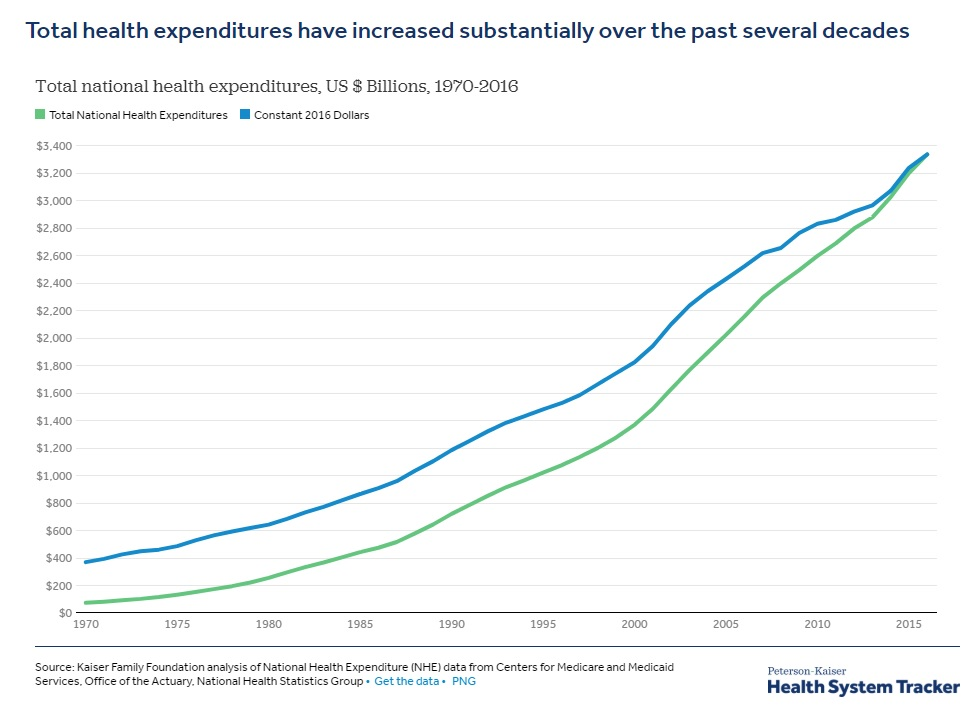
    If you think “economic epidemic” is a hyperbolic term to use in this context, think again. As referenced in my previous blog post about the continuing battle to repeal the ACA, the U.S. domestic healthcare system costs around $3.3 trillion to the American economy each year. What’s less known is that this figure is projected to continue rising as it has almost every year since the 1960s. 

    Chart of how total health expenditures have increased over time. 

    Some are projecting the U.S. to hit bankruptcy as early as the year 2035 if this trend continues to grow as exponentially as it has the past few decades. With baby boomers entering their elder years and both millennials and generation X set to surpass the population totals of the boomers by 2028 (Millennials in ’19 and Gen X in ’28), we can expect the requirements of our nation’s healthcare program to rise as well. Now is the time for change. As I alluded to earlier in this piece, we need to be cognizant of our past mistakes to ensure they aren’t repeated down the road with financially dire consequences. 

    The MLR Rule: Medical-Loss Ratio

    The MLR rule is a lesser known mandate to the public that was included in ACA implementation. Some will argue that it had positive intentions in how our insurers spend premium dollars, which isn’t incorrect in theory, but it has a troubling method in which it determines how the rule is executed. 

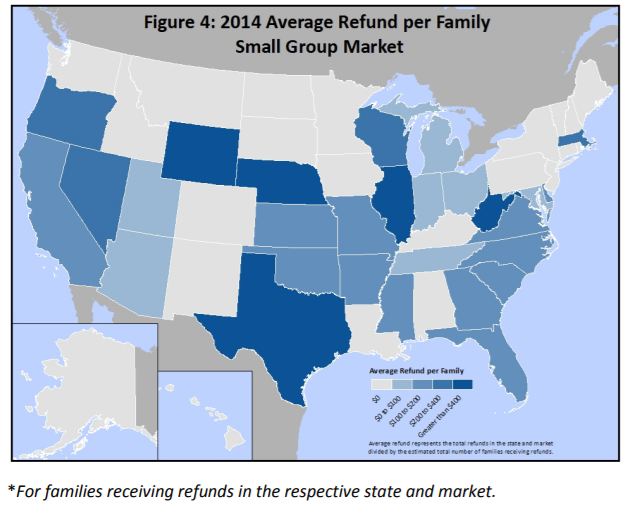
    In short, the MLR rule for small employers dictates that insurers must spend 80% of every premium dollar (it’s 85% for large employers) toward actual medical expenses, claims, and quality improvement. This percentage does not include items such as advertising, administrative costs, and profit to which the remaining 20-15% of premiums are spent. There are provisions in place that when insurers fail to satisfy at least an 80% loss ratio they must issue rebates back to consumers. These rebates totaled $469 million dollars in 2014, with 29.86% of those rebates attributed to the small group (under 500 employees) market. 

    Map of the average refund per family in the small group market. 

    Image via the Centers for Medicare & Medicaid Services

    Many insurers will build in features such as risk assessments, screenings, and coaching hotlines to ensure their “medical expenses” reach the MLR threshold regardless of whether their consumers are likely to use those enhancements or not. 

    The failings of this rule are relatively simple to point out in economic terms: if an insurer’s profits are dictated by a fixed percentage of product costs—in this case we’re speaking of “cost” as medical premiums—the business/insurer has every incentive to see the overall cost of its product rise, thus increasing profit margins. 

    As we diagnose some of the issues included in the ACA and what to avoid in future reform policies, I think this percentage based MLR rule must be exiled. Our economy can’t afford to maintain the rate of rising healthcare costs with large insurers incentivized to maintain a similar mantra. I think we can achieve a healthy balance between the two, but improved consumer-centric policies must serve as the catalyst.

    Current Solutions for Businesses: Self-Funding 

    Although the tone of this article may seem slightly cynical, I promise it’s not meant to be. However, I do think it’s necessary to be transparent of the flaws within our current system. There are alternative options for businesses looking to get ahead of the upcoming reform trend before it hits home in the coming years.

    One solution is self-funding, which was included in the ACA as an alternative funding source outside of fully funded group insurance and is immune to the MLR rule. The immunity to MLR and other provisions within the ACA allow self-funded groups to control healthcare spending by accessing live claims data, become risk rated, and earn back unused premium at the end of their policy year. Since most self-funded groups aren’t managed by a large carrier, but rather the business itself or a reinsurer with similar interests as the group, premium costs are more easily maintained to fit an appropriate fiscal trend without the controversial incentives found nestled within the ACA. 

    With GMS specializing in level-funding, a form of self-funding, we feel that the transparency of our healthcare consultants and creative product solutions align us with the goals of many employers. Continue to follow GMS benefit related blog posts to stay on top of current healthcare advances and reach out to your local office to learn more about the healthcare solutions we can create together.

  • Following a 19.1 percent-32 percent hike in 2018, 2019 Obamacare rates are expected to rise by double digit percentage points, again. Though speculation by market experts have resulted in a slew of responses as to why premiums have continued to rise, 2019’s increase is one of the most cut and dry responses by insurers to current reform changes. Within this article, we’ll explore the proverbial straw that broke the camel’s back, which happens to be one of the pillars the ACA was built on: the individual mandate.

    Medical equipment sitting in front of rising costs of the current healthcare system.

    On Dec. 22, 2017, President Donald Trump signed a bill that effectively repealed the penalties associated with the ACA individual mandate. In a previously published blog post, I detailed the legislative headache this bill caused but the effects span much further than a complicated ruling by the Justice Department. As the financial implications begin to be rolled out to the public in the form of premium increases for ACA policies, let’s peel back the initial goals for the individual mandate and evaluate how we can improve on said goals during the next round of regulatory changes. 

    Improving the “Risk Pool”

    The ACA’s community rating system is geared towards diversifying risk within its pool of insured consumers. In short this means combining old, young, healthy, and ill individuals into one large risk pool from which insurers are to offer coverage. Ideally, this community pool would reduce the overall risk and stabilize premium rates. The mandate had an overarching goal of expanding this pool by including previous uninsured individuals. 

    Enforcing the Tax Penalty  

    To ensure that the ACA’s pool is properly diversified, a tax penalty was implemented to deter folks from electing to go without insurance and effectively remove themselves from the aforementioned risk pool. This “penalty” has been a serious point of contention over the last few years as it was made constitutional by being defined as a tax by the IRS rather than a penalty for lack of purchase. 

    Prior to it’s repeal, many believe the tax associated with the individual mandate was in fact too low. If one were to simply accept the tax penalty and go without coverage, they’d likely spend much less money than what a year’s worth of major medical premiums cost. This was a major concern for ACA supporters in that the very goal put in place to increase younger and healthier enrollment was doing quite the opposite. If early ACA adopters could redefine one detail regarding the bill, a higher tax to make the choice between going with or without coverage more difficult likely tops their list. 

    Premium Tax Credit

    For individuals that followed the direction of the mandate’s initiatives, a tax credit on premium was issued assuming you met certain financial guidelines. Generally speaking, subscribers would receive enough credit to keep their premium payments below 9.5 percent of household income. The amount of each subsidy issued was determined by your take home pay, but even individuals making up to four times the federal poverty limit were eligible for some form of tax credit. 

    Some experts believe that tax credits were extended too far and for too many individuals. Cutting back on the top 10 percent of earners still receiving tax credits would make a larger pool of funds available to those closer to the federal poverty limit. In an ideal world, this theoretical increase in available funds for lower earners would increase the likelihood of them implementing coverage. With most of those low earners being young post-grads, it would have behooved ACA implementers to entice those individuals into joining the risk pool by any means necessary. 

    Making Healthcare More Available and Affordable

    Hopefully the above factors and failures will open discussions to innovative and reflective reform changes. If nothing else, it should provide a blueprint for what to avoid when attempting to make our domestic healthcare more available and more affordable. 

    At GMS, we pride ourselves on relaying insightful and valuable information to our clients and their workforces. We offer unique benefit platforms and comprehensive consultation services. Reach out to your local office and inquire about how we can help you today!

  • When Donald Trump ran for the Presidency in 2016, a major plank of his platform was the repeal and replacement of the Affordable Care Act. In fact, pretty much every Republican in 2016 ran on that promise.

    In the summer of 2017, several Republican Senators and every Democrat Senator torpedoed that promise by not agreeing to a plan. Since then, this administration has made several attempts to sink the ACA where they could.

    A gavel of a judge blocking new association health plan rules meant to sink the affordable care act.

    The Trump Administration’s Attempts to Sink the ACA Through AHPs

    The first, and perhaps most powerful as far as Washington D.C. is concerned, attempt is the decision to no longer enforce the individual mandate. If you recall, there was supposed to be a financial penalty on any individual who didn’t have an insurance plan through an employer or on their own. The problem with that plan was always twofold:

    • If you weren’t working or weren’t filing taxes, there was no way for the IRS to collect that penalty.
    • In many instances, the penalty was less costly than the insurance itself.

    The administration began creating new rules for Association Health Plans (AHPs). These AHPs allowed “businesses and individuals [to] band together to create group health plans that offer less expensive coverage than the ACA.” In other words, Associations could pull together multiple employers and individuals into a larger group, offering better rates. In most cases, the trade-off was no protections for what was deemed “minimal coverage.”

    Recently, a federal judge ruled that the Trump Administration attempted an “end run” around the ACA and, in effect, violated the Affordable Care Act.

    Affordable Healthcare Options for Business Owners

    If you are a business owner and you thought these plans were a way to get out from under the considerable financial burdens of the ACA, you may be back at square one.

    Well, there may still be a multiple-employer healthcare option for you. If you would like to learn more about the large group buying power of a Professional Employer Organization (PEO), as well getting additional HR services and regulatory and tax protections, please contact GMS to talk to one of our experts today.

  • The 50-employee mark is more than just a milestone; it’s also an important number for some major regulation requirements. Once your business has 50 full-time employees, various federal and state laws become mandatory, which can wreak havoc on your business if you don’t prepare for them. Here’s what your business needs to do to stay compliant once it reaches 50 full-time employees.

    Multiple employees during a training session at an applicable large employer.

    Health Insurance

    While smaller businesses can choose to offer health insurance, it becomes a requirement once your business reaches 50 or more full-time or full-time equivalent employees. At that point, the Affordable Care Act designates your business as an applicable large employer (ALE).

    Any ALE is required to meet the employer shared responsibility provisions found in the Affordable Care Act. These provisions give ALEs two options:

    • Offer health coverage that the ACA deems “affordable and provides “minimum value” to full-time employees and their dependents
    • Make a payment to the IRS any of the ALE’s full-time employees receive a premium tax credit for purchasing individual coverage on a Health Insurance Marketplace

    In addition to offering coverage – or opting to not offer coverage and pay penalties – ALEs are required to report to the IRS about their health care coverage. This means every ALE must file both Form 1095-C and Form 1094-C to the IRS, as well as a similar statement for each full-time employee.

    Determining full-time equivalent employees

    You may have noticed that threshold to be considered an ALE was set at 50 full-time or full-time equivalent employees. This means that you don’t need 50 strictly full-time employees to meet ALE designation if you have enough part-time individuals to qualify.
    Full-time employees include any worker who averages at least 30 hours of service per week in a calendar month. Full-time equivalent employees are a combination of individuals who do not meet full-time specifications, but whose combined work is determined to equate to that of a full-time worker.
    Per the IRS, there is a two-step process to determine the number of full-time equivalent employees at your business.

    1. Combine the number of hours of service of all non-full-time employees for the month (do not include more than 120 hours of service per employee)
    2. Divide the total by 120

    The total number represents a company’s number of full-time equivalent employees. That total would then be added to the number of regular full-time employees. If the combined number is at least 50 – for example, 40 full-time employees and 10 full-time equivalent employees – your business is considered an ALE.

    Family Medical Leave Act (FMLA)

    Unlike the Affordable Care Act, the Department of Labor (DOL) does not look to full-time and full-time equivalent employees to determine which businesses must comply with FMLA. Instead, the DOL simply writes that “private employers with at least 50 employees are covered by FMLA.” FMLA also applies to businesses with fluctuating workforces as long as they had at least 50 employees for 20 or more total workweeks in the current or previous year. These employees must then meet the following stipulations to be eligible for FMLA:

    • Work for the employer for at least 12 months
    • Work at least 1,250 hours during the 12 months before the start of leave
    • Work at a jobsite where the employer has at least 50 employees within 75 miles

    If eligible, employees are entitled to take unpaid, job-protected leave for various permissible reasons. These include taking up to 12 weeks of leave in a 12-month period for the following:

    • The birth of a child and to bond with the newborn child within one year of birth
    • The placement with the employee of a child for adoption or foster care and to bond with the newly placed child within one year of placement
    • A serious health condition that makes the employee unable to perform the functions of his or her job
    • To care for the employee’s spouse, son, daughter, or parent who has a serious health condition

    FMLA Compliance requirements

    Covered employers must also take steps to notify employees about FMLA rights. The first step is to display an FMLA poster prepared by the DOL at all locations. The next is to provide general notice with the same information as the poster in the employee handbook. If no handbook exists – and it absolutely should – employers must distribute a general notice to all employees and any new individuals when hired.

    As expected, the FMLA has penalties in place for any employers who meet the 50-employee threshold who deny or interfere with permitted leave or fail to meet notification requirements. Updated penalty amounts can be found on the DOL website.

    Miscellaneous State Laws

    Only looking to federal requirements can land your business in hot water. Certain states have their own regulations for businesses once they reach the 50-employee threshold. One of the more notable examples is that New York employers with 50-plus full-time employees must give at least 90 days’ written notice for mass layoffs, employment losses, or relocations. This law is a variation of the federal Worker Adjustment and Retraining Notification Act (WARN), which only applies to businesses with at least 100 employers. As a result, you’ll want to consult with your state government’s site to review any local laws that go into effect at the 50-employee threshold.

    Prepare Your Growing Business

    Growth is great, but it can become a major problem if you aren’t prepared for the additional compliance concerns and internal responsibilities. More employees mean more time spent handling payroll managementbenefits administration, and other key HR needs – unless you find a partner that can manage these critical functions and save you much-needed time.

    Whether you’re a startup or a 50-plus employee business, Group Management Services provides professional HR management to help you make your business simpler, safer, and stronger while you focus on ways to grow your company. Contact us today to talk to one of our experts about what we can do to help you protect your company now and prepare for the future.