2025 W-2 Forms are now available in your GMS Connect employee portal here.

  • In the 12 years that I’ve been working for GMS, I’ve met with thousands of business owners in hundreds of industries. While every company has their unique problems and issues, some issues tend to be universal.  In the 26 years that GMS has been in business, we have found that most business owners… 

    • Think they’re paying too much in worker’s compensation premiums and not getting enough in return for it.
    • Want to offer their employees great health insurance, but don’t want to pay the ridiculous premiums being charged.
    • Don’t fight their unemployment claims because “it’s just not worth it and they’re going to get it anyway.”
    • Hate the stupid bureaucratic paperwork they have to go through, keeping them from more important tasks.
    • Have trouble finding good employees.
    • Have a hard time keeping them when they do find them because they’re losing them to other companies with better wages and benefits.

    Did I miss anything?

    A small business growing with the help of a PEO serving as an outsourced HR department. 

    Why Do Big Competitors Have an Advantage?

    So now, small business owners often compete against bigger companies and are at a distinct disadvantage. Why? Because large companies tend to have a few things that small businesses don’t:

    • A payroll department that pays the employees, takes care of their W-2s, does all their quarterly filings, etc.
    • An internal benefits department that gets the best rates for them on their ancillary benefits and 401k, and is more often than not, self-insured for their healthcare, giving them the data they need to better manage their benefits and control those costs.
    • An internal risk department that manages all their workers’ comp and unemployment claims and has the legal power to contest claims that they feel are fraudulent.
    • An HR department that handles the entire lifecycle of an employee from the recruiting, either done internally or through a service, onboarding, training, and eventual separation by departure or retirement.

    How You Can Compete

    Fortunately, there are measures you can take to stand with the competition. If you’re like most companies your size, you can:

    • Hire an accountant or a payroll service to handle your payroll.
    • Use a broker for your benefits and rely on your accountant or financial advisor to set you up with the best possible retirement plan option.
    • Sign up with a TPA or insurance broker to manage your worker’s comp, hoping for the best possible discount and then pray you don’t lose it.
    • Waste your time fighting unemployment claims, or worse yet, don’t contest them at all.
    • Use a recruiter, word of mouth or a sign in your front yard trying to find help and then hope that you’re doing all the right things from a regulatory standpoint.

    Well, that’s why the PEO industry, Professional Employer Organization, was created back in the 1970s and has grown to a $176 billion industry and why GMS is rapidly becoming one of the largest PEOs in the country. By acting as an outsourced HR department, our clients get all the same benefits of a large company and you can get:  

    • An internal payroll department that takes on all the tax liability of your employees.
    • A benefits department that can get you the best rates and possibly even into a self-insured healthcare plan with minimal risk. You also have the option of a 401k plan that is low cost and relieves you of fiduciary responsibility.
    • A risk management department that is self-insured for worker’s comp, providing better rates as well as complimentary legal service on all claims, both for worker’s comp and unemployment.
    • An HR department that handles everything from the onboarding of employees to termination and everything in between as well as keeping you compliant with all government regulations.

    The best part is that you’re getting all these specialists for less than it would cost you to hire one of them in even a part-time capacity. At its basic level, a PEO consolidates your vendors, increases your buying power, and provides HR support and recruiting assistance to help you in that growth. How do we do that? Through the PEO relationship.

    We partner with our clients and mutually share or co-employ our clients’ employees. By adding their employees to our PEO, GMS is a 26,000-employee company that has the leverage to be self-insured for our worker’s comp and healthcare and get better rates on everything from 401k to vision, dental, life, disability, drug testing, background checks, etc.  Virtually everything necessary for employee management.

    Contact GMS today to talk to one of our experts about what we can do to level the playing field for your business.

  • Managing the operations of a small business is costly and requires time away from more valuable projects. That’s why many small and mid-size businesses outsource human resources, payroll, employee benefits, and risk management services. A PEO (Professional Employer Organization) can help take these responsibilities off the plate of business owners, so they can focus on the growth and success of their business.

    We’ve put together a guide to understand what PEO services entail and how to choose the right PEO for your business.

    PEO services help small and mid-size businesses with employee management.

    What is a PEO?

    A PEO provides comprehensive business solutions and services. Through the co-employment model, PEOs work with small and mid-size businesses to:

    • Manage payroll and tax administration
    • Manage human resources and risk management functions
    • Provide employee benefits
    • Stay compliant

    By providing these services, PEOs help make the companies they serve a better place to work and conduct business. This typically translates into faster growth, higher retention rates, and increased success for businesses. The National Association of Professional Employer Organizations (NAPEO) found that businesses working with a PEO:

    • Grow 7 to 9 percent faster
    • Have 10 to 14 percent lower employee turnover
    • Are 50 percent less likely to go out of business

    PEOs help businesses grow by allowing them to spend more time improving productivity and profitability while focusing on their core mission. Additionally, employees benefit by gaining access to big-business employee benefits such as 401(k) plans, wellness programs, and health, dental, life and other insurance offerings. All of this contributes to the success of a company.

    How to Choose a PEO

    There are more than 900 PEOs in the U.S., according to NAPEO. With so many options, it can be hard to know which one to choose. Follow these tips to help you to choose the right PEO for your business.

    Assess Your Business Needs

    Before talking to a PEO, you should take stock of your business needs. What current challenges does your business face? Do you anticipate any changes to your company that could impact the services you need? Look at facets of your business, such as:

    • Payroll: Between managing payroll and filing taxes, small and mid-sized companies spend an average of $2,000 per employee each year to handle payroll and many incur IRS penalties each year due to compliance issues. Outsourcing payroll services to a PEO can save you time and money by providing you with a simplified, online payroll system.
    • Human Resources: From recruiting and retaining employees to tracking vacation time, managing your company’s HR responsibilities takes a lot of time. Outsourcing these HR functions to a PEO can help you save time and money, while growing your business.
    • Risk Management: Managing your company’s risk on your own can be time-consuming and costly. Instead, you can build toward a more secure future by outsourcing to experts at a PEO. PEOs can help you qualify for workers’ compensation discounts, keep unemployment tax rates down, and create a safer environment for your employees.

    Identifying your needs within each of these categories will help you better determine how your business will use a PEO and set the stage for choosing a qualified partner.

    Build Your Benefits Package

    Employee benefits will make your business a great place to work and help retain talent. While you’ll be hard pressed to find a PEO that doesn’t offer access to health insurance, the providers they work with and the amount of coverage their plans provide will vary. In addition to assessing your business needs, you’ll need a good sense of what types of health coverage your current and future employees will require and what you’re willing to spend on it.

    When you work with a PEO, instead of directly with insurance companies, you’ll be able to leverage buying power through mass policies, which lets you take advantage of purchasing multiple policies at typically lower premiums.

    Speaking of multiple policies, you’ll also want to consider other benefits like dental, vision, and life insurance as well as 401(k) retirement savings programs to make your business more attractive to quality candidates. Additionally, wellness programs can help manage your premiums, while keeping your business running like a well-oiled machine. Whichever benefits are most appealing for your business, you’ll want to do your research to make sure you find a PEO that has everything you require.

    Perform a PEO background check

    When vetting PEOs, it’s important to look at their history, experience, and qualifications. Ask questions, such as:

    • How many companies do they partner with?
    • Do they have experience working in your industry?
    • How many employees do they represent?
    • What is their client retention rate?

    And don’t forget to look at reviews from places like Google and Facebook. These are all telling signs of whether a PEO will be able to properly handle your business needs.

    Additionally, accreditations from organizations like the Better Business Bureau (BBB) and certifications, such as the Certification Program for Professional Employer Organizations (CPEOs) from the IRS, help demonstrate trustworthiness and reliability in a PEO. CPEO certification affects the employment tax liabilities of both the CPEO and its customers. To become and remain certified under the CPEO program, CPEOs must meet tax status, background, experience, business location, financial reporting, bonding, and other requirements. With only 37 CPEOs in the country, small businesses know they are working with a trusted partner.

    Evaluate a PEO’s Technology

    The purpose of PEO is to make your life easier. If the technology platform that a PEO offers isn’t simple to use, then the PEO is going to be more of a burden than an asset to your company. Web-based payroll portals benefit employers by compiling everything they need to manage their back office in one place. They also help employees get paid on time, track time, and access W-2’s and paystubs.

    Your PEO’s online payroll system should help employers:

    • Manage and access payroll information
    • Complete payroll in minutes, not hours
    • Easily keep track of deductions
    • Simplify workers’ compensation calculations and payments
    • Generate on-demand payroll reports

    These payroll functions streamline the process for employers and keep employees satisfied.

    Beyond payroll, any other administrative functions a PEO can digitize is only to your advantage. Your PEO should offer online data collection services for:

    • Employee reviews
    • Timekeeping and PTO requests
    • Health insurance and employee benefits
    • Company communication
    • Employee handbooks

    Being able to store these types of files in an online portal makes it easier for you to access, edit, and track.

    Focus on Your Business

    The point of working with a PEO is to ease your workload. A PEO that you have to manage is only going to add to your stress and laundry list of tasks and responsibilities. Knowing your PEO is taking care of your more administrative needs while you focus on the core of your business is comforting to business owners.

    Your PEO should provide you with designated HR, payroll, and benefits specialists to meet all of your needs. Additionally, your PEO should have a comprehensive risk management team, from  safety specialists that keep your workplace and employees safe, to unemployment and workers’ compensation experts to investigate and help process claims.

    By having a PEO handle the HR, payroll, benefits, and risk management side of your business, you’ll be able to focus on what really matters: building your business.

    Work With a PEO

    When you work with a PEO, you need to make sure all your needs will be met. Group Management Services offers payroll, human resources, employee benefits, and risk management services to help your business succeed. With our proven history, easy-to-use online payroll portal, and dedicated team of experts, GMS is proud to take on your administrative burdens. When you work with us, you can put your focus back on client relationships, building an effective team, and growing your profits, while we help you reduce costs, limit risk, and save time and money.

    Ready to work with a best-in class PEO? Contact GMS today to talk with one of our experts to see how we can make your business simpler, safer, and stronger.

  • A recent article written by the Wall Street Journal  outlines some startling financial data in regard to our domestic health insurers and their cryptic billing process established by CMS (Center for Medicare/Medicaid Services). Although GMS typically focuses on the private insurance markets—as they are the most relevant for businesses—examining the continued failures of CMS may provide some insight as to why our domestic healthcare system operates so poorly and why prices for both public and private health insurance markets are sky-rocketing.  

    Costs associated with the U.S. healthcare system. 

    A Look into the Market’s Rising Prices

    Medicare is a socially-funded program meant to provide health benefits for tax-paying citizens age 65 and older and permanently-disabled individuals of all ages. Medicare, a majority of the CMS which also splits some funding with state and federal Medicaid programs, is typically divided into four parts, coined Medicare parts:

    • A (Hospital insurance)
    • B (Supplementary Medical insurance)
    • C (Medicare Advantage)
    • D (Medicare prescription drug benefit(s)) 

    Medicare is funded primarily by tax-payers and Medicare subscribers who are required to pay a monthly premium to utilize the benefits provided through CMS policies.

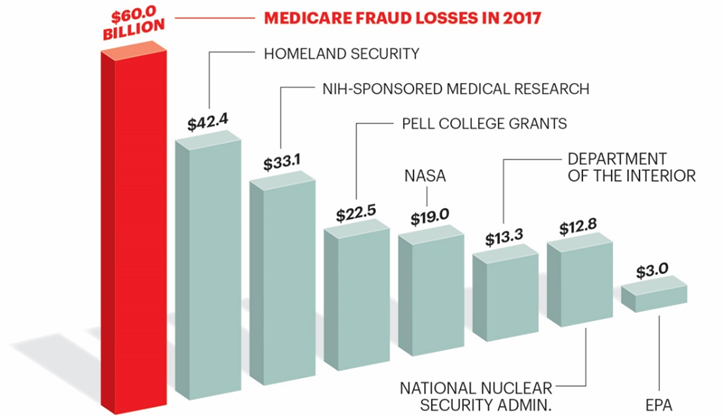
    What most citizens don’t know is that CMS is the largest buyer of healthcare policies in the world and files enough fraud, waste, and abuse statistics to land itself within the Fortune’s 500 top 50 based solely on the amount of money lost each year. That’s right, the fraud waste and abuse of Medicare in 2017 was enough to top revenue for entire organizations like Best Buy, Disney, and Fed-Ex. The figure also dwarfs the full budgets for programs like Homeland Security, the EPA, and NASA by tens of billions of dollars, if not more. 

    As astonishing as those statement may be, these trends have continued almost every quarter, year, and decade since 1965:

    Healthcare loss trends. 

    Contributing to this $60 billion eyesore is an antiquated billing system that largely remains confidential. What the WSJ highlighted (and what we’ll continue to discuss for the remainder of this article) are the overpayments made to Medicare Part-D insurers for inaccurate estimations of cost for upcoming fiscal years (FY). As detailed above, Part-D handles the Rx benefits for Medicare subscribers and is interestingly administered 100 percent by private insurers. 

    These “overpayments” surpassed the $9 billion mark from 2006-2015 and were paid out to private insurers on top of existing revenue for administering these Part-D plans. The question as to how $9 billion seemingly slipped through taxpayers’ hands and into the revenue stream of top-insurers is what’s intriguing… or maybe infuriating is the right word to use here. 

    The Bidding Process for Private Insurers

    In order to address that question, we’ll need to take a brief look into the bidding process for these private insurers and how re-payments by CMS are made on an annual basis.

    Every summer Part-D insurers send detailed cost-projections for what it would take to fund all Medicare Part-D subscribers’ prescription costs for the following year (about 40 million people). These projections are split into two main categories: Direct Subsidies and Reinsurance Subsidies.

    Direct Subsidies contain projections for the majority of services through Part-D. When insurers submit these bids and real costs fall below what was originally projected, CMS allows insurers keep a portion of the difference. Keep in mind that these “projections or bids” are what Medicare bills to taxpayers to ensure proper coverage. In this case, insurers are seemingly incentivized to inflate their bids (by an obvious but overlooked billing loophole) knowing they’ll get to keep some of what isn’t used by the Medicare Part-D population while taxpayers get to bear the financial brunt of these egregious errors. 

    Reinsurance Subsidies are siloed for Medicare subscribers that have extremely high-costing medications. These high-costing medications, sometimes referred to as “specialty” meds, can often times be upwards of $5,000 for a 30-day supply. Humira, a popular drug that’s used to treat Rheumatoid Arthritis among other chronic illnesses and is often advertised on television, will run you about $6,409 for a 28-day supply without applicable medical or prescription insurance. For these subsidies, insurers must pay back any overages in cost projections should they fall above what was actually spent. However, if insurers’ projections fall below what was actually spent, Medicare will fund the remaining amount. 

    Imagine you’re the controlling party for one of these large private insurers. If you could legally receive billions of dollars simply by “over-projecting” one of your bids and legally save billions of dollars by undercutting a different bid with the sum of those earnings or savings being pushed off to the subscribers you’re insuring and American tax-payers, what would you chose? 

    The Grave Reality of the U.S. Healthcare System

    Given the above details, the first question that comes to mind might sound something like this: “So Medicare Part-D allows 100 percent administration of a federally subsidized program by private insurance companies, but also allows said companies to submit their own budget forecasts and allows them to keep some of that allocated money if they’re wrong in creating those budgets?” With an 11 percent error rate in 2016 Medicare payments, it’s not hard to see how this staggering $9 billion figure is only a fraction of what the programs wastes annually. Applying these malpractices to a $3.5 trillion-dollar industry (the United States healthcare system, which is showing steady annual spending growth and will likely eat over 25 percent of the GDP within the next decade) and the grave reality of what’s at stake is easily recognizable. 

    I would highly encourage anyone interested to read more about the WSJ’s findings, but will conclude with the following:

    As the economic epidemic of our healthcare system continues to worsen, it’s articles like this from the WSJ that bring to light how much taxpayer money is truly wasted through an irresponsibly administered system like CMS. The issues found here can be replicated time and time again throughout various programs in our healthcare system and are a big piece of why healthcare costs, specifically insurance premiums, continue to climb. 

    Although it’s not always enjoyable to put these concerning statistics and unsavory business practices in frame for our readers, the transparency that GMS owes to our clientele will always reign. If you’re interested in working with realistic brokers to create modern solutions for your group’s health plan, contact GMS to speak with a dedicated healthcare professional.

  • In the past, business owners in Michigan had the option of whether they wanted to offer paid sick leave for their employees. However, Michigan adopted the Earned Sick Time Act (ESTA) Sept. 5, 2018, making it the 11th state to have a mandatory paid sick leave law in effect. Within a few months, the state’s legislature amended the bill, adopting the Paid Medical Leave Act (PMLA) as a modified version of the initial act that will go into effect starting March of 2019. 

    With all the changes in Michigan’s paid sick leave laws, it’s time for business owners in the state to take stock of exactly what the PMLA requires of them, if they should reevaluate their paid leave policies, and what they need to do to be compliant with the new law.

    An employee staying home through her company’s paid sick leave policy. 

    What the Paid Medical Leave Act Does

    The short answer is simple: staring in March, employees in Michigan will accrue paid sick time based on the amount of time they work. 

    Which Businesses are Affected

    While the ESTA originally impacted all businesses to some degree, the PMLA only covers employers with 50 or more individuals. However, small employers with fewer than 50 individuals may offer paid medical leave if they choose to do so.

    Which Employees are Affected

    The ESTA had a broader definition of eligible employees, which included full-time employees, part-time employees, independent contractors, and temps. The PMLA limits the scope of which employees are eligible for paid sick leave with a dozen exclusions listed out in the senate bill.

    • An individual who is exempt from overtime requirements under section 13(a)(1) of the fair labor standards act, 29 USC 213(a)(1)
    • An individual who is not employed by a public agency, as that term is defined in section 3 of the fair labor standards act, 29 USC 203, and who is covered by a collective bargaining agreement that is in effect
    • An individual employed by the United States government, another state, or a political subdivision of another state
    • An individual employed by an air carrier as a flight deck or cabin crew member that is subject to title II of the railway labor act, 45 USC 151 to 188
    • An employee as described in section 201 of the railway labor act, 45 USC 181
    • An employee as defined in section 1 of the railroad unemployment insurance act, 45 USC 351
    • An individual whose primary work location is not in Michigan
    • An individual whose minimum hourly wage rate is determined under section 4b of the improved workforce opportunity wage act, 2018 PA 337, MCL 408.934b
    • An individual described in section 29(1)(l) of the Michigan employment security act, 1936 (Ex Sess) PA 1, MCL 421.29
    • An individual employed by an employer for 25 weeks or fewer in a calendar year for a job scheduled for 25 weeks or fewer
    • A variable hour employee as defined in 26 CFR 54.4980H-1
    • An individual who worked, on average, fewer than 25 hours per week during the immediately preceding calendar year

    How Time is Accrued

    Both the ESTA and PMLA agreed that eligible employees are set to earn paid medical leave as soon as the act goes into effect March 2019. However, the FMLA changes the rate of accrual from one hour per every 30 hours to one per every 35 hours of service time. It also limits accrual to only one hour of paid sick leave in a calendar week. 

    In addition, the FMLA lowers the cap for paid leave to 40 hours per year instead of the ESTA’s 72. Time can be carried over into the next year, but usage is still capped at 40 hours. The PMLA also added an allowance for employers to add a waiting period of 90 calendar days before new hires can use paid sick leave.

    How Time is Used

    In terms of use, employees have a lot of wiggle room. Foreseeable leave, such as planned surgeries, procedures, etc., require up to seven days of notice. However, a sudden illness is not foreseeable, which means employees only need to give notice of sick leave as soon as reasonably possible. Earned paid leave can be used in one-hour increments, although the PMLA does permit employers to set a different increment policy in their employee handbooks.

    Another notable difference between the PMLA and the ESTA is that the amended bill gives employers more freedom to request documentation. Per the PMLA, employers can require reasonable documentation when employees use paid leave for absences of less than three days. In addition, employees have at least three days to provide the necessary documentation for absences.

    What it Means for Your Business

    If you have a business in Michigan and that business has fewer than 50 individuals, the PMLA won’t directly affect you. However, the act is part of a growing trend of more states adopting some form of required paid sick leave. This trend can serve as an opportunity to attract and retain better talent.

    Whether or not paid sick leave is mandatory for your business, you can still make it feel like a benefit for your employees. According to Access Perks, 88 percent of employees named sick leave as one of the most desirable PTO benefits. By offering paid sick leave—especially one that goes beyond any legally-required minimums—you can make your business more attractive to potential job candidates while rewarding your current employees.

    It is important to note that some business owners may be concerned that employees may abuse paid sick leave. However, that may not necessarily be the case. Monster notes that absenteeism did not notably increase when a paid sick leave law was passed in San Francisco and that the same employees who were likely to falsely call in sick in the past are the same who would abuse paid leave when it’s offered. 

    In fact, Access Perks notes that “89 percent of employees come to work sick with 19 percent admitting to doing this more than once a month.” By giving your employees the opportunity to take paid sick leave, they’ll be more inclined to use it when they really need it instead of forcing themselves to come to work and infecting other employees.

    How to Protect Your Business

    Regardless of your paid leave policy, you’ll need to adjust your policies and employee handbook. An outdated handbook can open you up to liability concerns, so it’s important to have your paid leave policy laid out so that employees have a clear understanding of the rules. It also allows you to have documentation in place to protect you from any legal claims against your company.  

    Another way to be safe is to work with experts who can help you roll out a new paid sick leave policy or any other program. As a Professional Employer Organization, GMS can help you establish an attractive benefits package and update your handbook appropriately. We can also help you stay ahead of new legislation or upcoming changes that may impact your business so you can act ahead of time. 

    Whether you need help with a paid leave policy or some other important business need, our Detroit branch or one of our other locations across the country can assist with risk managementoutsourcing payrollbenefits administration, and other key HR functions. Contact GMS today to talk to one of our experts about how we can help your business.

  • Winter isn’t coming—it’s here. The falling snow and frigid air are good reminders to prepare your workplace for the winter months ahead. From power outages to workplace injuries, winter weather can have some chilling effects on your business operations. Read on to understand why workplace safety is important and the winter workplace safety measures your organization should take this season.

     Implementing winter workplace safety tips help keep these two businessmen shaking hands safe.

    Why Invest in Workplace Safety

    Winter weather can cause many workplace injuries and safety hazards. Don’t think your organization is immune. For example, in 2014, there were 42,480 work injuries involving ice, sleet, or snow that required at least one day to recuperate, according to the U.S. Bureau of Labor Statistics. These injuries resulted from falls, slips or trips; overexertion and bodily reaction; and transportation incidents. However, had the proper winter workplace safety precautions been taken, many of these workplace injuries likely could have been prevented.

    Workplace injuries not only result in lost work hours, but safety violations can also lead to costly fines. The average penalty for a willful or repeated violation is $129,336. Additionally, your insurance rate will go up with the more workers compensation costs your organization takes on. To avoid these expenses, it’s best to implement loss prevention strategies before workplace accidents happen. Through human resource and risk management tactics, you can build toward a more secure future for your company while saving time and cutting costs for your business in the process.

    Winter Workplace Safety Tips

    Businesses can’t keep operations running and thriving without a healthy and efficient workforce. That’s why it’s important to prepare for the elements now to keep your employees safe and ensure your workplace continues to run smoothly during the winter months. 

    Here are a few winter workplace safety measures you can implement at your organization this season:

    Prevent slip-and-fall accidents

    Snow, ice and freezing temperatures in the winter can create wet and slippery surfaces at work that will lead to accidents. Most snow and ice-related slip and falls happen outdoors, so make sure your parking lots, driveways, and walkways are cleared and salted so workers can travel safely between the worksite and their vehicle.

    Winter workplace accidents can also occur indoors, especially in entryways, hallways, and other rooms where ice and snow have been tracked in from outside. Lay down absorbent mats and set up wet floor signs to help employees safely move around the office during the winter months.

    Safeguard your air quality

    Cold temps lead to tightly sealed workplaces, so the office can get a bit stuffy during the winter months. According to the U.S. Environmental Protection Agency, the levels of contaminants and pollutants found in indoor air can be between 2 and 5 times higher than outdoor air. 

    To prevent the accumulation and buildup of contaminants inside your workplace, use cleaning, break room, maintenance, and office supplies that don’t emit vapors or distribute contaminants. Also, take advantage of warm winter days to open the windows and filter some of the air out.

    Back up utilities, technology, and data

    Power outages can happen when weather conditions take a turn for the worse, causing technology and utilities to fail. In case the electricity goes out, keep flashlights stashed around the office so employees can safely navigate their way to the exit. Additionally, pipes can freeze and burst if the heat is off for too long and sump pump failure could cause flooding. Consider investing in a backup power generator to keep the building utilities running smoothly.

    A bad storm can also cause electrical surges that can damage expensive technology equipment, such as computers, printers, TVs, and data centers. Make sure your devices are hooked into surge protectors to avoid any electrical damage. Additionally, loss of power can result in loss of company data. Regularly back up data through a hosted off-site or onsite service, and make sure your back-up system is functioning properly before a potential storm hits.

    Allow a work-from-home option

    Inclement weather can affect an employee’s ability to get to work safely and in a timely manner, so it’s important to have a telecommuting policy in place. Every year, more than 1,300 people are killed and 116,800 people are injured in vehicle crashes on snowy, slushy, or icy pavement, according to the U.S. Department of Transportation Federal Highway Administration (FHWA).

    Not to mention, the time your employees waste on a lengthy winter commute could be put to better use if they avoid it altogether and work from home. The FHWA says speeds can be reduced by as much as 40 percent during bad weather, increasing travel time delay—and the last thing you want is an employee speeding to work to avoid clocking in late.

    If the job permits, encourage your employees to work from home if they feel unsafe commuting to the office during inclement weather. Make sure your staff has the proper equipment, such as access to the company intranet and important contact information saved to do their job effectively from home. During the winter months, employees should get in the habit of taking laptops and work materials home when they leave for the day in case a bad storm rolls in overnight. 

    Keep sick employees out of the office

    Bad weather isn’t the only safety hazard companies have to overcome during the winter months. Colder temperatures often come with a rise in sickness, such as the common cold and flu, and unfortunately, that doesn’t deter some employees from coming into the office.

    According to NSF International, about 1 in 4 employees goes to work when they’re sick. While this might sound good for meeting deadlines, these employees are not only putting the entire office at risk for getting sick, they’re actually being less productive than if they would have just taken a sick day to recover.

    Encourage employees not to come into the office when they’re sick, either by working from home or taking the day off. Sanitize workspaces, especially desks, keyboards, door knobs, and bathroom keys on a more frequent basis during the winter months when flu season is at its peak.

    More Workplace Safety Help

    It’s important for business owners to take a proactive approach to workplace safety, especially during the winter months. Group Management Services can help with onsite consulting, jobsite inspections, accident and injury investigations, training, and education to make sure your workplace is a safe environment for employees.

    As you prepare for the winter, you might also want to think about other ways you can prepare your workplace year-round. GMS offers a variety of payroll, risk management, and human resources services to help keep your business running smoothly all through the year. 

    Want to make your workplace safer? Contact GMS today to talk with one of our experts about how you can ensure workplace safety at your organization.

  • Probably. Maybe. Maybe not. Who knows? Do you know?

    As a Sales Rep for a Professional Employer Organization (PEO), I talk with small to medium-sized business owners on a day-to-day basis. I never cease to be amazed at how well they know their company, their employees, their business, their industry, and their competition. When you spend 80 hours a week working on your business, you become an expert.

    Yet, these same business owners will often tell me, “I don’t know what I don’t know. And even if I knew what I didn’t know, I don’t always know how to find out what I need to fix, remedy, or comply with the situation.” Of course, they don’t. They’re devoting all their time to making a better product and/or a better company.

    If you’re new to the game or haven’t spent a lot of time thinking about this, you might be wondering what regulations I’m speaking of in the title of this post. After all, those are geared towards large companies, not small, independent businesses, right?

    Compliance chalkboard for small businesses.

    Federal Regulations for Business of All Sizes

    Some things are required no matter the size of your company. For example, you must make sure you have I-9 forms on all your employees and that they’re filed correctly.  There are hefty fines tied to misfiled or missing forms. You also need to have the required employment posters hanging in prominent places for your employees so they can see what their workplace rights are.

    Other laws are based on how many employees you have. For example, if you have between one and 10 W-2 employees, these laws apply to you:

    • Fair Labor Standards Act (FLSA)
    • Employee Polygraph Protection
    • Equal Pay Act
    • Consumer Credits Protection Act
    • National Labor Relations Act

    Once you have between 11 and 14 employees, you have to become compliant with OSHA and all federal health and safety standards. That includes all the reporting that comes with it.

    From 15 to 19 employees, you need to start paying attention to the following regulations:

    • Title VII, Civil Rights Act
    • Title I, Americans with Disabilities Act
    • Pregnancy Discrimination Act

    At 20 employees, you have to worry about COBRA (if you’re offering benefits) and Pregnancy Discrimination Act. And it goes on and on and on… you get the idea.

    How to Stay in Compliance with Federal Regulations

    How does a business owner know what they need to be compliant with while working full-time on their business? There are several ways I can think of:

    • During all your downtime, read up on federal regulations and keep tabs on all the changes as they happen
    • Pay an attorney to keep you abreast of these things
    • Hire someone on staff whose sole responsibility is keeping track of these things

    These are all good options, but many small business owners find the best option is to partner with a Professional Employer Organization, like GMS, that will not only keep you compliant but will also take on all the regulatory liability of your employees.

    Recent studies show that small businesses that use PEOs grow 7 to 9 percent faster, have 10 to 14 percent lower employee turnover, and are 50 percent less likely to go out of business. Contact GMS today to learn how we can help take over these administrative burdens, allowing you to focus on your core business.

  • Ever wonder the reasoning behind a paycheck? As in, why does one employee make a certain amount, while another earns more or less? It all comes down to an organization’s compensation philosophy. 

    Does your organization have a compensation philosophy? A WorldatWork survey found that more than nine in 10 companies have a compensation philosophy; however, that doesn’t mean their compensation philosophies are any good. Nearly one in three compensation philosophies aren’t in writing, while about half of employees don’t even know or understand them. This presents a huge missed opportunity for companies, as there are many benefits to pay transparency. 

    Intrigued? Read on to learn what compensation philosophy is and how your organization can benefit from having a good compensation strategy in place.

     A small business owner handing out a paycheck that was based in compensation philosophy.

    What is Compensation Philosophy?

    A compensation philosophy answers the “why” behind employee pay. In a formal, written statement, a compensation philosophy should identify the organization’s pay programs and reward strategies and create a framework for consistency. This basis will serve as the guiding principles that drive decision making regarding compensation at a company.

    Compensation philosophies are typically created by your company’s human resource professionals. That may be a dedicated employee or yourself, depending on the makeup of your business. When developing a compensation philosophy, the Society for Human Resource Management (SHRM) says several factors should be taken into consideration, including:

    • Company’s financial position
    • Size of the organization
    • Industry
    • Business objectives
    • Market salary data
    • Level of difficulty finding qualified talent

    A good compensation philosophy should support the organization’s business goals and objectives, while still being competitive in the market. A reward system for raises and bonuses should also be factored into a compensation philosophy.

    Why is Compensation Philosophy Necessary?

    Compensation philosophies are used to attract, retain, and motivate employees. There are several reasons why your organization should be transparent about your compensation philosophy.

    Demonstrate commitment

    By taking the time to ensure fair compensation strategies, your organization can help employees feel appreciated. According to a survey by the American Psychological Association, 93 percent of employees said they are motivated to do their best work when they feel valued. Sharing your compensation philosophy will show your employees that you care and are invested in their wellbeing.

    Retain employees

    The way you approach compensation can have a direct impact on employee satisfaction. In fact, how they feel about your pay process can be even more important than how much they’re paid. According to a PayScale survey, an employee’s perception of your payroll process is “5.4 times more impactful on how satisfied they are than how they’re paid relative to market.” That suggests that if your organization is fair and transparent about compensation, employee satisfaction and retention rates could increase.

    Attract talent

    Payroll transparency can impact more than just your current employees. Publishing or sharing your compensation philosophy with job candidates should attract more talent and help find the right people whose needs and values align with your philosophy. As SMART Recruit Online found, job listings with a compensation listed increased the total number of candidates by 30 percent. Candidates appreciate companies that are transparent about pay, and the number of applicants an organization receives will likely reflect that.

    Ensure equal pay

    While there are allowable pay differences based on factors not prohibited by law, your compensation philosophy should show equal pay for equal work. Feeling underpaid is a top reason why employees quit their jobs, so ensuring equal pay through your compensation philosophy will help increase retention rate.

    How to Write a Compensation Philosophy

    There are many different types of compensation philosophy. For example, financial services company Citi and predictive marketing platform Windsor Circle are two very different, yet good compensation philosophy examples. Citi takes a more philosophical approach to its compensation philosophy by laying out guidelines rather than fixed numbers, whereas Windsor Circle delves into the details of its compensation package. Despite their different approaches, both compensation philosophies hit the marks on fairness, transparency, and commitment.

    Small business management blog BizFluent laid out four different ways you can write a compensation philosophy.

    Percentile-based

    Some organizations will use percentiles in their compensation philosophy. Percentiles spell out where wages will fall in relation to the regional wage market. For example, a company might pay its employees at the 60th percentile of the regional wage market. This means that employees will earn more than the bottom 60 percent of your market, but less than the top 40 percent of that same population.

    Fixed numbers

    A compensation philosophy that uses specific numbers will detail exactly what each employee makes. For example, an entry-level employee might make $25,000 during their first year, and $30,000 during their second year, dependent upon good performance. Listing a fixed number or range can also help attract more candidates when it comes time to hire.

    Compensation package breakdown

    A compensation structure is a great place to include items apart from salary that make up an employee’s compensation package. This will include base pay, health insurance, and other forms of indirect compensation and even non-monetary rewards like recognition and achievements.

    Non-specific

    A non-specific compensation philosophy won’t provide percentiles, hard numbers, or even a breakdown of what the compensation package includes. Instead, the compensation philosophy will focus more on the guiding principles that help the organization determine how it will pay its employees. The philosophy, using Citi as an example, might say that one of its objectives is to “attract and retain the best talent to lead the company to success.” Citi’s philosophy aims to do this by providing competitive compensation programs and compensating employees based on ability, contributions, and performance.

    How to Review Your Compensation Philosophy

    Compensation philosophies should be reviewed regularly and updated when necessary. When reviewing your compensation philosophy, SHRM says you want to be able to answer “yes” to the following questions.

    Is the compensation philosophy equitable? 

    HR is the neutral department in an organization, so it’s your duty to make sure all rules, including employee pay, are fair and impartial. One department or employee shouldn’t get preferential treatment over another unless there is a justifiable reason behind it.

    Is the compensation philosophy defensible and perceived by employees as fair?

    There will be times when you need to defend your compensation philosophy like when an employee asks for a raise you can’t give. A good compensation strategy will retain talent by motivating employees to perform to their full potential and rewarding those that do. It will also attract candidates with the right salary requirements. Make sure wages are competitive with market value, or an employee or potential candidate may seek an opportunity that pays better elsewhere.

    Is the compensation philosophy fiscally sensitive?

    It’s important to define the competitive market position of the organization as it applies to base pay, variable compensation, and benefits opportunities. Make sure the compensation strategy supports the business strategy, competitive outlook, operating objectives, and human capital needs.

    Are the programs included in the compensation philosophy legally compliant?

    The rights of employees to be free from compensation discrimination is protected under several federal laws, including the Equal Pay Act, Title VII, the Age Discrimination in Employment Act (ADEA), and the Americans with Disabilities of Act (ADA). The Fair Labor Standards Act (FLSA) also dictates minimum wage, overtime pay, recordkeeping, and child labor practices.

    Does the organization effectively communicate the compensation philosophy to employees?

    Communicating the compensation philosophy to employees can create a sense of fairness so no one feels cheated or underpaid. The WorldatWork survey found that 46 percent of organizations share minimal pay information with their employees, and the ones that do say more than half of their employees don’t understand it. When you share your compensation philosophy with your employees, opt for an “open door” policy so employees feel comfortable asking questions.

    Does the compensation strategy attract new hires?

    It’s a good idea to make job candidates aware of a company’s compensation philosophy, as it can help attract top talent. Does your compensation philosophy include salary listings, fair market pay, and language that makes employees feel valued? Applying these strategies can help attract more new hires to your business. 

    Attract and Retain Good Employees with the Right Compensation Philosophy

    Simply having a compensation philosophy isn’t enough. Understanding what makes a good compensation philosophy and being transparent about pay will help your organization attract, retain, and motivate employees. 

    Group Management Services offers a variety of payroll, risk management and human resources services, including national and local compensation strategies for businesses looking to hire. Contact GMS today to talk with one of our experts about how you can define compensation philosophy at your organization.

  • A culture of workplace safety not only helps protect you and your employees from avoidable accidents, it can also benefit your business financially. Costs associated with workers’ compensation rates can add up over time, but preventative measures can help businesses save their hard-earned money.

    One place that has seen the benefits of reduced fees is North Carolina. Business Insurance reported that two states announced workers’ compensation rate reductions in 2019, led by a 17.2 percent drop for the Tar Heel State. What could have caused this and how does it affect small business owners? Here’s what you need to know.

    An injured employee filling out a claim for a small business dealing with high worker’s compensation claims.

    What Does the Rate Decrease Mean for Small Businesses Owners in North Carolina?

    There’s nothing uniquely different about North Carolina’s workers’ compensation laws, so that isn’t the reason why the state’s decrease in rates is markedly higher than others. Instead, the first takeaway from the announced rate decrease is that businesses in North Carolina have focused on better implementations of safety programs and procedures in the past year. As Business Insurance notes, employers are reporting fewer claims overall and that the claims are less severe on average than in the past.

    Another potential explanation could involve the growth of non-manual-labor-intensive jobs. These jobs are less prone to workplace injuries, so an increase of employees in these fields relative to other industries naturally lowers the average number of claims.

    Of course, the 17.2 percent rate drop doesn’t mean that business owners can simply enjoy the statewide trend and rest on their laurels. Since every business can deal with different insurance carriers, industries, and other factors; that drop likely represents an average decrease and not a guaranteed rate drop. In that case, it’s possible that your business could see an increase in rates despite the statewide trend. To combat this, you’ll want to take some of the same measures that helped North Carolina achieve such notable rate drops.

    What Can Small Business Owners Can Do to Lower Their Workers’ Compensation Rates?

    There are several ways that you can help protect your business and limit the chances of claims. One of the most notable methods to do this is through safety programs. A successful workplace safety program can help employees avoid dangerous situations, as well as provide some additional benefits for your business. Another way to help lower worker’s compensation rates is to conduct risk assessments. These assessments can identify potential areas where your business is non-compliant with OSHA laws. In addition, they can highlight other areas that are technically fine in terms of safety codes but could still be improved.

    Creating a safer work environment isn’t the only way to help lower worker’s compensation claims. You can also take a proactive approach to claim management. If an employee has an incident that results in a back injury, it’s important to go through the proper process to show that your business took all the right steps, such as filing the first report of injury and helping the employee find an appropriate doctor. After that, a good return-to-work plan can help the employee ease back into their responsibilities without negatively affecting their injury.

    It’s also important to note that not all worker’s compensation claims are legitimate. Instances of fraudulent claims are uncommon—ABC News notes that worker’s compensation fraud accounts for roughly one or two percent of cases—but the costs associated with them can increase your rates if gone unnoticed. If you think that a claim may be fraudulent, you can work with claims management experts to investigate the situation and make sure that your business is protected in another way.

    How a PEO Can Help You Manage Worker’s Compensation Claims

    Proper worker’s compensation claim management is important, but it also requires a lot of work in an area that you may not have the time or expertise to properly handle. As a Professional Employer Organization, GMS has experts in locations across the country who can help you take the right measures to help lower your rates and protect your business.

    If you own a business in North Carolina, our Charlotte branch can work with you to protect your company and its employees. If you’re not based in the Tar Heel State, don’t worry—we have locations across the country that can assist with risk managementoutsourcing payrollbenefits administration, and other key HR functions. Contact GMS today to talk to one of our experts about how we can help your business prepare for the future.

  • Let’s face it; you’re not going to get along with every person you meet—and that includes the people you work with.

    Conflict in the workplace happens at every organization and ignoring it can be costly. A study by professional training and coaching company CPP, Inc. found that 85 percent of employees experience conflict in the workplace. When it’s fight or flight, it’s easy to want to avoid conflict at all costs; however, your organization will surely pay the price by avoiding conflict management altogether. CPP’s research found that workplace conflict wastes nearly three hours per week, costing $359 billion in paid hours.

    Because every employee possesses a unique set of attitudes, visions, and values that may differ from that of their co-workers, these differences can sometimes lead to conflicts in the office. We put together some conflict management tips to help you understand what can spark a conflict in the workplace and how you can put out the flames for even the hottest office tempers.

    Two employees with clashing personalities, egos and opinions get into a conflict at work.

    What Causes Conflict in the Workplace?

    Given the multitude of personality types in any given workplace, it’s no surprise that the vast majority of employees find themselves dealing with conflict in a professional capacity. CPP found that the main sources of conflict include:

    •  Personality clashes and warring egos
    • Stress
    • Heavy workloads and inadequate resources
    • Poor leadership
    • Lack of role clarity and accountability
    • Bad team pairing
    • Compensation issues

    When Should HR Get Involved?

    When there’s a conflict in the workplace, it’s best to work to resolve the issue right away. If conflict is left unresolved—or handled incorrectly—workplace conflict can have negative results. It’s especially important for HR to step in during the following scenarios.

    Employees threaten to quit over the problem

    Employee retention rates can drop if a problem isn’t properly handled. Research by PsychTests found that 42 percent of workers would quit their jobs due to a toxic work environment.

    Disagreements get personal

    When you don’t correct a problem, employees tend to believe they can do and say whatever they please, like hurling personal insults and attacks at colleagues. This can lead to a loss of respect between employees and create a huge bullying problem at your company. About one in five workers say they have directly experienced bullying on the job, according to a survey by the Workplace Bullying Institute.

    The morale and success of your organization is affected

    A unified company will boast high morale and great business performance. When conflict threatens the culture and success of your company, your organization can’t perform to its full potential. A toxic workplace culture can cause workers to feel stressed, depressed, and anxious, and they may even lose sleep over it. This can negatively impact your employees’ immune systems, making workers more susceptible to illness and sick days. Employees may even just take days off to avoid the office bully, as the CPP survey found that one in four workers have seen conflict lead to sickness or absence.

    Positive Results of Conflict Management

    Good conflict management can lead to lasting benefits for your organization. By taking the right measures to resolve conflict in the workplace, CPP found that 76 percent of workers saw positive outcomes, including:

    Improved working relationships and a better understanding of others

    Conflict resolution is all about open communication, so it’s important that employees calmly talk about workplace issues to help everyone better understand each other and see situations from different points of views. Maybe one employee doesn’t like when another listens to music at without headphones. Perhaps someone else doesn’t like that he or she was passed over for a promotion. These problems don’t always go away on their own, so talking about it can not only improve working relationships, it can also help prevent problems in the future.

    Better solutions to future problems and challenges

    Having the right infrastructure in place for dealing with conflicts can provide an excellent precedent for how conflicts can be dealt with in the future. That way, you know how to handle any conflict before it becomes a bigger issue.

    Greater performance and increased motivation

    When employees are happy, they will be more motivated to do a good job. A study from the University of Warwick found that employee happiness can result in a 12 percent increase in productivity.

    Try This Conflict Management Strategy

    Whether it’s a quarrel between two employees or a squabble across entire departments, it’s best not to waste any time getting to the bottom of it. Schedule a meeting to address the problem in a private, neutral setting, such as a conference room.

    You can also follow these nine steps adapted from the Society for Human Resource Management to quickly and effectively resolve the conflict:

    1. Set ground rules. All parties should agree to treat each other with respect and try to listen and understand each other’s views.
    2. Ask each participant to describe the conflict and their ideal outcome. Focus on specific behaviors and problems instead of on people and have them use “I” statements rather than pointing the finger with “you” statements.
    3. Ask participates to repeat back what others have said to ensure there is no miscommunication.
    4. Summarize the conflict based on what you have heard. Make sure participants are all in agreement.
    5. Brainstorm solutions. Discuss all possible options in a positive manner. Remember: No idea is a bad idea.
    6. Process of elimination: Rule out any solutions that participants agree won’t help resolve the issue.
    7. Summarize all possible options to determine the best possible solution. Make sure all parties agree on the solution.
    8. Execute the agreed-upon solution by assigning next steps to each participant. Make sure all parties agree on their next steps. Lay out a plan to follow up, if necessary.
    9. End the meeting on good terms. Ask the participants to shake hands, apologize and thank each other for working to resolve the conflict.

    While it’s easy to want to shy away from conflict at work, it’s far better for your organization to address these issues. Employee training and performance managementare key HR functions that can help create a workplace culture that fosters camaraderie—not conflict—among your employees. Contact Group Management Services today to talk with one of our experts about the different ways you can manage conflict at your organization.

  • Whether you’re trying to find a way to save time and energy by outsourcing payroll administration or your old payroll partner just isn’t cutting it, you’re going to have to deal with the process of switching to a new payroll system, also known as payroll conversion. A rough transition to a new payroll system can lead to serious issues, including IRS penalties for non-compliance. Fortunately, there are some ways to help alleviate some potential issues that can arise when you convert your payroll process to a new system.

    A small business owner going going through the payroll conversion process with a PEO. 

    Conversion Timing

    Once you’ve decided that it’s time to switch to a new payroll provider, it’s important to consider when you want to start the process. Planning a conversion at a certain point in the year can help simplify the conversion process. 

    Typically, the end of the calendar year is one of the best times to undergo payroll conversion as it allows you to start the new system off fresh regarding balances. You can also convert payroll at the end of a quarter, but you’ll have to enter historical data like employee earnings, taxes, and deductions based on the time of the year. If you decide to convert in the middle of a quarter, you’ll have to make sure everything matches up on the exact dates, which can leave you open to a greater potential for errors and a longer conversion process. 

    Data Transfer and Verification

    No matter when you decide to undergo payroll conversion, you’re going to need to transfer a lot of data to your new payroll company. A good payroll partner will have a set list of information you need to provide and how it should be delivered. Some companies may ask you to manually enter data yourself, but others will simply ask you to provide your information physically or electronically and they will transfer it to the new system for you. 

    Depending on the company, they may even tailor your setup checklist to your company or the payroll company you worked with previously to simplify the process. In general, the more your new payroll company takes off your hands, the easier the conversion process will be on your end.

    Once the information is in the system, it’s important to ensure that everything is set up properly and that all the data provided is correct. A new payroll company can test the accuracy of both the system and the data by running your old system at the same time as your new system to cross-reference key details so that everything runs as it should once you’re completely switched over to your new payroll process.

    Payroll Tax Management

    There are many different functions of payroll management, and handling payroll taxes is an extremely important one. One third of small businesses spend at least 40 hours per year managing payroll taxes, so you want to make sure that your new payroll partner has a payroll process that doesn’t complicate payroll tax management and reporting

    When you’re ready to switch to a new payroll partner, ask about how potential vendors update tax table information and convenient options for sharing information so that you aren’t left in the dark when it’s time to manage payroll through your new payroll system. In fact, you may find that some payroll partners can take on some of the responsibilities and liabilities involved with payroll taxes. This not only can help simplify the payroll conversion process by lowering the number of tasks you need to manage, it can save you time and energy for years to come.

    Customer Support

    Your new payroll partner is there to make your life easier, so don’t be afraid to ask questions and find out just what level of support they offer. These questions include:

    • Do you have any relevant clients that I can call for a reference?
    • Will I have a consistent contact during the payroll conversion process?
    • What hours is customer support available and how are they available?
    • Do you provide a checklist or timeline for what happens during the transition and who is responsible for these tasks?
    • How much do you help with payroll compliance issues?
    • Will you keep me up to date with any new payroll laws or changes to current regulations?
    • How will my employees access their payroll information and documents?

    If a potential payroll partner appears to dodge your questions, that could be a sign that they aren’t the right fit for your business. Instead, they should provide clarity as to how they’ll simplify the conversion process, which should include assigning you a dedicated point person and a detailed setup checklist. This list should clearly lay out the payroll conversion process, including meetings, system training, and other demos to make sure that you know how to work with the new system and avoid any early hiccups during the transition.

    The Advantages of Payroll Management Through GMS

    At GMS, we know that the process of switching to a new payroll partner and online payroll software can be stressful. That’s why any new GMS client is assigned a dedicated coordinator who will help guide you through the payroll conversion process, which includes gathering necessary documentation, entering data into the system, and communicating key details to ensure a smooth transition to GMS.  

    While some companies solely handle payroll, payroll administration is just one of many vital HR services that GMS offers. We provide comprehensive HR solutions for small business owners, including benefits administration, risk management, and other functions. As your business grows, your time becomes an increasingly valuable commodity. We help you reclaim that time to focus on building your business while strengthening your company through expert HR management.

    Ready to make the switch to a new HR partner? Contact GMS today to talk to one of our experts about payroll administration and other key HR functions.